Can You Bring Food Through Airport Security? TSA Rules Explained
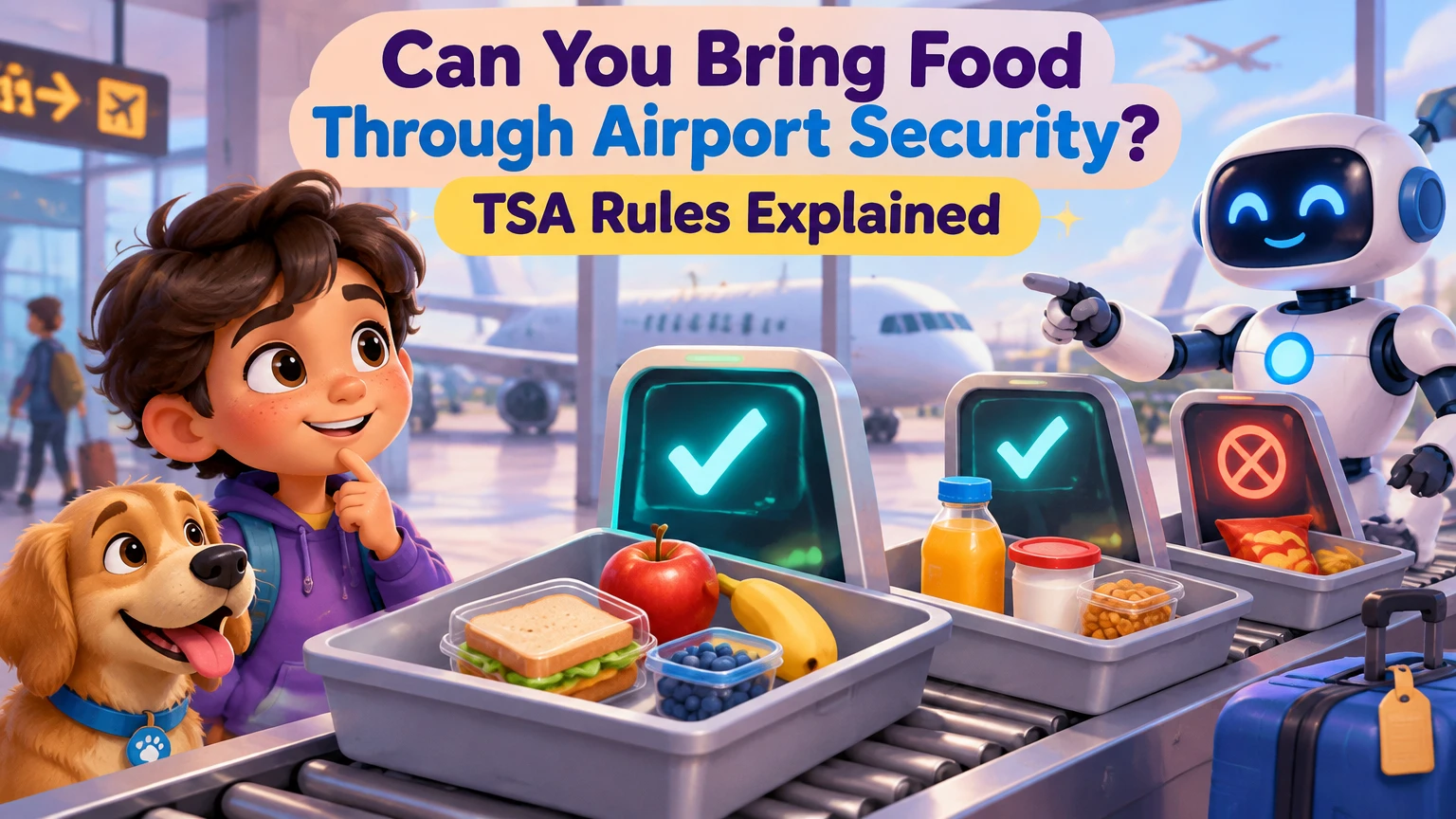
Yes, you can bring food through airport security in the United States, and most solid foods are allowed in carry-on bags. The main exception is food that is liquid, gel-like, spreadable, pourable, or squeezable, which generally must follow the TSA 3-1-1 liquids rule: containers must hold 3.4 ounces or less and fit in one quart-sized bag.
Key Facts at a Glance
- TSA generally permits solid foods, including sandwiches, bread, fruit, cooked meat, candy, cookies, and chips, in carry-on luggage.
- Peanut butter, hummus, yogurt, soup, salsa, gravy, jam, honey, and similar foods are treated as liquids or gels for checkpoint screening.
- A liquid or gel food must normally be in a container with a capacity of 3.4 ounces, or 100 milliliters, or less.
- TSA measures the container’s capacity, not merely the amount of food remaining inside it.
- Baby formula, breast milk, toddler drinks, baby food, and medically necessary liquids can exceed 3.4 ounces when declared for separate screening.
- Airport security approval does not guarantee that customs authorities will allow food into the destination country.
Can You Bring Food Through Airport Security in a Carry-On?
Yes, most food can pass through airport security in a carry-on bag, particularly when the food is solid, dry, and individually packaged. TSA does not impose a general calorie, weight, or item-count limit on ordinary solid food, although airline baggage size and weight limits still apply to the bag carrying it.
A sandwich, bagel, pizza slice, granola bar, hard cheese, roasted nuts, or apple can usually travel through a domestic U.S. checkpoint. A cup of yogurt, jar of almond butter, or container of soup is different because the food can be poured, squeezed, spread, or spilled.
The checkpoint decision is based primarily on the food’s physical characteristics and packaging. A dry pasta salad may pass as a solid meal, while the same meal surrounded by a substantial amount of dressing may receive additional screening or fall under the liquid rule.
TSA rules apply at the security checkpoint. The U.S. Department of Agriculture, U.S. Customs and Border Protection, state agriculture agencies, airlines, and destination-country authorities may impose separate rules before or after the flight.
Which Foods Are Allowed in Carry-On Bags?
Solid snacks, baked goods, dry meals, and many cooked foods are normally allowed in carry-on bags without the 3.4-ounce limit. Travelers should use leak-resistant containers and keep dense or unusual foods accessible because an officer may inspect them.
| Food example | Carry-on treatment | Typical packaging | Main issue |
|---|---|---|---|
| Sandwich with dry filling | Allowed | Wax paper or reusable bag | Wet sauces can change the screening result |
| Apple, orange, or banana | Usually allowed domestically | Whole and uncut | Destination customs may prohibit entry |
| Cookies or cake | Allowed | Rigid food container | Cream or custard may be treated as a gel |
| Hard cheese | Allowed | Sealed bag or container | Dense blocks can prompt inspection |
| Cooked chicken or steak | Usually allowed | Leakproof container | Odor, grease, and temperature control matter |
| Chips, crackers, or pretzels | Allowed | Original package | Crushing is the main practical risk |
| Dry pasta or rice | Allowed | Sealed container | Sauce or broth can trigger the liquid rule |
| Protein or granola bars | Allowed | Commercial wrapper | Nut butter filling may receive closer inspection |
| Salad with little dressing | Usually allowed | Leakproof container | Separate dressing is easier to screen |
| Pie or pastry | Usually allowed | Rigid box | Custard, cream, or liquid filling may change classification |
A solid food does not become prohibited merely because it is homemade. However, homemade meals can be harder for an X-ray operator to interpret when they are tightly packed, wrapped in foil, or stored in opaque containers.
Which Foods Follow the 3-1-1 Liquids Rule?
Food follows the TSA 3-1-1 rule when it is liquid, gel-like, creamy, spreadable, paste-like, or easily poured. The container must hold no more than 3.4 ounces, or 100 milliliters, and the container must fit in the traveler’s single quart-sized, resealable liquids bag.
The rule concerns container capacity. A 6-ounce jar containing only 2 ounces of peanut butter can still be rejected because the jar itself exceeds the permitted capacity.
| Food or drink | Carry-on limit at security | Checked-bag treatment | Practical example |
|---|---|---|---|
| Peanut or almond butter | 3.4 oz container | Larger containers generally allowed | Use a labeled travel jar |
| Hummus | 3.4 oz container | Larger containers generally allowed | Pack individual cups |
| Yogurt | 3.4 oz container | Larger containers generally allowed | A sealed 5-ounce cup exceeds the limit |
| Salsa or pasta sauce | 3.4 oz container | Larger containers generally allowed | Drain sauce from a meal or separate it |
| Soup or gravy | 3.4 oz container | Larger containers generally allowed | A full thermos cannot pass screening |
| Jam, honey, or maple syrup | 3.4 oz container | Larger containers generally allowed | Buy full-size bottles after security |
| Cream cheese | 3.4 oz container | Larger containers generally allowed | A bagel is easier without a large side tub |
| Salad dressing or oil | 3.4 oz container | Larger containers generally allowed | Use small commercial packets |
| Ice cream | Usually limited as a gel | Larger quantity may be checked | Frozen state does not always remove the restriction |
| Smoothie | 3.4 oz container | Larger containers generally allowed | Empty the bottle before screening |
The 3-1-1 rule applies to the screening checkpoint, not to food purchased after security. A traveler can buy a full-size drink, soup, or yogurt in the secure terminal and take it to the aircraft, subject to airline rules and connection procedures.
Can You Bring Drinks Through Airport Security?
Ordinary drinks in containers larger than 3.4 ounces cannot normally pass through a TSA checkpoint. Empty bottles, tumblers, and hydration reservoirs are generally permitted, so travelers can bring the container through security and fill it after screening.
A drink frozen completely solid may receive different treatment from a liquid, but travelers should not rely on partially frozen beverages. As the contents melt, the item becomes a liquid and may be rejected. The most reliable approach is to carry an empty bottle and purchase or refill a drink after the checkpoint.
| Beverage situation | Checkpoint result | Best action |
|---|---|---|
| 20-ounce bottle of water | Not allowed through screening | Empty it before the checkpoint |
| Empty reusable bottle | Generally allowed | Fill it after security |
| 3-ounce juice container | Usually allowed | Place it in the quart bag |
| Frozen drink, fully solid | May be allowed if solid at screening | Keep it completely frozen |
| Partially melted drink | Usually treated as a liquid | Drink, discard, or empty it |
| Coffee purchased before security | Usually exceeds liquid limit | Finish it or discard it |
| Breast milk or formula | Exempt in reasonable quantities | Declare it to the TSA officer |
How Should You Pack Food for the Checkpoint?
Pack food in a way that lets an officer identify it quickly and inspect it without unpacking the entire bag. Place solid meals near the top, separate liquid foods into the quart bag, and use transparent or easily opened containers whenever possible.
Step 1: Separate Liquid and Gel Foods
Move spreads, sauces, yogurt, hummus, and other qualifying foods into containers no larger than 3.4 ounces. Put those containers in the same quart-sized bag as toiletries rather than hiding them among solid snacks.
Step 2: Use Leak-Resistant Containers
A practical flight meal uses a rigid container with a tight lid, a resealable bag for dry items, and a separate small container for dressing. Leave headspace in liquid containers only when the container still meets the capacity limit, because an underfilled large jar remains noncompliant.
Step 3: Avoid Dense Wrapping
Aluminum foil can make an X-ray image harder to interpret and may result in manual inspection. Parchment paper, clear plastic wrap, or a transparent silicone pouch usually makes the contents easier to identify.
Step 4: Keep Food Accessible
Place food in one section of the bag instead of scattering it around electronics, shoes, and clothing. A grouped lunch container reduces repacking time if an officer asks to examine it.
Step 5: Follow Lane-Specific Instructions
Traditional X-ray lanes may ask travelers to remove food, electronics, or liquids. CT scanner lanes often allow more items to remain inside the bag, but procedures vary by airport and lane. Follow the officer’s instruction rather than relying on TSA PreCheck, a previous trip, or another airport’s process.
Do You Have to Remove Food From Your Bag?
You may have to remove food from your carry-on, but the requirement depends on the airport, lane, scanner, and officer’s instructions. Standard X-ray lanes often require selected items to be placed in a bin, while many computed tomography lanes allow more belongings to remain packed.
TSA PreCheck does not guarantee that food can stay in the bag. PreCheck changes several screening procedures, but officers can still direct a traveler to remove a food item for a clearer image or physical inspection.
Food is more likely to attract attention when it is dense, opaque, wrapped in foil, packed in unusual layers, or surrounded by liquid. Additional screening does not mean the food is illegal. It usually means the operator needs more information.
What Happens During Secondary Screening?
During secondary screening, a TSA officer may open the container, inspect the food visually, swab the bag or item, or ask the traveler to identify it. The traveler can explain the ingredients and intended use, but an officer may still prohibit an item that falls under the liquid rule.
Do not argue that a large container is nearly empty. Show the container’s labeled capacity or transfer the food into a compliant container before arriving at the airport.
Can You Bring Meat, Seafood, and Frozen Food?
You can generally bring cooked or raw meat and seafood through a U.S. airport security checkpoint in either carry-on or checked luggage, provided the food is packed securely. Security screening and temperature safety are separate concerns, so perishable food needs insulation and a realistic travel time.
Ice and gel packs used to chill food should be frozen solid when presented at the checkpoint. A pack that is partly melted, slushy, or visibly liquid may be treated as a liquid and rejected. This rule concerns screening, not food-safety advice.
| Cold food item | Carry-on possibility | Packing requirement | Main risk |
|---|---|---|---|
| Frozen steak | Generally allowed | Double-bagged and insulated | Thawing and leakage |
| Cooked chicken | Generally allowed | Leakproof container | Odor and temperature |
| Fresh fish | Generally allowed | Sealed container with insulation | Liquid seepage |
| Hard cheese | Generally allowed | Wrapped or boxed | Dense X-ray image |
| Gel ice pack, frozen solid | Usually allowed | Keep completely frozen | Rejection after thawing |
| Gel ice pack, slushy | May be rejected | Refreeze before travel | Liquid classification |
| Dry ice | Often permitted in limited quantities | Airline approval and vented packaging | Carbon dioxide buildup |
| Frozen breast milk | Allowed under infant rules | Declare separately | Separate inspection |
Airlines may impose additional rules for dry ice, including a maximum quantity, package labeling, and advance approval. Check the operating airline before packing dry ice because airline acceptance is separate from TSA screening.
Are Baby Food, Breast Milk, and Medical Liquids Exempt?
Yes, TSA permits breast milk, infant formula, toddler drinks, baby food, and medically necessary liquids in quantities greater than 3.4 ounces. Travelers should remove these items from the carry-on and tell the TSA officer before screening begins.
The exemption does not mean the items bypass inspection. TSA may use X-ray screening, visual inspection, explosive-trace detection, or other approved procedures. A traveler can request that an opened container not be placed directly into an X-ray machine, but an alternative inspection may take longer.
Pack infant and medical items together in an accessible cooler or pouch. Bring only the amount reasonably needed for the trip plus a practical reserve, and carry prescriptions, physician letters, or supporting documentation for medical liquids when available. TSA does not require a prescription for every medically necessary liquid, but documentation can clarify the situation.
| Item | 3.4-ounce limit | Declaration | Useful preparation |
|---|---|---|---|
| Breast milk | Exempt | Yes | Separate cooler pouch |
| Infant formula | Exempt | Yes | Keep bottles accessible |
| Baby food puree | Exempt | Yes | Group pouches together |
| Toddler drink | Exempt | Yes | State the child’s age and need |
| Liquid medication | Exempt when medically necessary | Yes | Keep original label |
| Standard protein shake | Usually subject to limit | Not automatically exempt | Carry powder or buy after security |
| Ordinary bottled water | Subject to limit | No exemption | Use an empty bottle |
Can You Bring Fresh Fruit and Vegetables?
Fresh fruit and vegetables are generally allowed through domestic U.S. airport security, but agricultural restrictions may apply based on the origin and destination. Hawaii, Puerto Rico, Guam, the U.S. Virgin Islands, and other U.S. territories can apply rules that differ from a trip entirely within the continental United States.
International customs authorities make the final decision about food entering a country. An apple, meat sandwich, seed, plant product, or fresh salad that passed departure security may need to be declared, consumed before landing, or discarded before the customs inspection area.
| Travel route | Departure security | Arrival consideration |
|---|---|---|
| New York to Chicago | Fresh produce generally allowed | Domestic restrictions are limited |
| California to Hawaii | Security may allow it | Hawaii agriculture rules can restrict produce |
| Florida to Puerto Rico | Security may allow it | Puerto Rico agriculture rules can apply |
| United States to Australia | Security may allow it | Australia has strict biosecurity controls |
| United States to United Kingdom | Security may allow it | Food import rules depend on product and origin |
| United States to Canada | Security may allow it | Canadian customs rules determine entry |
Declare food when the destination requires a declaration. A declaration does not necessarily mean confiscation or a penalty, while failing to declare a restricted agricultural product can create avoidable problems.
Is Checked Baggage Better for Food?
Checked baggage is better for full-size liquids, large jars, canned foods, and durable packaged foods, while carry-on luggage is better for meals needed during the flight and foods that could be damaged or lost. Checked bags still require leak prevention, temperature planning, and compliance with airline and customs rules.
| Decision factor | Carry-on food | Checked-bag food | Better choice |
|---|---|---|---|
| Full-size soup or sauce | Usually prohibited at security | Usually permitted | Checked bag |
| Sandwich for the flight | Convenient | Inaccessible after check-in | Carry-on |
| Expensive specialty cheese | Accessible but inspected | Risk of loss or damage | Depends on value |
| Fresh fish for a long trip | Temperature can be monitored | Longer handling chain | Carry-on with insulation |
| Bottled olive oil | Security liquid limit applies | Protective wrapping required | Checked bag |
| Infant formula | Immediately available | Inaccessible during flight | Carry-on |
| Canned food | Heavy and often opaque | More practical | Checked bag |
| Fragile pastries | Easier to monitor | Crushing risk | Carry-on |
Checked baggage does not eliminate customs restrictions. A full-size bottle of maple syrup may be permitted in a checked suitcase but still subject to destination-country import rules.
Should You Bring Food or Buy It After Security?
Bring food when dietary control, price, or a long connection matters. Buy food after security when you need a full-size drink, hot meal, or liquid item and do not want to manage screening restrictions.
Airport prices vary by location, but a typical traveler may spend $5-$8 on a bottled drink, $10-$20 on a prepared meal, and $3-$7 on a packaged snack. Home-packed dry snacks often cost less than $2 per serving, although the savings depend on ingredients and baggage space.
| Priority | Bring food from home | Buy after security |
|---|---|---|
| Typical cost | $1-$8 per serving | $3-$20 per item |
| Dietary control | High | Depends on airport vendors |
| Full-size liquids | Restricted before screening | Usually available |
| Waiting time | 5-10 minutes to pack | 5-25 minutes to purchase |
| Food temperature | Usually cold or shelf-stable | Often hot or freshly prepared |
| Delay protection | Strong if food is nonperishable | Depends on terminal hours |
| Baggage weight | Adds 0.5-2 pounds typically | Adds little before purchase |
| Best use | Long trips and special diets | Drinks and hot meals |
For a delayed flight, dry foods such as crackers, nuts, protein bars, bread, and shelf-stable fruit are more dependable than a refrigerated meal that may remain warm for several hours.
What Common Food-Packing Mistakes Cause Problems?
The most common mistake is treating a food’s label as more important than its physical form. TSA screening focuses on whether the substance behaves like a liquid or gel, so “food,” “natural,” and “homemade” do not automatically remove the 3.4-ounce restriction.
Mistake 1: Using a Large Nearly Empty Jar
A 6-ounce jar with 2 ounces of hummus still has a container capacity above the limit. Transfer the hummus into a container labeled or designed for 3.4 ounces or less.
Mistake 2: Bringing a Half-Melted Ice Pack
A slushy gel pack may be rejected even when it began the trip fully frozen. Freeze it solid immediately before travel and place it beside food that needs cooling.
Mistake 3: Packing a Wet Meal as a Solid Meal
A sandwich with a small amount of spread is usually practical, but a container full of curry sauce, gravy, or soup can fall under the liquids rule. Separate sauce into a compliant container.
Mistake 4: Wrapping Food in Several Layers of Foil
Foil can obscure the X-ray image and lead to a bag search. Use clear packaging and keep the ingredient list available for unusual homemade foods.
Mistake 5: Assuming TSA Approval Covers Customs
Security checks whether an item creates a transportation-security concern. Customs checks whether the item may cross a national or agricultural border. Consume or discard restricted fresh foods before customs when the destination rules require it.
Mistake 6: Relying on Another Airport’s Scanner Procedure
A CT lane may let food remain in the bag, while a conventional lane may require removal. Pack for easy access and listen to the local officer.
What Food Is Best for a Long Flight?
The best carry-on foods for a long flight are compact, low-liquid, low-odor, and stable for several hours without refrigeration. Dry sandwiches, crackers, nuts, bars, hard cheese, whole fruit for domestic travel, and individually wrapped baked goods are usually easier than soups or sauced meals.
A practical long-flight food kit can include:
- Two sandwiches with a modest amount of spread.
- One sealed bag of crackers or pretzels.
- A protein bar or shelf-stable snack.
- Whole fruit when permitted on the route.
- An empty refillable bottle.
- Napkins and a resealable waste bag.
- A small compliant container of dip or dressing.
Avoid foods with strong odors, fragile sauces, excessive grease, or packaging that cannot be resealed. Cabin temperature, turbulence, and limited tray-table space make spill resistance more important than culinary quality.
Frequently Asked Questions
Can I bring a homemade meal on a plane?
Yes, a homemade meal can usually travel in carry-on luggage when it is mostly solid and packed in a leakproof container. Keep soup, gravy, dressing, hummus, and large amounts of sauce within 3.4-ounce containers. Separate wet ingredients from the main meal to reduce screening delays and spills.
Can I bring canned food through airport security?
Canned food may be allowed, but a can containing liquid, brine, syrup, or sauce can be subject to the 3.4-ounce rule. Cans are also dense and opaque, which can prompt additional screening. Put large canned goods in checked baggage when practical, and verify destination customs rules.
Can I bring protein powder through TSA?
Yes, protein powder is generally permitted in carry-on luggage. TSA may request additional screening, particularly for powder containers larger than 12 ounces, or 350 milliliters. Keep the powder in its original labeled packaging when possible and expect that an officer may open or test it.
Can I bring alcohol through airport security?
Alcohol purchased before security is subject to the liquids rule unless each container is 3.4 ounces or smaller and fits in the quart bag. Alcohol purchased after security can usually be carried onto the aircraft, but drinking personal alcohol onboard is governed by federal rules and airline policy. Checked-bag limits also apply.
Can I bring food through security during an international trip?
Yes, departure security may allow the same solid foods permitted on domestic trips, but arrival customs rules are separate. Meat, dairy, fresh produce, seeds, and prepared meals can be restricted or require declaration. Check the destination’s official customs or biosecurity guidance before packing food.
What should I do if TSA takes my food?
If an officer determines that food cannot pass screening, you generally must discard it, return it to a vehicle, or place it in checked baggage if that option remains available. Do not conceal the item or argue about its classification. Repack future portions in compliant containers and separate liquids before reaching the checkpoint.
The Bottom Line
Can you bring food through airport security? Yes. Pack solid, low-liquid foods in your carry-on, place spreads and pourable foods in containers of 3.4 ounces or less, declare infant and medically necessary liquids, and follow the instructions at your specific screening lane. Remember that TSA approval covers checkpoint security, not destination customs.