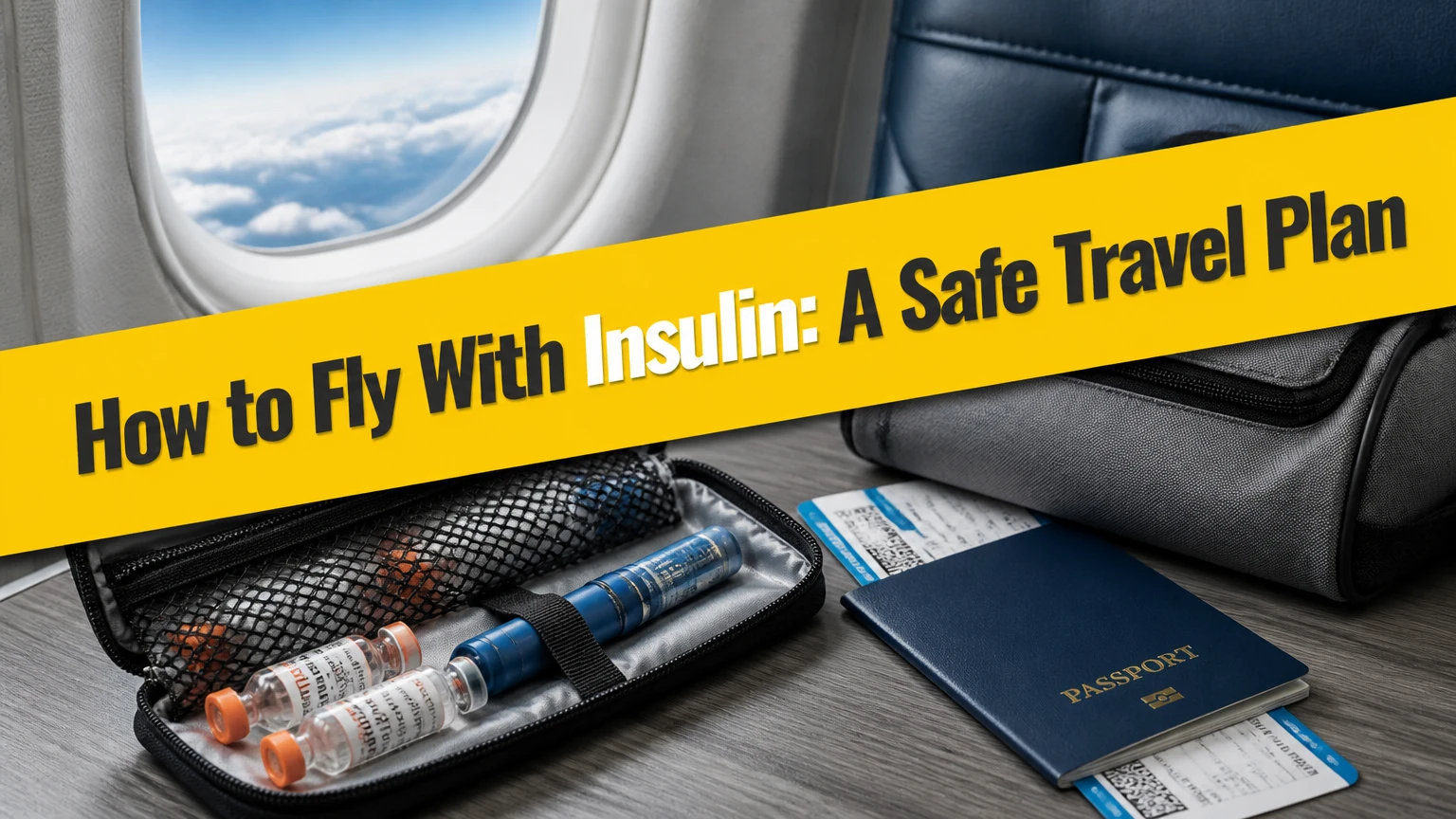
How to Fly With Insulin: A Safe Travel Plan
Flying with insulin is the process of transporting medication, injection supplies, pumps, CGMs, and glucose treatment through airport security while preserving dose safety. Insulin can usually travel in a carry-on bag under medical-liquid exemptions, but travelers must declare supplies, follow device-manufacturer guidance, and prevent freezing, overheating, loss, or dosing mistakes.
Key Facts / Quick Answer
Keep all insulin, glucagon, needles, monitoring supplies, and emergency carbohydrates in the aircraft cabin, never in checked luggage.
Medical liquids are exempt from the usual 3.4-ounce, 100 mL limit in the United States when they are medically necessary and declared to TSA.
Carry at least twice the insulin, infusion sets, sensors, needles, and test strips needed for the itinerary, divided between two cabin bags.
Do not place insulin directly against frozen gel packs. Insulin that freezes must be discarded, even if it later appears normal.
Request an alternative screening method before your pump or CGM enters an X-ray machine or a scanner that the manufacturer prohibits.
Ask your diabetes clinician for a time-zone dosing plan when the trip crosses several time zones, especially with long-acting insulin or a pump.
How does airport security handle insulin?
Airport security generally permits insulin and associated diabetes supplies after the traveler identifies them as medically necessary. In the United States, TSA allows medically necessary liquids, aerosols, gels, and frozen items in quantities greater than 3.4 ounces, although officers may inspect or test them separately.
TSA’s published instruction is direct: “Inform the TSA officer that you have medically necessary liquids.” Declare the supplies before screening begins, rather than waiting until an officer notices an unusual pouch or liquid.
A medical exemption is not a guarantee of immediate approval. Security staff can open containers, inspect labels, swab the exterior, or use other procedures that do not damage the medication. Arriving 2-3 hours before departure gives more time for a manual inspection, a supervisor review, or a device-specific screening request.
What documents should you carry?
A prescription label is usually more useful than a generic doctor’s letter because it connects the medicine to your name and prescribed treatment. A letter remains helpful for international customs, large quantities, controlled emergency medicines, or travelers carrying a pump and multiple devices.
Carry paper and digital copies of:
- Prescription labels and the generic names of every insulin product.
- A clinician’s letter listing insulin, glucagon, syringes, pen needles, pump supplies, CGM supplies, and testing equipment.
- Your clinician’s phone number and the manufacturer support number.
- Insurance details and an emergency prescription.
- A translated medication list for countries where English is not widely used.
A TSA Disability Notification Card can communicate that you have diabetes, but it does not replace the medical-liquid exemption or device instructions. Check the departure airport, transit airport, and destination authority because security rules outside the United States may use different procedures.
What should you pack for an insulin flight?
A safe diabetes travel kit contains medication, delivery equipment, monitoring tools, temperature protection, and supplies for foreseeable disruptions. The quantity should match the full itinerary plus a reserve, not merely the scheduled flight time.
| Supply category | Normal trip quantity | Practical reserve | Cabin-storage rule |
|---|---|---|---|
| Insulin | Itinerary requirement | 100% extra | Keep in personal item or medical bag |
| Syringes or pen needles | One per planned use | 50%-100% extra | Retain pharmacy packaging |
| Infusion sets | One per change | 2-4 additional sets | Protect from crushing and moisture |
| CGM sensors | Wear period required | 1-2 additional sensors | Follow the maker’s scanner guidance |
| Blood glucose strips | Testing schedule | 50% extra | Keep meter and strips together |
| Glucagon | 1 prescribed kit | 1 additional if available | Keep instructions with the kit |
| Ketone strips | 1 sealed package | 1 package extra | Protect from heat and humidity |
| Fast glucose | 15-20 grams per treatment | 2-4 treatments accessible | Keep at seat level, not overhead |
Pack insulin pens, vials, cartridges, and glucagon in their original pharmacy-labeled packaging where possible. Loose needles can attract questions at customs, while labeled supplies establish a clear medical purpose.
Place rapid-acting glucose tablets, gel, or a small juice product in the personal item under the seat. A meal delay, missed connection, or tarmac hold can make overhead luggage inaccessible.
How much insulin should you bring?
Bring the prescribed amount for the entire trip, then add at least 100% extra when feasible. A 10-day trip requiring 20 units per day might require 200 units for planned use and another 200 units as a reserve, with the exact amount determined by your prescription and clinician.
A reserve should cover more than extra doses. Illness, spoiled food, unusual activity, pump failure, accidental damage, and a delayed return can all increase insulin needs. Do not change insulin doses simply to make supplies last longer.
Divide the total supply between two cabin bags. Keep the primary supply with you and place the reserve in a companion’s personal item if you are traveling together. Never divide supplies so that one bag contains the only insulin needed for the next several hours.
Why should insulin stay in carry-on luggage?
Insulin should remain in the cabin because checked baggage can experience freezing temperatures, extreme heat on the tarmac, rough handling, and delayed delivery. The aircraft cabin is pressurized and temperature-controlled, while the baggage hold is not a reliable medication environment.
Freezing damages insulin’s protein structure. A vial that has frozen may look clear and may still move through a pen, yet its glucose-lowering effect can be reduced or absent. The NHS advises travelers to avoid freezing insulin and to keep it away from direct heat and sunlight.
Gate-checking creates the same risk as ordinary checked baggage. If an airline asks you to surrender a roller bag at the gate, remove every medication and diabetes device first, or use a smaller medical bag that stays under the seat.
What happens if insulin freezes or overheats?
Do not use insulin that has frozen, thawed after freezing, changed color, developed particles, or been exposed beyond the temperature limits in its product information. Contact the manufacturer or pharmacist if exposure is uncertain, and use an unaffected backup supply.
Heat exposure is product-specific. Many opened insulin products can remain at room temperature for approximately 28 days, but some formulations allow 42 or 56 days, and the permitted upper temperature varies by brand. The package insert controls.
| Exposure event | Likely consequence | Immediate action | Replacement trigger |
|---|---|---|---|
| Frozen insulin | Reduced or absent potency | Quarantine and label it | Any confirmed freezing |
| Direct sunlight | Localized overheating | Move to shade and inspect | Temperature exceeds label limit |
| Hot car or tarmac | Rapid temperature rise | Transfer to approved storage | Unknown duration above limit |
| Normal cabin travel | Usually acceptable | Keep in insulated pouch | Damage, leakage, or label breach |
| Warmed gel pack contact | Cold injury or freezing | Separate medication from pack | Any ice crystals or freezing |
| Lost checked bag | No access to doses | Contact airline and clinician | Missed dose risk or delayed recovery |
An insulin cooler protects against temperature swings, but it does not make every product safe indefinitely. An evaporative pouch normally cools without freezing, while a gel-pack case needs a barrier between the pack and the medication. A small temperature indicator can document an exposure event, but it cannot restore damaged insulin.
How should insulin be stored in transit?
Unopened insulin commonly requires refrigeration at 36-46°F, or 2-8°C, while in-use products often have a labeled room-temperature allowance around 59-86°F, or 15-30°C. The precise range and duration differ by formulation, so check the manufacturer’s storage instructions before departure.
The safest arrangement is an insulated medication case with the insulin separated from frozen packs by a thick cloth or internal divider. Do not freeze an evaporative wallet unless its instructions explicitly allow it, and never place a vial directly on ice.
A hotel refrigerator can be useful, but avoid the freezer compartment and the cold air outlet. Ask hotel staff to confirm that the minibar does not automatically shut off or freeze medicines.
| Storage option | Typical cost in USD | Useful duration | Main limitation |
|---|---|---|---|
| Insulated pouch | $15-$40 | 4-12 hours | Does not actively cool medication |
| Evaporative wallet | $20-$50 | 2-4 days after soaking | Needs clean water and airflow |
| Gel-pack case | $25-$80 | 8-24 hours | Direct contact can freeze insulin |
| Portable powered case | $80-$250 | Several days | Requires charging and temperature monitoring |
| Hotel refrigerator | $0-$25 typical fee | Entire stay | Temperature may be too cold or unstable |
A counterintuitive safety rule matters here: colder is not automatically safer. Insulin must stay within its labeled range, and a frozen medicine is unusable even when the surrounding cooler feels reassuringly cold.
Can insulin pumps and CGMs go through scanners?
Insulin pumps and CGMs require device-specific screening decisions because manufacturers differ on X-ray, computed tomography, millimeter-wave, and metal-detector exposure. TSA’s general airport procedure does not override the instructions from Abbott, Dexcom, Medtronic, Tandem Diabetes Care, Insulet, or another device maker.
Before screening, tell the officer that you are wearing a pump or CGM and ask for the procedure recommended by its manufacturer. Do not remove a sensor or infusion set merely to satisfy a screening request unless your clinician or device instructions support removal.
| Device or supply | Screening concern | Safer planning step | What to verify |
|---|---|---|---|
| CGM sensor | Some makers prohibit X-ray or CT exposure | Request an alternative when applicable | Current Dexcom, Abbott, or Medtronic instructions |
| Insulin pump | Manufacturer limits may apply | Keep attached and explain its function | Current Tandem, Medtronic, or Insulet guidance |
| Spare pump | X-ray restrictions may apply | Carry documentation and request hand inspection | Manufacturer travel policy |
| Glucose meter | Usually less restrictive | Pack with strips in cabin | Battery and strip temperature limits |
| Insulin vial or pen | Liquid inspection is possible | Declare as medical medication | Label and storage temperature |
A metal detector, pat-down, visual inspection, or explosive-trace swab may be available, but airport procedures vary. Requesting an alternative does not mean refusing all screening. It means asking officers to inspect the device through a method that does not conflict with its instructions.
If a device accidentally passes through a prohibited scanner, monitor readings against symptoms and a blood glucose meter, contact the manufacturer, and replace the device if its function becomes unreliable. Do not assume that a normal display proves accurate readings.
How do you manage insulin across time zones?
Time-zone travel changes clock-based dosing, meal timing, sleep, activity, and access to food. Basal insulin plans need the most deliberate adjustment, while pump users may need a temporary schedule change and multiple daily injection users may need a clinician-designed interval plan.
Traveling west creates a longer calendar day; traveling east creates a shorter one. That simple rule is not a dosing prescription. The correct adjustment depends on insulin type, dose timing, pump settings, diabetes type, glucose patterns, and the number of zones crossed.
| Travel pattern | Typical scheduling issue | Safer preparation | Avoid |
|---|---|---|---|
| Same time zone | Meals may shift slightly | Follow the usual clock schedule | Skipping monitoring |
| Westward, 3-5 hours | Longer waking day | Ask about meal and basal timing | Doubling a basal dose |
| Eastward, 3-5 hours | Shorter interval between doses | Use a written transition plan | Taking doses too close together |
| More than 5 hours | Significant clock displacement | Convert doses to destination time | Improvising during flight |
| Pump therapy | Basal profile may mismatch local time | Program changes with clinician | Changing settings without a plan |
Set your phone to the destination time at a deliberate point, such as boarding or arrival, and write down the last dose time in both home and destination time. Check glucose more often during the transition, particularly before meals, sleep, exercise, and correction doses.
For long-acting insulin, ask your diabetes clinician whether the dose should shift gradually, use a temporary interval, or follow another individualized method. For pump therapy, preserve basal delivery unless a clinician has supplied a different schedule.
What is the safest airport and flight routine?
A repeatable routine reduces errors when security, meals, and sleep occur at unusual times. Use the following sequence for domestic or international travel:
- Two to four weeks before departure: Confirm prescriptions, refills, device policies, insurance, destination healthcare, and any pump loaner program.
- One week before departure: Assemble the full reserve, label the bags, test batteries or chargers, and print the medication letter.
- The day before travel: Check insulin appearance, sensor and infusion-set dates, glucose supplies, ketone strips, glucagon, and fast carbohydrates.
- At airport entry: Keep medication accessible, declare medical liquids, and explain wearable devices before screening starts.
- At the gate: Reconfirm that the medical bag will remain with you if other luggage is gate-checked.
- During the flight: Keep glucose treatment under the seat, drink normally, monitor according to your care plan, and move periodically when medically appropriate.
- After landing: Inspect supplies, confirm local time, check glucose, and store insulin according to the destination temperature and product label.
Flight cabins do not require routine insulin dose changes because of cabin pressure. However, insulin pens, syringes, and pump reservoirs can behave differently when air bubbles expand or contract. Follow the device instructions, prime only as directed, and check the dose rather than improvising with a vial.
What changes on international flights?
International travel adds customs, language, import, pharmacy, and healthcare-access problems. Airport security permission does not automatically guarantee that a destination country will accept an unlimited quantity of prescription medicine.
Before departure, check the destination embassy, customs authority, airline, and airport transit rules. Ask whether a prescription, physician letter, translated document, or advance declaration is required. Some countries restrict specific medicines, needles, or emergency products even when the medicine is legal in the United States.
| International planning item | Typical lead time | Document or quantity | Failure consequence |
|---|---|---|---|
| Destination medication rule | 2-6 weeks | Country-specific approval | Confiscation or delayed entry |
| Physician letter | 1-3 weeks | Medication names and doses | Customs questioning |
| Emergency prescription | 1-2 weeks | Generic insulin name | Slower replacement |
| Local pharmacy research | 1-2 weeks | Two nearby pharmacies | No immediate supply source |
| Travel insurance review | Before payment | Diabetes and interruption terms | Uncovered medical costs |
| Translation | 3-10 business days | Medication and device list | Communication errors |
Keep medicines in labeled packaging and carry a prescription using generic names, such as insulin glargine or insulin lispro, alongside the brand name. Do not rely on finding the same concentration, pen design, or formulary abroad.
Crossing a border with a pump or CGM can also involve radio-frequency rules, replacement-sensor availability, and mobile-app compatibility. Download essential data before leaving home and carry a conventional meter even if the sensor normally provides continuous readings.
What if a problem occurs during the trip?
A travel plan needs explicit responses to predictable failures. The correct response depends on the event, but insulin access and glucose safety take priority over convenience.
| Problem | First response | Escalation point | Safety decision |
|---|---|---|---|
| Low glucose | Use prescribed fast carbohydrate | Emergency help if unable to swallow | Do not delay treatment for meal service |
| High glucose with ketones | Follow sick-day plan and hydrate | Urgent care for vomiting or persistent ketones | Pump users need a backup injection plan |
| Lost insulin | Contact clinician and insurer | Local urgent care or emergency department | Do not substitute another product casually |
| Pump failure | Use backup delivery method | Manufacturer support | Follow the written backup schedule |
| Missing luggage | File a report immediately | Airline baggage and travel insurer | Use only cabin reserves while recovering |
| Possible freezing | Quarantine affected product | Pharmacist or manufacturer | Use verified unaffected insulin |
Someone who cannot safely swallow during severe hypoglycemia needs emergency assistance, not food or drink forced by mouth. Companions should know where glucagon is stored and how to use the prescribed product.
Pump users should carry backup injection supplies even when the pump has worked reliably for years. A pump failure can create a rapid insulin deficit, particularly for people using only rapid-acting insulin in the device.
What does preparation cost?
Basic preparation can cost nothing beyond existing supplies, while specialized cooling and backup equipment may add $20-$250. A clinician letter may be free or involve an administrative charge, and replacement insulin abroad can cost substantially more than a normal prescription.
Budget for the reserve itself, additional sensors, needles, a meter, cooling equipment, airport transport, and insurance excesses. The most expensive mistake is often underpacking, because emergency replacement in a foreign country may require a consultation, a new prescription, and a different product.
| Expense | Typical cost in USD | When it applies | Budget note |
|---|---|---|---|
| Doctor travel letter | $0-$30 | International or complex travel | Ask about administrative fees |
| Cooling wallet | $20-$50 | Warm destinations or long transfers | Reusable option |
| Powered travel case | $80-$250 | Extended remote travel | Add charging costs |
| Extra glucose meter | $15-$60 | Backup testing | Useful after device failure |
| Travel insurance | Policy-dependent | International trips | Check diabetes exclusions |
| Emergency consultation | $50-$300 typical | Lost or unusable medication | Country and clinic vary |
Travel insurance should explicitly cover pre-existing diabetes, medication replacement, medical evacuation, trip interruption, and device failure where relevant. A policy that covers hospitalization but excludes routine insulin replacement may not solve the main travel risk.
Frequently Asked Questions About How to fly with insulin
Can I bring insulin in a cooler through airport security?
Yes, insulin and its cooling materials can generally pass through security as medically necessary items when declared. Keep insulin separated from frozen packs, present it for inspection, and avoid packing it in loose containers that obscure labels. The destination and transit airport may apply different documentation or quantity rules.
Can I fly if my insulin is already opened?
Yes, opened insulin can travel in the cabin if it remains within the storage temperature and in-use period specified by the manufacturer. Record when the pen, vial, or cartridge was first used. Discard it if it freezes, overheats beyond the label limit, changes appearance, or reaches its stated beyond-use date.
Should I take insulin before boarding a flight?
Take insulin according to your prescribed meal, correction, basal, or pump schedule, not simply because boarding begins. Check glucose, food availability, and the destination time when deciding how to follow the plan. Ask your clinician for written instructions before travel, especially for long flights or changing time zones.
Can I bring syringes and needles on an airplane?
Yes, diabetes-related syringes, pen needles, lancets, and infusion equipment are generally permitted when carried with insulin or other injectable medication. Keep them in original labeled packaging when possible and declare them with the medication. Airline and destination customs rules may require additional documentation for international travel.
What should I do if airport security damages my CGM or pump?
Ask for a supervisor, record the airport and screening method, and contact the device manufacturer. Use a blood glucose meter for confirmation if readings do not match symptoms or expectations. Follow your backup insulin-delivery plan, and seek urgent medical help for severe symptoms, vomiting, ketones, or persistent uncontrolled glucose.
Can I buy insulin at my destination?
Possibly, but availability, prescription requirements, concentration, brands, and storage conditions vary by country. Research a local pharmacy and medical clinic before departure, carry the generic insulin name, and do not substitute a different insulin without professional guidance. Your own cabin reserve should remain the primary supply.
Conclusion
How to fly with insulin safely comes down to four controls: keep medication in the cabin, declare it at security, protect it from freezing and overheating, and carry a documented backup plan. Divide at least twice the expected supplies between two carry-on bags, verify pump and CGM screening instructions, and obtain individualized dosing advice before crossing time zones.