How to Use a Squat Toilet Safely
A squat toilet is a floor-level plumbing fixture used in a deep crouch, with the user’s feet on raised footplates and waste directed into a drain pan. To use one safely, protect clothing, face the correct direction, keep both feet flat, squat close to the pan, clean with water or permitted paper, and flush according to the facility’s instructions.
Key facts
Face the raised hood when a hood is present; on a flat pan, follow the molded foot-placement arrows or face the doorway.
Keep trousers and underwear above the wet floor, preferably at or below the knees only if they cannot touch the pan.
Place both feet fully on the textured footplates and keep your heels down for balance.
Do not flush paper, wipes, or sanitary products unless the facility explicitly permits them.
A typical manual flush uses about 2-4 liters, but the correct amount depends on the trap and drainage design.
People with knee, hip, ankle, balance, or mobility problems may need a seated toilet or support rail instead.
What Is a Squat Toilet?
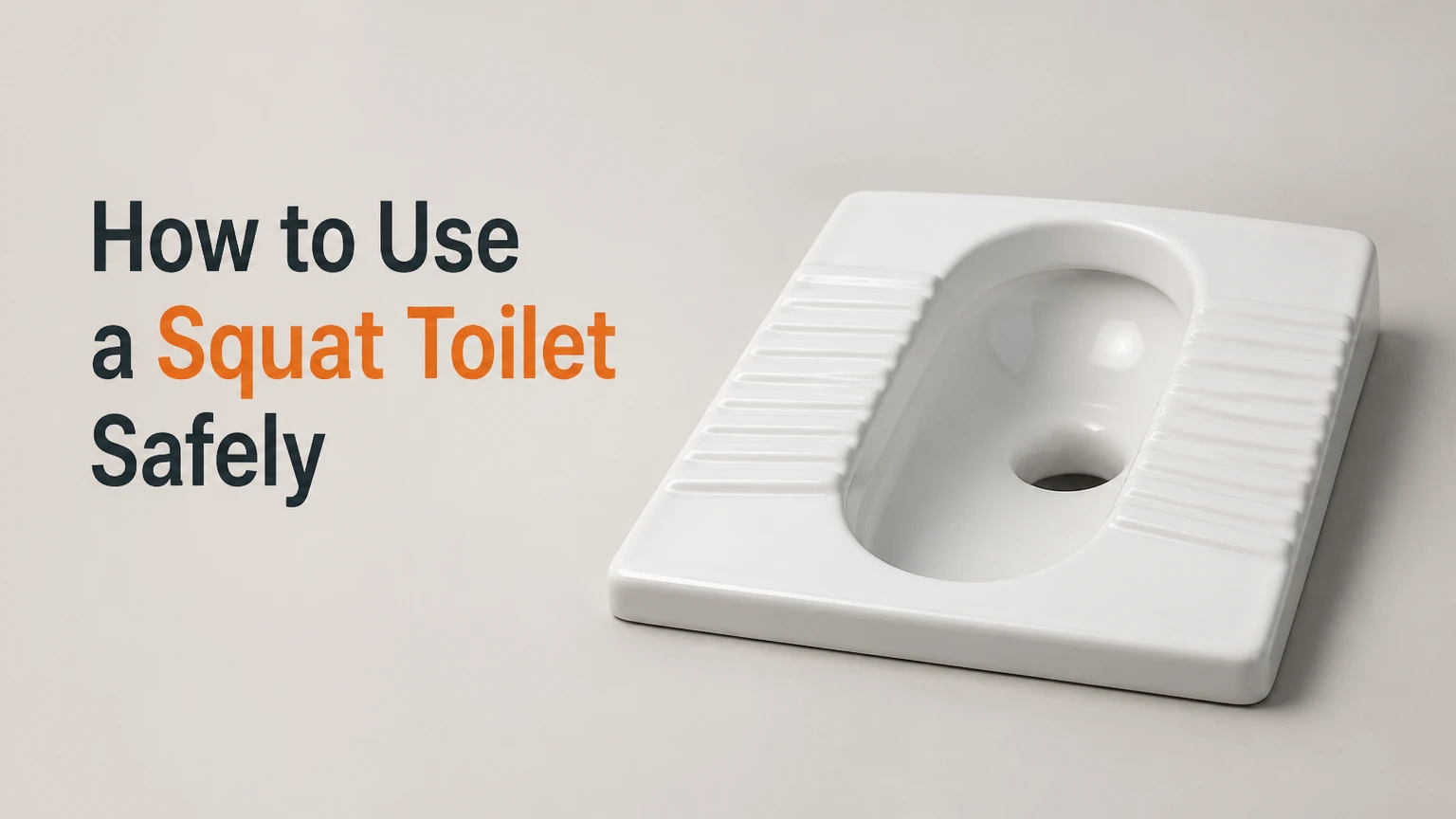
A squat toilet is a ceramic, porcelain, stainless-steel, or molded fixture installed at floor level or on a low platform. The pan has a central waste opening, textured footplates, and a connected drain that may include a water trap to limit sewer gas and backflow.
Unlike a seated toilet, the fixture does not support the user’s body weight through a raised bowl or seat. The user lowers into a crouch while facing the pan’s intended direction. Some models have a raised hood at the front, while others use arrows, ridges, or a wider splash shield to indicate orientation.
The design is compact and easy to wash around, which explains its use in homes, railway stations, schools, workplaces, and public bathrooms across parts of Asia, the Middle East, Africa, and southeastern Europe. “Asian toilet,” “Indian toilet,” and “Turkish toilet” are common informal names, although designs and local practices vary considerably.
How Does the Fixture Work?
A squat toilet sends waste through a floor-level pan into a drainage pipe, using either a built-in flush valve, a cistern, or manually poured water. The footplates position the user’s shoes away from the center channel, while the hood or splash guard helps direct waste and reduce forward spray.
The plumbing beneath the pan matters more than the visible ceramic. A water-sealed trap helps block odors, but some basic or temporary facilities use simpler drainage arrangements. A manual pour must deliver enough water quickly to move waste through the trap without creating a splash or overflow.
| Component | Typical specification | User function | Failure risk |
|---|---|---|---|
| Footplates | 20-35 cm apart, model-dependent | Supports shoes and sets stance | Slipping when wet |
| Ceramic pan | About 50-65 cm long | Directs waste toward the outlet | Splashing if misaligned |
| Platform | About 10-20 cm high on raised models | Lifts pan above surrounding floor | A trip hazard at the edge |
| Water trap | Commonly 50-75 mm seal depth in plumbing systems | Limits odor and sewer-gas entry | Slow drainage if obstructed |
| Manual flush | Typically 2-4 liters per pour | Moves waste through the outlet | Overflow if poured too slowly |
A practical rule is to inspect the pan before squatting. Confirm where the drain opening is, locate the water source or flush control, and identify the waste-paper bin before your clothing or balance becomes difficult to manage.
What Types of Squat Toilets Are Available?
Squat toilet types differ mainly by pan shape, platform height, splash protection, flushing system, and whether the fixture can support seated use. The visible design gives useful clues about orientation and cleaning, but the concealed drainage layout determines installation difficulty.
- Flat in-floor pans: Flush with the surrounding tile and common in public facilities.
- Raised platform pans: Installed above the surrounding floor to simplify drainage or washing.
- Hooded pans: Include a raised front dome that indicates the direction to face.
- Dual-flush pans: Use a cistern or valve with separate lower and higher water volumes.
- Hybrid units: Combine a squat pan with a fold-down or removable seat.
- Portable or temporary pans: Used in some construction, camping, or emergency settings and may connect to a holding tank rather than a sewer.
| Type | Typical height | Flush method | Best fit | Main limitation |
|---|---|---|---|---|
| Flat in-floor | 0 cm above tile | Valve or bucket | Public bathrooms and new construction | Wet floor can spread around the pan |
| Raised platform | 10-20 cm | Cistern or bucket | Facilities needing easier floor washing | Platform edge can cause trips |
| Hooded | 0-20 cm | Valve, cistern, or bucket | First-time users needing orientation | Hood can be awkward for tall users |
| Dual-flush | 0-20 cm | Two-button cistern | Water-controlled residential installations | More moving parts and higher cost |
| Hybrid | 0-20 cm pan plus seat | Cistern or valve | Homes needing flexible use | Seat hardware complicates cleaning |
How to Use a Squat Toilet Safely
Using a squat toilet safely takes four actions: prepare clothing, establish the correct stance, clean without contaminating your hands or clothing, and flush using the available system. The most common first-use problems are incorrect orientation, trousers touching the floor, and unstable tiptoe squatting.
1. Prepare Clothing and Belongings
Roll long trousers, skirts, or loose garments above the ankles before entering the cubicle. If clothing is wide, wet, or difficult to control, remove the lower garments and use the door hook rather than risking contact with the pan or floor.
Lower underwear and trousers only as far as necessary. Keeping them around the knees gives more control than dropping them to the ankles, provided the fabric cannot touch the wet floor. Move phones, wallets, keys, and bags to a secure pocket or hook before crouching.
Check the floor first. A puddle beside the footplate can make a technically correct stance unsafe.
2. Identify the Correct Direction
Face the raised hood on a hooded pan. The hood usually marks the front, protects against forward splash, and positions the body over the outlet. On a flat pan, look for molded arrows, wider footplates, or a splash shield; if no markings exist, face the direction that places your feet on the designated pads and your body over the drain.
Do not assume every floor pan faces the doorway. Designs differ by country, manufacturer, and renovation history. A quick visual inspection is safer than copying another user’s orientation.
3. Place Your Feet and Lower Your Body
Put one foot on each textured footplate, with toes pointing forward or slightly outward. Keep your entire sole down, then lower your hips slowly while holding a stable wall or grab rail if one is available.
Keep your knees aligned with your toes and your torso slightly forward. A deep squat brings the body closer to the pan and reduces the chance that waste lands on the rim or surrounding tile. Do not balance on your toes, because the smaller contact area increases calf fatigue and backward-fall risk.
The stance should feel stable before you begin. If your heels cannot remain down, use a seated alternative rather than forcing the position.
4. Clean According to Local Equipment
Use the water dipper, bidet hose, or toilet paper provided by the facility. Keep the hose nozzle or dipper away from the pan surface, and control the water flow so that it does not spray onto your legs, clothing, or nearby floor.
Many water-washing practices use one hand for washing and the other for handling clothing, the door, or the dipper. The specific hand custom differs by region, so follow local etiquette without treating one cultural practice as a universal plumbing rule.
Dry with permitted paper if available. Place used paper in the designated bin when signs or staff indicate that flushing is prohibited.
5. Flush and Leave the Area Clean
Use the flush button, lever, foot pedal, or pull handle after cleaning. For a manual system, fill the dipper or bucket and pour water directly into the pan’s outlet in a controlled stream. A forceful pour can move waste, but repeated splashing increases contamination of the floor.
Wash your hands with soap and running water for at least 20 seconds when available. The Centers for Disease Control and Prevention identifies handwashing with soap as a primary way to prevent the spread of germs after toilet use; sanitizer is a backup when hands are not visibly dirty and soap is unavailable.
| Stage | Correct action | Typical time | Main check |
|---|---|---|---|
| Clothing | Roll or remove lower garments | 15-30 seconds | Fabric stays above wet floor |
| Orientation | Face hood or follow foot markings | 5-10 seconds | Drain sits beneath body |
| Stance | Feet flat on footplates | 10-20 seconds | Heels and soles stay grounded |
| Cleaning | Use water or approved paper | 30-90 seconds | Hose and hands avoid contamination |
| Flushing | Use valve or 2-4 liters manually | 10-30 seconds | Water drains without rising |
| Hand hygiene | Soap and water, or sanitizer | 20 seconds | Hands are cleaned before leaving |
Expert insight: In practice, the safest manual flush is usually a controlled pour aimed at the throat of the pan, not a high bucket dump. The latter may create a contaminated splash zone, especially when the outlet is shallow or partially blocked.
Is a Squat Toilet More Hygienic?
A squat toilet reduces direct skin contact with a shared seat, but it is not automatically more hygienic. Hygiene depends on the cleanliness of the footplates, floor, flush handle, water dipper, hose nozzle, handwashing facilities, and the user’s technique.
A seated toilet concentrates contamination on the seat and flush controls. A squat pan spreads more risk toward footwear, trouser hems, and surrounding floor when users miss the outlet or splash during manual flushing. Neither fixture eliminates pathogens, and handwashing remains the decisive behavior after use.
Keep a small travel kit containing tissues, hand sanitizer, a few plastic bags, and, where appropriate, disinfecting wipes for personal items. Do not wipe a bidet nozzle with a chemical product unless the facility permits it, because residue may contact skin.
Water Washing and Paper Disposal
Water is often supplied through a hand hose, tap, dipper, or bucket. The user should keep the water source from touching the drain, floor, or body, then wash hands after personal cleaning even if the washing hand itself was used for the water.
Toilet paper rules are local rather than universal. Narrow pipes, low-flow drains, septic tanks, and public maintenance practices may require paper to go into a lined bin. If a sign says “do not flush,” obey it; if no sign exists, ask staff or use the facility’s supplied instructions.
| Waste item | Flush only when | Safer default when uncertain | Why |
|---|---|---|---|
| Toilet paper | A sign permits flushing | Use the designated bin | Paper can obstruct narrow drains |
| Wet wipes | Almost never | Dispose in a bin | Wipes resist breakdown |
| Sanitary products | Never | Wrap and bin | They expand and block outlets |
| Tissues | Only if permitted | Use a bin | Some tissues are thicker than toilet paper |
| Hair or litter | Never | Use a solid-waste bin | Nondegradable material enters the trap |
Squat Toilets Compared With Seated Toilets
A squat toilet requires lower-limb strength, ankle flexibility, and balance, whereas a seated toilet requires the user to transfer onto a raised surface. Squatting may reduce the hip angle and alter the anorectal position, but claims that the posture guarantees effortless or faster bowel movements are stronger than the available evidence supports.
A 2019 review in the Journal of Clinical Gastroenterology discussed posture modification as a possible aid for some people with defecatory difficulty, while also noting that evidence remains limited. The Mayo Clinic gives a simpler bowel-health rule: “Don’t ignore the urge to have a bowel movement.” Posture can help some users, but hydration, fiber, medication effects, and pelvic-floor disorders also matter.
| Feature | Squat toilet | Seated toilet | Practical consequence |
|---|---|---|---|
| Body support | Footplates only | Seat and bowl | Squat models demand more balance |
| Knee position | Deep flexion, often below hip level | Usually 90-110 degrees | Squat posture may aggravate knee pain |
| Skin contact | Usually no seat contact | Seat contact | Seat hygiene matters more on seated models |
| Accessibility | Poor without rails or strength | Better for transfers | Seated models suit many older users |
| Floor cleaning | Pan and surrounding tile | Bowl, seat, and floor | Squat rooms tolerate frequent mopping |
| Plumbing retrofit | Requires floor access | Existing rough-in often sufficient | Squat conversion can cost more |
| Footprint | Pan occupies a narrow floor zone | Bowl projects from wall | Squat pans can leave more open floor |
Expert insight: A squat pan is “touch-free” only at the seat. Users still touch flush handles, door latches, hose nozzles, and sometimes walls for balance, so the absence of a seat does not remove the need for careful hand hygiene.
Who Should Avoid Squatting or Use Support?
People with severe knee or hip arthritis, recent lower-limb surgery, dizziness, poor balance, painful ankle restriction, or significant weakness should not force a deep crouch. Pregnancy alone does not automatically prohibit squatting, but reduced balance, joint pain, or medical restrictions can make a seated toilet safer.
Children may need supervision because the pan opening, wet floor, and deep stance create fall and contact hazards. Anyone who cannot rise from the position without pushing on an unstable wall should choose a seated toilet, grab rail, or supervised alternative.
A raised toilet seat, bedside commode, or accessible cubicle may be safer than a floor pan. A footstool placed in front of a Western toilet can raise the knees, but it does not reproduce the same floor-level balance demands and should have a non-slip base.
Seek medical advice for recurring pain, bleeding, faintness, persistent straining, or inability to control bowel movements. A fixture choice cannot diagnose or correct those conditions.
What Does a Squat Toilet Cost to Buy and Install?
A basic ceramic squat pan typically costs about $50-$150 in the United States, while a higher-spec dual-flush or hybrid fixture may cost $360-$720 before installation. Total project cost depends more on floor demolition, drainage relocation, waterproofing, and tile replacement than on the pan itself.
A new installation during construction is usually simpler than a retrofit into a finished concrete slab. A contractor may need to expose the drain, create the correct pipe fall, install a trap, waterproof the floor, and restore the surrounding tile. Local permits and labor rates can change the final budget substantially.
| Project item | Typical USD range | Typical duration | Cost driver |
|---|---|---|---|
| Basic ceramic pan | $50-$150 | Same day to order lead time | Material and brand |
| Dual-flush fixture | $360-$720 | 1-3 days to source and fit | Valve, cistern, controls |
| Plumbing labor | $350-$800+ | 1-2 days | Access and drain location |
| Concrete-floor retrofit | $800-$2,500+ | 2-4 days | Demolition and structural repair |
| Waterproofing and tile | $300-$1,200 | 1-2 days | Room size and tile finish |
| Complete basic retrofit | $1,000-$4,000+ | 2-5 working days | Scope, permits, and finish work |
These are typical planning ranges, not quotes. A licensed plumber should verify pipe size, trap configuration, venting, waterproofing, and local building requirements before purchase.
How Much Water Does a Squat Toilet Use?
A manually flushed squat pan commonly uses about 2-4 liters per cleaning cycle, although the amount varies with pan geometry, waste volume, pipe length, and the speed of the pour. Dual-flush models may use a low or high cistern setting, while some installations use more water to compensate for poor drainage.
The United States Environmental Protection Agency’s WaterSense specification limits qualifying tank-type toilets to 1.28 gallons per flush, about 4.8 liters. A manual pan can therefore use less water in some situations, but a repeated bucket flush after a blockage may use more than a single efficient seated flush.
| Fixture or method | Typical water per flush | Control | Efficiency note |
|---|---|---|---|
| Manual dipper flush | 2-4 liters | User-controlled | Depends on pour technique |
| Dual-flush squat pan | 3-6 liters | Cistern button | High setting moves more solids |
| WaterSense seated toilet | Up to 4.8 liters | Tank valve | Certified efficiency standard |
| Older gravity toilet | 6-13 liters | Tank valve | Often uses substantially more |
| Partial rinse | 1-2 liters | User-controlled | May leave residue or solids |
What Problems Can Occur?
The most common problems are slipping, splash contamination, blocked drainage, incorrect orientation, odor, and difficulty standing. Each problem has a practical response, but forcing a damaged or unstable fixture can cause injury.
Slipping and Falling
Use the footplates rather than the smooth pan rim. Keep one hand free for a stable grab rail, avoid carrying loose objects, and postpone use if the floor is visibly flooded and another facility is available.
Never squat on the toilet rim or seat of a hybrid model unless the manufacturer explicitly designed it for that load. A seated lid is not a foot platform.
Slow Drainage or Overflow
Stop adding water when the level rises instead of falling. Close the flush valve, warn other users, and notify staff. A plunger designed for the fixture may help, but inserting wire, sticks, or chemical drain cleaner can damage seals and push an obstruction deeper into the pipe.
If waste water reaches footwear or skin, wash exposed skin with soap and water. Clean or isolate contaminated shoes and clothing before entering another shared space.
Odor or Backflow
Persistent sewer odor may indicate a dry or defective trap, poor venting, a failed seal, or a drainage defect. Pouring large quantities of water into an unknown fixture may conceal the symptom temporarily without fixing the cause.
A plumber should inspect recurrent odor, bubbling, gurgling, or backflow. Those signs point to a system problem rather than a user technique problem.
Incorrect Direction
If the pan has a hood, face it unless clear signage says otherwise. If a flat pan has no markings, position your feet so your body is centered over the outlet and ask a facility attendant when uncertainty remains.
How Do You Maintain One at Home?
Clean the pan, footplates, surrounding tile, flush controls, and drain cover on a routine schedule, using a product compatible with the fixture material. Rinse away cleaning chemicals according to the manufacturer’s instructions, and keep the floor dry enough to preserve traction.
Inspect grout, sealant, hinges on hybrid seats, hose connections, and the flush valve. A loose hose connection can wet the floor, while worn grout can allow repeated spills to reach the subfloor.
| Maintenance task | Recommended interval | Tool or material | Warning sign |
|---|---|---|---|
| Rinse and clean pan | Daily in shared settings | Mild bathroom cleaner | Visible residue |
| Clean footplates and tile | Daily to weekly | Brush and detergent | Slippery film |
| Check hose and tap | Weekly | Visual inspection | Drips or loose fittings |
| Inspect trap drainage | Monthly | Water-flow test | Slow emptying |
| Check grout and sealant | Every 6-12 months | Inspection light | Cracks or dark damp areas |
| Professional plumbing check | As needed or annually in heavy-use sites | Licensed plumber | Odor, gurgling, backflow |
Frequently Asked Questions About How to use a squat toilet
Can I use a squat toilet if I cannot keep my heels down?
Do not force the position if your heels rise, knees hurt, or balance feels unstable. Tiptoe squatting reduces stability and increases muscle fatigue. Choose a seated toilet, use an approved grab rail, or ask for an accessible cubicle. Limited ankle flexibility can make a floor-level pan unsafe even when leg strength is good.
Should I face the door or the raised hood?
Face the raised hood when the pan has one because the hood generally marks the front and helps contain splash. On a flat pan, follow arrows, molded foot markings, or local instructions. If no indicator exists, center your body over the drain and keep your feet on the textured pads rather than relying on the doorway.
What should I do if my clothes touch the bathroom floor?
Move away from the contaminated area without dragging the garment farther through the water. Rinse washable fabric promptly, wash exposed skin with soap and water, and place contaminated clothing in a separate bag. Hand sanitizer is useful for hands when soap is unavailable, but it does not replace laundering fabric.
Are squat toilets suitable for constipation?
A deep crouch may help some people reduce straining by changing hip and pelvic position, but a squat toilet is not a treatment for constipation. The Mayo Clinic advises not ignoring the urge to defecate, while persistent symptoms may require medical assessment of diet, medication, hydration, or pelvic-floor function.
Can I flush toilet paper in a floor-level pan?
Flush toilet paper only when the facility explicitly permits it or clearly provides a compatible system. When signs direct users to a bin, use the bin and never flush wipes, sanitary products, or litter. Narrow pipes, septic systems, and low-flow drains can block even a small amount of unsuitable material.
Is a squat toilet better than a Western toilet?
Neither fixture is universally better. A squat pan avoids seat contact and can use little water with manual flushing, but it demands balance, ankle range, and knee flexion. A seated toilet usually provides safer transfers and better accessibility. The appropriate choice depends on mobility, plumbing, hygiene facilities, and user preference.
Conclusion
To use a squat toilet, control your clothing, identify the correct direction, place both feet flat on the footplates, lower into a stable crouch, clean with the supplied method, and flush only what the plumbing permits. The design can be compact and water-efficient, but how to use a squat toilet safely depends equally on balance, floor condition, drainage, handwashing, and accessibility.