How to Travel With a CPAP Machine: Complete Guide
A CPAP machine is a prescribed medical device that delivers pressurized air through a mask to keep the upper airway open during sleep. How to travel with a CPAP machine depends on protecting the device, carrying it in the cabin, confirming power and water requirements, and maintaining therapy during flights, hotels, cruises, or camping.
Key Facts
Keep the CPAP machine, mask, tubing, power supply, and prescription in carry-on baggage.
Most modern devices accept 100-240 volts, but international travel still requires a plug adapter.
A standard bedside CPAP typically weighs 2.5-3 pounds; a dedicated travel model commonly weighs 0.5-1 pound.
Drain and dry the humidifier before transport. Use manufacturer-approved water at the destination.
Lithium batteries belong in carry-on baggage. Check the airline’s current watt-hour limits before departure.
Never change pressure settings or replace prescribed treatment with an oral appliance without guidance from a sleep clinician.
What Is a CPAP Machine?
A CPAP machine treats obstructive sleep apnea by drawing room air through a filter, increasing its pressure, and sending the airflow through tubing to a nasal, nasal-pillow, or full-face mask. The resulting pressure helps prevent repeated upper-airway collapse, oxygen drops, snoring, and sleep disruption.
CPAP means continuous positive airway pressure. Automatic positive airway pressure, or APAP, adjusts pressure within a prescribed range, while bilevel positive airway pressure, or BPAP, uses different pressures for inhalation and exhalation. Travel packing is similar, but the power adapter, tubing, humidifier, and mask must match the exact device.
The American Academy of Sleep Medicine recommends effective treatment for diagnosed obstructive sleep apnea rather than casually stopping therapy for travel. The practical reason is simple: one missed night may cause daytime sleepiness, impaired driving, headaches, or poor concentration, while repeated untreated nights can return the symptoms therapy controls.
A CPAP machine is not an oxygen concentrator. It does not create oxygen, and it does not treat every form of sleep-disordered breathing. People with central sleep apnea, significant lung disease, or prescribed oxygen should ask their clinician whether their travel equipment requires additional medical planning.
How to Prepare for Travel
A reliable preparation plan begins four weeks before departure and ends with a functional equipment check on departure day. The most useful rule is to prepare for one failure, such as a lost bag, damaged mask, dead battery, or unavailable water, without carrying an entire spare machine.
| Time before departure | Task | Practical result |
|---|---|---|
| 4 weeks | Confirm prescription, clinician letter, airline policy, and destination access | Documentation and replacement plan are ready |
| 2 weeks | Test battery, adapters, mask fit, and machine operation | Problems appear before the trip |
| 72 hours | Buy water, backup supplies, and a 10-foot extension cord | Hotel and power gaps are covered |
| 24 hours | Drain humidifier, clean components, and charge battery | Equipment is dry and ready to pack |
| Departure day | Keep CPAP in cabin baggage and inspect the case | Therapy stays with the traveler |
Four Weeks Before Departure
Ask the prescribing clinician or durable medical equipment provider for a copy of the prescription, device settings, and model information. A medical-necessity letter can help explain the device to airline staff, border officials, or a hotel medical desk, although requirements differ by country and carrier.
Record the machine’s serial number and photograph the power supply label. The label normally lists input voltage, output voltage, amperage, and polarity. Those details matter if the original power brick is lost and a replacement must be found abroad.
Contact the airline if you plan to use the device during a flight. Airlines can restrict when equipment may operate, require advance notice, limit battery use, or prohibit connection to the aircraft seat power outlet. Approval to carry a machine does not always mean approval to use it in the cabin.
Two Weeks Before Departure
Test the complete setup for at least two nights. Include the mask, tubing, humidifier setting, power brick, extension cord, plug adapter, and battery if one will be used. A travel device that works at home may still fail when paired with an incompatible cable or battery.
Check the destination’s electrical system. Most current CPAP machines support 100-240 V and 50-60 Hz, but some older units and accessories do not. A plug adapter changes the socket shape; it does not convert voltage. A voltage converter is necessary only when the device is not compatible with the local voltage.
The Day Before Departure
Drain the water chamber completely and allow it to air-dry. Pack the machine only when the chamber and its surrounding surfaces are dry, because trapped moisture can encourage microbial growth and damage electronics during movement.
Inspect the mask cushion for cracks, the headgear for stretched elastic, the tubing for pinholes, and the power cord for fraying. Pack a replacement cushion or mask, filters, connector, and any proprietary humidification cartridge required by the model.
Should You Take a Home or Travel CPAP?
A standard home CPAP offers familiar therapy and usually has a larger humidifier, while a dedicated travel CPAP reduces weight and power demand at a higher purchase price. The better choice depends on trip duration, therapy comfort, battery use, humidity needs, and the cost of replacing equipment.
| Feature | Standard home unit | Dedicated travel unit |
|---|---|---|
| Typical weight | 2.5-3 pounds | 0.5-1 pound |
| Typical power draw | 65-90 watts with humidification | 20-30 watts, model dependent |
| Typical retail price | $600-$1,100 | $850-$1,200 |
| Typical noise rating | 25-27 dBA | 29-32 dBA |
| Humidification | Water chamber | Waterless HME or optional module |
| Replacement mask compatibility | Broad, model dependent | May require approved masks or connectors |
A travel model is useful when luggage volume, battery endurance, or frequent movement matters. It may be less suitable for a person who depends on heated humidification, dislikes proprietary parts, or sleeps poorly with a smaller device’s airflow noise.
A home machine is often the better decision for a single hotel trip because purchasing a second device can cost hundreds of dollars without improving treatment. Use the familiar unit if it fits safely in a padded carry-on and the destination has reliable mains electricity.
Expert insight: The machine is rarely the heaviest part of the system. A heated humidifier, 90-watt power brick, battery, extension cord, and distilled-water container can exceed the device’s weight. Weigh the complete packed kit, not the machine alone.
Can You Fly With a CPAP Machine?
Passengers can generally fly with a CPAP machine, but airline and airport procedures vary by country, security agency, aircraft, and battery type. Carry the device in the cabin, tell the screening officer that it is medical equipment, and verify with the airline whether in-flight operation needs advance approval.
In the United States, the Transportation Security Administration generally allows CPAP equipment through security and commonly treats it as a medical device rather than part of the standard carry-on allowance. A screening officer may ask for the main unit to be removed from its case. Policies can change, so check TSA and airline guidance before travel.
Place the CPAP in a clear plastic bag or clean case before putting the machine in a screening bin. Ask whether the device can receive an alternative screening method if available. Keep the mask and tubing protected, because those components contact the face and are harder to replace during a journey.
For international travel, the departure airport’s security authority controls screening. Carry the prescription and device documentation in English plus the destination language when practical. A letter does not override security rules, but it can reduce confusion about why a medical device is being carried.
Using CPAP During a Flight
Ask the airline whether the aircraft has an approved electrical outlet and whether the outlet supports medical equipment. Never assume a seat outlet can deliver the startup or continuous wattage a CPAP requires, and do not connect a battery to an aircraft outlet unless the battery manufacturer permits it.
Airline approval and equipment compatibility are separate questions. A carrier may permit use but require a battery, while another may permit carriage but restrict operation during takeoff, landing, or turbulence.
| Flight situation | Recommended action | Main limitation |
|---|---|---|
| Day flight under 6 hours | Carry the machine; use it only if clinically needed and approved | Cabin use may be impractical |
| Overnight flight over 6 hours | Request airline instructions in advance | Seat power may be unavailable |
| Flight using lithium battery | Keep battery in cabin and check watt-hours | Airline approval may apply above 100 Wh |
| Flight with oxygen | Coordinate CPAP and oxygen prescriptions | CPAP is not an oxygen source |
| Connection across countries | Recheck each carrier’s policy | Rules can differ on the same itinerary |
How to Power a CPAP Away From Home
CPAP power planning requires three checks: the device input range, the destination plug shape, and the energy source’s capacity. A plug adapter solves socket compatibility, while a battery or converter solves availability and, in some cases, voltage or current compatibility.
International Voltage and Plug Adapters
Read the machine label before departure. If it says 100-240 V, 50-60 Hz, the CPAP can normally accept household voltage in the United States, United Kingdom, Europe, Australia, and many other regions when paired with the correct plug adapter.
Do not use a cheap universal adapter with a loose fit or exposed contacts. Choose an adapter rated for the power brick’s input and carry a second adapter for a phone or laptop so the CPAP does not compete for the only bedside socket.
Battery Capacity and Airline Limits
Battery duration depends on pressure, leak rate, altitude, heated humidification, tubing temperature, battery age, and the machine’s conversion losses. A typical travel CPAP may use 20-30 watts, but manufacturer-specific DC cables can reduce conversion losses compared with an AC inverter.
A simple estimate is:
Required watt-hours = device watts × hours of use × 1.3
For example, a 25-watt machine used for 8 hours requires about 260 Wh after a 30% planning margin. Manufacturer battery tables are more reliable than this estimate because actual draw changes by model and settings.
| Battery example | Nominal capacity | Approximate use at 25 W | Airline planning |
|---|---|---|---|
| Compact travel battery | 95 Wh | 3-4 hours | Usually within common limits |
| Medium CPAP battery | 160 Wh | 5-6 hours | May require airline approval |
| Large external pack | 240 Wh | 7-8 hours | Confirm carrier permission |
| Two 95 Wh batteries | 190 Wh total | 6-7 hours | Carry individually in cabin |
Lithium-ion batteries generally must remain in carry-on baggage and be protected from short circuits. Many airlines allow batteries up to 100 Wh without approval, permit 100-160 Wh with approval, and restrict larger capacities. These are common thresholds, not universal rules. Confirm the exact policy for every airline on the itinerary.
Turn off heated humidification and the heated tube when battery duration matters. The machine can require substantially more energy with those features enabled, while a waterless humidification system or passive setup may extend operation.
Expert insight: Battery labels often show milliamp-hours rather than watt-hours. Convert capacity with the formula Wh = Ah × V. A 20 Ah battery at 12 V equals 240 Wh, not 20 Wh, so the airline threshold cannot be judged from amp-hours alone.
How to Handle CPAP Water
A standard humidifier should use distilled water or the water type specified by the manufacturer because minerals can accumulate on the chamber and internal air path. Waterless travel systems avoid the chamber, but their heat-moisture exchange cartridges are model-specific consumables.
| Water option | Use in a standard humidifier | Mineral concern | Travel judgment |
|---|---|---|---|
| Distilled water | Preferred | Very low | Best planned option |
| Demineralized water | Often acceptable if labeled appropriately | Low | Check manufacturer guidance |
| Reverse-osmosis water | Variable | Low to moderate | Verify treatment and labeling |
| Ordinary bottled water | Not automatically safe | Variable | Do not assume purity means low minerals |
| Tap water | Avoid for routine use | Moderate to high | Can scale the chamber |
| Boiled tap water | Emergency-only option | Minerals remain after boiling | Use briefly, then clean chamber |
Pack enough water for the first night if local availability is uncertain, but do not place a large bottle in cabin baggage where liquid restrictions apply. Buy distilled water after security or at the destination when possible. A hotel pharmacy, supermarket, hospital, or dialysis supplier may stock it.
Boiling kills many organisms but does not remove dissolved minerals. If a clinician or manufacturer permits an emergency night with boiled and cooled water, empty the chamber afterward and clean it according to the device manual. Vinegar can damage some components, so use it only when the manufacturer specifically permits the concentration and procedure.
Where Should CPAP Equipment Go?
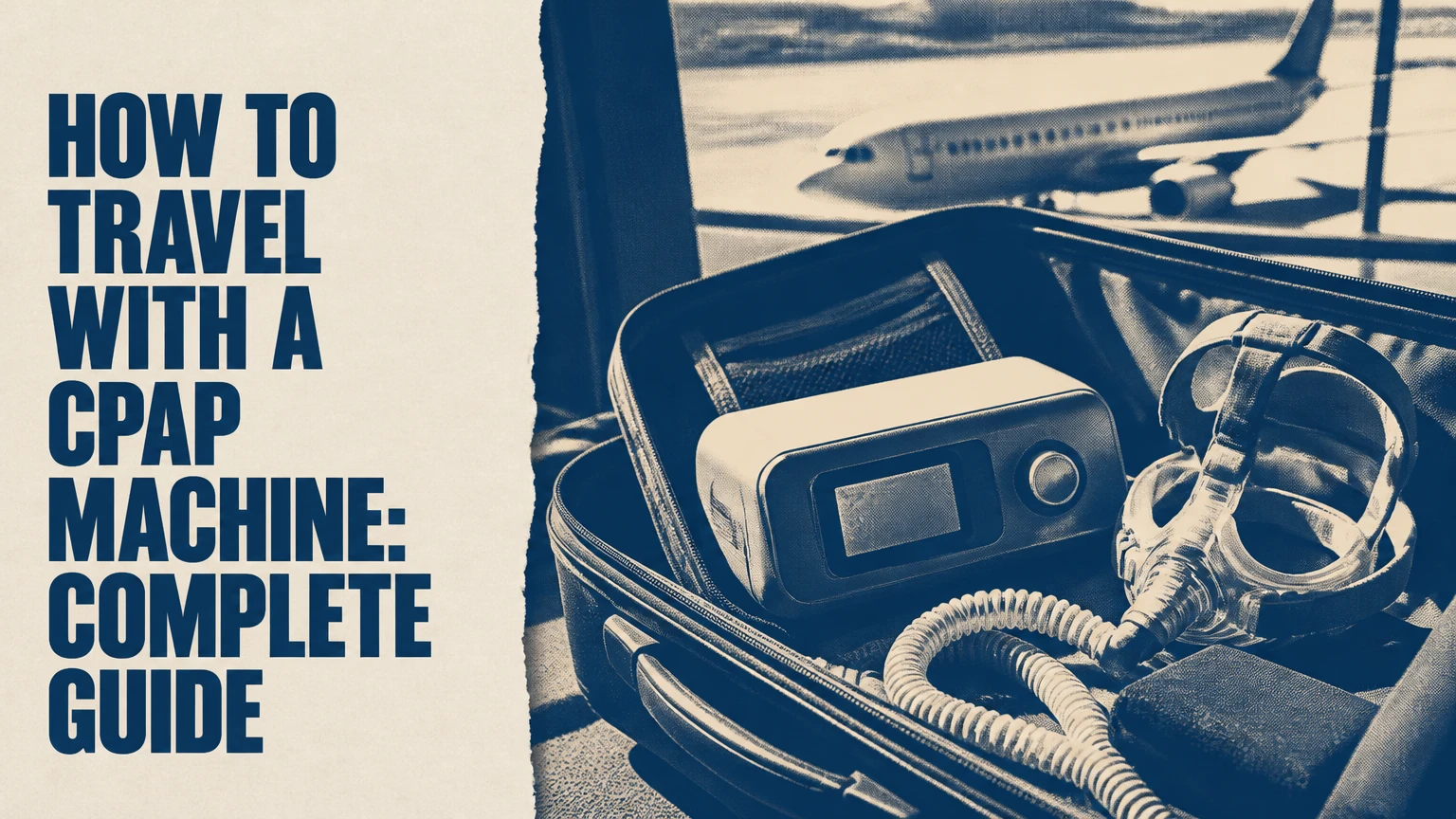
CPAP equipment should travel in a dedicated carry-on case rather than checked luggage. The case should protect the blower from impact, keep the mask clean, and leave enough room for the power supply, backup parts, documents, and a short extension cord.
| Component | Pack location | Backup recommendation | Typical replacement difficulty |
|---|---|---|---|
| Blower unit | Carry-on case | No second unit usually needed | High |
| Mask cushion | Carry-on case | One spare cushion | Medium |
| Tubing | Carry-on case | One spare tube for long trips | Medium |
| Power brick and cable | Carry-on case | Photograph specifications | High abroad |
| Filters | Carry-on case | 2-4 spare filters | Low |
| Prescription and model label | Personal document pouch | Digital copy | Low |
The most useful backup is often a cushion, connector, or power cable rather than a second machine. A broken silicone seal can make therapy impossible, while a missing filter is usually easier to replace locally.
Use a 6-10-foot extension cord with a grounded plug when the manufacturer permits it. Hotel beds frequently place outlets behind furniture, across the room, or on a switched circuit. Keep the cord away from walking paths, heaters, and bathroom water.
What If You Cannot Bring a CPAP?
A person who cannot transport a CPAP should ask a sleep specialist about a temporary treatment plan rather than simply stopping therapy. A custom mandibular advancement device may help selected adults with mild to moderate obstructive sleep apnea, while positional therapy helps people whose breathing events occur mainly when sleeping supine.
| Alternative | Best-supported situation | Electricity needed | Main limitation |
|---|---|---|---|
| Custom mandibular advancement device | Selected mild to moderate OSA | No | Requires fitting and dental follow-up |
| Positional therapy | Positional OSA | No | Often inadequate for non-positional or severe OSA |
| Hotel rental CPAP | Forgotten or damaged equipment | Yes | Availability and settings may differ |
| Backup home machine | Frequent or remote travel | Yes | Adds weight and cost |
| No treatment | None | No | Can restore apnea symptoms and safety risks |
A custom oral appliance is not interchangeable with a CPAP prescription. It can cause jaw discomfort, tooth movement, bite changes, or inadequate control when poorly fitted. Over-the-counter mouthpieces are not equivalent to a clinician-managed mandibular advancement device.
Do not use sedatives, alcohol, or opioid medication as a substitute for treatment. These substances can worsen airway collapse and impair judgment, especially at altitude or after a long flight.
Common Problems During Trips
The most common travel failures are preventable: the machine is checked, the battery is untested, the wrong adapter is packed, or the humidifier is transported full of water. A written backup plan reduces the chance that one missing component ends therapy.
Hotels, Cruises, and Rental Accommodation
Call the hotel before arrival if you need distilled water, an accessible outlet, a refrigerator for medication, or a quiet room. Ask housekeeping to remove scented cleaning products from the bedside area if fragrance irritates the airway.
Cruise ships may use different outlet types and can have limited medical support. Carry the CPAP onboard, bring a plug adapter, and ask the cruise line about electrical restrictions. Do not connect equipment to an outlet labeled for shavers unless the device’s power requirements are compatible.
If a CPAP is lost or damaged, contact the equipment supplier, sleep clinic, hotel, airline baggage office, and travel insurer immediately. Do not accept a replacement machine with unknown pressure settings unless a qualified clinician verifies the prescription.
Altitude, Dry Air, and Condensation
Airplane cabins and high-altitude destinations have low humidity. Nasal dryness can improve with a properly adjusted humidifier, saline nasal spray, or a waterless system, but a clinician should guide pressure changes.
Condensation in tubing, sometimes called rainout, occurs when humidified air cools inside the tube. Lower the humidifier setting, use a heated tube if available, raise the tube under the bedding, or keep the machine lower than the mask. Never cover the blower’s air intake.
Expert insight: A pressure reading that feels different after changing masks does not prove the prescription is wrong. Mask leak, altitude, tubing resistance, and a different exhalation-relief setting can alter comfort without requiring a new pressure.
A Practical Packing Checklist
Use the following checklist 24 hours before leaving:
- Pack the CPAP blower in a protective cabin case.
- Add the mask, headgear, tubing, power brick, and manufacturer-approved accessories.
- Pack one spare cushion or backup mask, two to four filters, and a connector.
- Drain and dry the humidifier chamber.
- Add the correct plug adapter and a 6-10-foot extension cord.
- Charge and label the battery with its watt-hour rating.
- Carry the prescription, clinician letter, serial number, and supplier contact.
- Photograph the device settings and power label.
- Confirm airport security and airline rules for the itinerary.
- Put the case where it can be reached quickly during screening or an overnight flight.
Do not pack the only power supply in checked baggage. Do not place a lithium-ion battery in checked baggage. Do not leave the machine loose inside a suitcase where clothing pressure can stress the humidifier latch or mask connector.
Frequently Asked Questions About How to travel with a CPAP machine
Does a CPAP machine count as a carry-on bag?
In the United States, TSA generally treats a CPAP as a medical device, and many airlines do not count it as a standard personal item or carry-on. Airline policies differ internationally, so keep the machine in a clearly identified case and confirm the carrier’s baggage policy before departure.
Can I sleep one night without my CPAP?
A single missed night may bring back snoring, apnea events, morning headache, or daytime sleepiness, although the immediate effect varies. Avoid driving if you feel drowsy, and contact your clinician if equipment failure will last more than one night or if you have severe apnea, heart disease, or oxygen needs.
How much distilled water should I take?
For a standard humidifier, plan roughly 8-16 fluid ounces per night, depending on climate, humidifier setting, mask leak, and chamber size. Carry only the amount allowed through security, then purchase additional distilled water locally. Empty the chamber before moving between destinations.
Can I use my CPAP at high altitude?
Most CPAP devices can operate at altitude within the manufacturer’s stated limit, but cabin pressure and mountain elevation can change comfort and oxygenation. Review the device manual and ask a sleep clinician before traveling to high elevation, especially if you use supplemental oxygen or have cardiopulmonary disease.
Can I rent a CPAP at my destination?
Some medical suppliers, hospitals, and specialist travel services rent CPAP equipment, but availability, mask compatibility, hygiene standards, and prescription requirements vary. A rental machine may use unfamiliar menus or settings, so arrange it before departure and verify the prescribed settings with your clinician.
Is a travel CPAP as effective as a home CPAP?
A travel CPAP can provide effective positive-airway-pressure therapy when its pressure range, algorithm, mask, and accessories suit the prescription. Smaller devices may have different humidification, noise, data, or mask compatibility. Compare treatment data and comfort with a sleep clinician before making a permanent switch.
Conclusion
How to travel with a CPAP machine becomes straightforward when therapy is treated as essential medical equipment: carry the complete system in the cabin, test power before departure, drain the humidifier, protect replacement parts, and confirm airline and battery rules. A standard home device is often adequate, while a travel model earns its cost mainly through lower weight and battery demand.