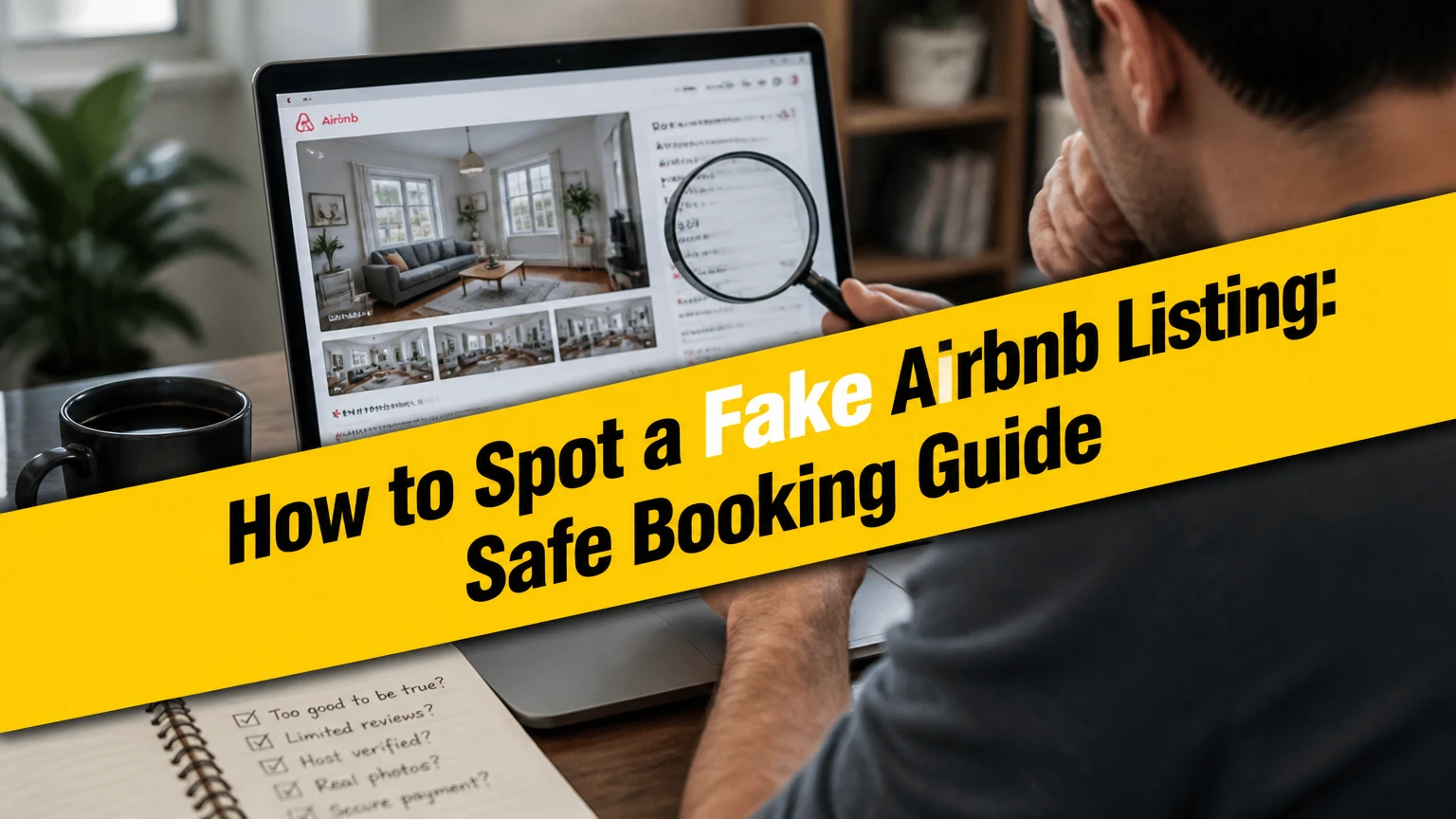
How to Spot a Fake Airbnb Listing: Safe Booking Guide
A fake Airbnb listing is a fraudulent or misleading accommodation advertisement that uses stolen photos, a false location, manipulated reviews, an unauthorized property, or a bait-and-switch promise. The strongest warning is usually a combination of an implausibly low total price, pressure to communicate or pay elsewhere, and details that cannot be independently verified.
Key Facts / Quick Answer
Keep every message, payment, and identity request inside Airbnb’s platform.
A price 20-30% below comparable homes deserves verification, not automatic rejection.
Reverse-image search can reveal stolen photos, but a clean result does not prove ownership.
Reviews are more useful when they span months and describe specific, consistent details.
Photograph the accommodation immediately after arrival and report serious discrepancies through Airbnb.
AirCover can help with qualifying reservation problems, but it is not a guarantee against every loss.
How to Spot a Fake Airbnb Listing Before Booking
To spot a fake Airbnb listing, compare the accommodation with local alternatives, verify the address and images, inspect the host’s review history, and refuse every request to move payment outside Airbnb. No single badge, review score, or identity check proves that a property is available, accurately represented, or controlled by the person advertising it.
In practice, fraud detection works through corroboration. A genuine listing should produce several independent signals: a plausible price, a coherent map location, room photos that match one another, a host who answers specific questions, and reservation terms that remain inside Airbnb.
Airbnb’s centralized records are valuable because support can see the reservation, messages, payment status, and listing history. That advantage disappears when a traveler pays by wire transfer, gift card, cryptocurrency, Zelle, Cash App, or PayPal Friends and Family after a host offers a discount.
The Federal Trade Commission’s consumer guidance states, “Never wire money to anyone you have not met in person.” The same principle applies to vacation rentals: a payment method that removes meaningful dispute rights converts a platform booking into a private transaction.
The five-minute screening test
| Check | Typical warning threshold | What to verify | Stop condition |
|---|---|---|---|
| Total price | 20-30% below five comparable homes | Cleaning fee, taxes, deposit, dates | Discount has no credible explanation |
| Review history | 5 reviews in one short week | Dates, detail, reviewer profiles | Repeated generic wording |
| Host response | Evasive after 2 specific questions | Address area, access, cancellation terms | Pressure replaces answers |
| Photo match | Any image appears elsewhere | Google Lens, TinEye, property details | Different city or accommodation |
| Payment route | Any amount outside Airbnb | Checkout screen and receipt | Wire, gift card, app, or link |
A low price alone is not proof of fraud. Seasonal vacancies, weekday demand, new furnishings, a basement room, or a nonrefundable cancellation policy can explain a discount. The problem is an unexplained discount combined with urgency or an off-platform request.
How Fake Vacation Rental Scams Work
Fake rental scams work by reducing a traveler’s time for verification and increasing emotional commitment. A criminal typically copies attractive images, creates or compromises an account, advertises scarce dates, and then redirects the guest to a payment or verification channel that Airbnb cannot monitor.
The platform itself is not the only attack surface. Criminals also use phishing emails, fake customer-support pages, duplicate accommodation advertisements, and compromised host accounts. A message sent through an authentic reservation thread can still be malicious if the host account has been taken over.
Airbnb may verify account identity or listing information under its policies, but verification does not establish that every photograph is original or that every future communication is safe. A verified identity means a person supplied information that passed a particular process. It does not necessarily prove property ownership.
Four common fraud patterns
- Phantom listing: The address is vacant, nonexistent, permanently unavailable, or unrelated to the advertised home.
- Hijacked property: A criminal copies a real home’s photographs or compromises a legitimate host account.
- Bait and switch: The advertised home is replaced with a smaller, dirtier, less accessible, or distant property.
- Account takeover: A trusted host profile is controlled by someone who sends new payment links or changes reservation instructions.
| Scam pattern | First-stage signal | Typical loss | Strongest evidence |
|---|---|---|---|
| Phantom home | Address does not map to a plausible residence | $100-$4,000+ | Map record, host messages, payment receipt |
| Hijacked property | Photos match another owner or city | Deposit or full booking | Reverse-image results and listing URLs |
| Bait and switch | “Emergency” relocation before arrival | Extra transport, inferior lodging | Original listing screenshots and videos |
| Account takeover | Sudden change in tone or payment details | Any additional payment | Account message timeline and support case |
An account takeover deserves special caution because the profile may contain years of genuine reviews. Review quality cannot fully validate a new message, new bank detail, or new external link.
Which Listing Details Deserve the Most Scrutiny?
The highest-value checks are price, location, photographs, host behavior, reviews, and reservation terms. These attributes work together: a listing with a modest discount and a detailed host may be reasonable, while an apparently perfect home with inconsistent geography and urgent payment demands is high risk.
Price and availability
Compare at least five similar accommodations for the same dates, neighborhood, guest count, bedroom count, and cancellation terms. Compare the final checkout total, not only the nightly rate, because cleaning fees and taxes can make a cheap headline price expensive.
A 25% discount is a screening trigger, not a verdict. A 60% discount for a high-demand weekend requires a specific explanation, such as a shared room, restricted access, or a materially different location.
Location and address
Airbnb may conceal an exact address until booking for privacy and security. Guests can still ask for the neighborhood, nearest cross street, building type, walking distance to a landmark, and whether the unit is an entire place or a private room.
Check the map pin against satellite imagery, street photos, transit routes, flood zones, and the building’s apparent use. A home advertised as a detached villa should not appear inside an office tower. A downtown apartment should not require a two-hour drive from the stated attraction.
Photos and visual consistency
Download several photos and run them through Google Lens or TinEye. Search distinctive objects, unusual architecture, visible text, and watermarks separately because criminals sometimes crop or mirror stolen images.
Reverse-image search has a limitation: original images, newly scraped images, and private social-media photos may produce no match. A clean search result means only that the image was not found in the searched index.
| Visual check | Credible pattern | Suspicious pattern | Practical action |
|---|---|---|---|
| Room sequence | Bedroom, bathroom, kitchen fit one floor plan | Windows and furniture change impossibly | Ask for a current room detail |
| Image source | Consistent lighting and composition | Luxury real-estate watermark | Search the watermark and image |
| Exterior | Building style matches map location | “Beach house” lacks exterior context | Request neighborhood landmarks |
| Capacity | Beds match bedroom and occupancy claims | Sofa beds inflate capacity | Count fixed beds and bathrooms |
| Recency | Seasonal details fit travel date | Snow outside, summer furniture inside | Ask when photos were taken |
One strong practitioner rule is to request a harmless, current detail that a real host can answer quickly, such as whether the bedroom window faces the street or courtyard. A scammer relying on copied images often answers with generic sales language.
Reviews and host history
Read the oldest, newest, and middle reviews rather than relying on the average score. Look for specific references to the entrance, noise, mattress, heating, stairs, cleanliness, and host communication.
A cluster of reviews posted within days does not automatically indicate fraud because a host may import reviews from another Airbnb listing under platform rules or receive several bookings after opening. It does justify checking whether the language, dates, and property details remain coherent.
| Review signal | Lower-risk interpretation | Higher-risk interpretation | Follow-up |
|---|---|---|---|
| Review age | 12-24 months of activity | All reviews in 7-14 days | Inspect reviewer profiles |
| Detail | Specific room and neighborhood facts | Generic “great place” wording | Search repeated phrases |
| Host replies | Answers complaints concretely | Identical replies to every guest | Read negative reviews |
| Property continuity | Same beds, layout, and amenities | Sudden luxury upgrade | Compare older photos |
| Guest identity | Varied profiles and trip patterns | Empty or newly created profiles | Treat rating as weak evidence |
What Should You Ask the Host?
Ask questions that test operational knowledge, not questions answered directly by the listing. A legitimate host can usually explain access, building rules, sleeping arrangements, nearby construction, and what happens if an amenity fails.
Send questions through Airbnb so the answers become part of the reservation record. Avoid sharing passport scans, card numbers, one-time passwords, or identity documents through an external link. If local law requires guest registration, ask how and where the information will be collected.
Useful questions include:
- What is the approximate cross street, and how long does it take to reach the nearest transit stop?
- Is the advertised address the building entrance or a nearby map point?
- Which beds are permanent, and how many bathrooms have showers?
- Who provides check-in instructions, and when are they released?
- Is the elevator, heating, air conditioning, or parking currently working?
- Are there local registration, occupancy, or quiet-hour requirements?
- If the accommodation becomes unavailable, what is the documented relocation process?
A host who cannot disclose a private exact address before booking may still answer the surrounding questions. A host who can disclose the address but refuses basic operational questions is a different risk.
Which Payment Methods Protect a Guest?
Payment through Airbnb provides the clearest evidence because the platform links the charge to a reservation and its published terms. Direct payment may eliminate platform support, cancellation remedies, and the ability to prove that the accommodation was represented by a particular host.
| Payment method | Typical reversibility | Evidence created | Risk level |
|---|---|---|---|
| Airbnb card checkout | High relative to direct transfer | Reservation, receipt, message record | Lowest available on platform |
| Credit card direct charge | Depends on issuer and merchant | Card statement and merchant record | Medium |
| Debit card direct charge | Often weaker dispute position | Bank statement | Medium-high |
| PayPal Goods and Services | Policy-dependent | Transaction and seller record | Medium |
| PayPal Friends and Family | Usually limited buyer protection | Transfer record | High |
| Wire, gift card, crypto, Zelle | Often difficult to reverse | Limited recipient evidence | Very high |
Airbnb hosts should not require a guest to complete a separate “card verification” form through a link in chat. A malicious page may harvest card data, passwords, identity documents, or one-time authentication codes even when the reservation itself is genuine.
Never pay a security deposit by an unrecorded method merely because a host promises a lower rate. If a deposit is legitimate, its amount, purpose, collection method, and return conditions should appear in the platform’s reservation terms or official house rules.
A 10-Step Process for Screening a Listing
Use the following sequence before booking. Each step creates evidence for the next one, and a failed step should outweigh a persuasive photograph or a high rating.
- Record the listing. Save the URL, headline, price, amenities, cancellation terms, host name, and all photographs.
- Benchmark the total. Compare five similar homes for identical dates and occupancy, including taxes and fees.
- Inspect the map. Check the neighborhood, building type, transit distance, and whether the pin matches the description.
- Search the images. Use Google Lens or TinEye on at least three distinctive photographs.
- Read review chronology. Examine recent, oldest, and negative reviews for property continuity.
- Check host behavior. Ask two detailed questions and observe whether the answers are precise.
- Verify booking terms. Confirm cancellation, occupancy, cleaning charges, deposits, and check-in timing on Airbnb.
- Reject external payment. Do not click unsolicited links or use irreversible payment channels.
- Confirm before travel. Keep the Airbnb thread active and ask when access instructions will appear.
- Inspect on arrival. Photograph the entrance, rooms, damage, utilities, safety equipment, and address before unpacking.
The most important stop condition is a demand to pay elsewhere. Do not negotiate around it. Report the message, preserve screenshots, and choose another accommodation.
A practical risk score
| Signal | Points | Meaning |
|---|---|---|
| Price more than 30% below comparable homes | 2 | Needs explanation |
| Image match in another city or listing | 4 | Strong fraud indicator |
| Host avoids specific questions | 2 | Operational inconsistency |
| Reviews cluster in under 14 days | 1 | Weak evidence alone |
| External payment or verification link | 5 | Stop and report |
| Address conflicts with description | 4 | Do not book until resolved |
A total of 0-2 points calls for ordinary caution, 3-5 points calls for additional verification, and 6 or more points means do not proceed. This is a practitioner screening tool, not an Airbnb fraud guarantee.
Airbnb, Hotels, and Direct Bookings Compared
Hotels generally offer stronger physical verification because a staffed property, brand website, front desk, and established merchant record provide multiple contact points. Airbnb offers more residential variety and can provide a useful centralized dispute record, while direct social-media bookings often provide the fewest protections.
| Attribute | Airbnb booking | Branded hotel | Direct social-media booking |
|---|---|---|---|
| Identity record | Account and reservation history | Corporate merchant and front desk | Often self-reported |
| Payment control | Platform checkout | Hotel merchant account | Wire or peer-to-peer common |
| Arrival remedy | Platform support and policy terms | On-site room replacement | Depends on individual owner |
| Address certainty | Exact address may follow booking | Public property address | May be vague or false |
| Accommodation variety | Homes, rooms, villas | Rooms and suites | Any claim, little validation |
| Best use case | Verified residential experience | Predictable service | Only with strong independent proof |
Hotels are not immune to phishing, fake websites, or unauthorized booking agents. A hotel’s physical presence reduces one category of risk, but travelers still need to verify the domain, payment page, cancellation terms, and merchant name.
What Happens If the Listing Is Fake?
If the accommodation does not exist, is inaccessible, or materially differs from the listing, do not quietly accept a substitute. Document the problem first, contact Airbnb through the reservation, and request a case number while preserving every message and receipt.
At the property
- Photograph the building number, entrance, lock, rooms, furnishings, view, damage, and missing amenities.
- Record the time, location, and any conversation with the host.
- Do not enter an unsafe property or confront a suspected criminal alone.
- Contact Airbnb through the official app or website, not a phone number supplied in an unexpected message.
- If stranded, obtain a reasonable temporary room and keep itemized receipts.
- Report threats, forced entry, identity theft, or immediate danger to local emergency services.
Airbnb’s rebooking and refund decisions depend on the facts, timing, reservation terms, and applicable policy. AirCover is a set of reservation protections, not travel insurance and not a promise that every indirect expense will be reimbursed.
The commonly repeated “24-hour protection” rule is too simple. Guests should report a serious problem immediately because response options can depend on prompt notice, available evidence, and whether the host can correct the issue. A payout delay to the host does not give the guest a guaranteed 24-hour inspection entitlement.
If you already paid outside Airbnb
Contact the bank, card issuer, payment service, and Airbnb immediately. Ask the bank whether a transaction recall, card replacement, fraud claim, or chargeback is available, but do not assume recovery is possible.
| Response | Recommended timing | Information to provide | Likely limitation |
|---|---|---|---|
| Airbnb report | Immediately | Listing URL, reservation, screenshots | Policy eligibility varies |
| Card issuer | Same day | Merchant, amount, date, evidence | Chargeback is not automatic |
| Bank transfer provider | Same day | Recipient, reference, fraud report | Funds may already be withdrawn |
| Password reset | Within minutes | Compromised email or account details | Other sessions may remain active |
| Local police report | For theft or threats | Receipts, identity, messages | Jurisdiction may limit action |
| Identity protection | After document exposure | Type of data disclosed | Monitoring cannot undo disclosure |
Change your Airbnb and email passwords if you clicked a suspicious link. Enable multifactor authentication where available, and contact the bank if you entered card details or a one-time code.
Important Limitations of Fraud Checks
No screening method proves that a rental is safe. Reverse-image searches miss unpublished images, reviews can be authentic but transferred to a new property under platform mechanisms, and a real host account can be compromised after a traveler completes research.
Verification badges also require careful interpretation. Airbnb changes product names, eligibility rules, and display treatments across markets, so a badge should be treated as one platform signal rather than a property guarantee. “Guest Favorite” indicates strong guest feedback under Airbnb’s criteria, not ownership or future availability.
Local legality creates another blind spot. A listing can be genuine but illegal under city rules, building restrictions, lease terms, or permit requirements. Guests may face cancellation or removal even without a conventional scam.
An honest decision balances risk with remedy. A hotel may cost $40 more per night but provide a staffed desk, while a residential listing may offer a kitchen and neighborhood access that a hotel cannot match. Choose the arrangement whose failure you can afford to manage.
Frequently Asked Questions About How to spot a fake Airbnb listing
Can a new Airbnb host be legitimate?
Yes. New hosts often have no review history because the property or account is genuinely new. Reduce uncertainty by checking coherent photographs, answering detailed questions in Airbnb, comparing the total price, and refusing external payment. A new account plus an extreme discount and vague answers is materially riskier than a new account alone.
How many Airbnb reviews are enough to trust a property?
There is no universal safe number. Five detailed reviews spread across several months provide more useful evidence than 50 generic reviews posted in one week, but even a heavily reviewed listing can be affected by a host-account takeover or a recent change in management. Review substance and continuity matter more than the score alone.
Does Airbnb verify every property on its platform?
No verification process should be interpreted as proof that every property detail is permanently accurate. Airbnb may verify selected identity, location, or listing information under its policies, but guests should still check photographs, amenities, address context, reviews, and reservation messages. Verification reduces some risks without eliminating misrepresentation or account compromise.
What if the host hides the exact address?
Airbnb may withhold the precise address until booking for privacy and security. Ask for the neighborhood, nearest cross street, building type, transit distance, and access arrangements before paying. If the map location conflicts with the description or the host refuses reasonable context, select another listing.
Can an Airbnb host ask for identification?
A host may need information required by local registration rules, but the request should be explained and handled through an appropriate, secure process. Never send a passport scan, card number, password, or one-time code to an unsolicited external link. Ask Airbnb support whether the request is consistent with the reservation and local requirements.
Can a bank reverse a vacation-rental scam payment?
Sometimes, especially for unauthorized card transactions reported quickly, but reversal is not guaranteed. Credit cards often provide a stronger dispute process than debit cards or irreversible transfers. Contact the issuer immediately, provide the reservation and message record, and ask which fraud or chargeback category applies.
Conclusion: How to Spot a Fake Airbnb Listing Reliably
To spot a fake Airbnb listing reliably, combine price comparison, map verification, reverse-image searching, review chronology, host questioning, and strict on-platform payment. Treat an external link, an urgent discount, or a last-minute property substitution as a stop signal, document discrepancies immediately, and contact Airbnb through the official reservation before accepting any replacement.