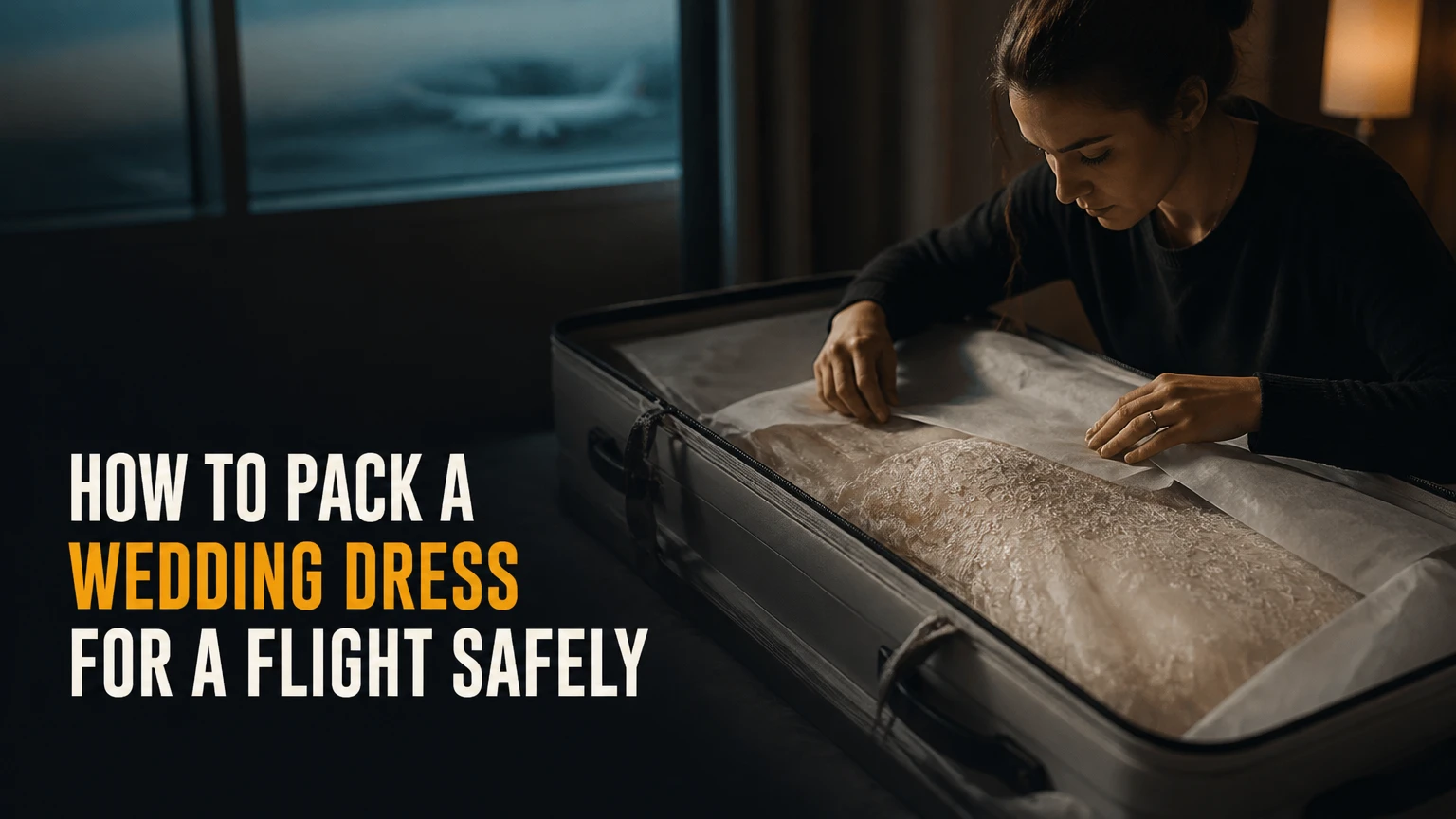
How to Pack a Wedding Dress for a Flight Safely
How to pack a wedding dress for a flight means protecting the gown from crushing, moisture, abrasion, and loss while keeping it in the cabin. The safest method is to carry the dress onboard in a suitable garment bag or hard-sided case, pad every fold with acid-free tissue, and arrange professional steaming after arrival.
Key Facts
Keep the wedding dress in the aircraft cabin whenever possible. Checked baggage can be delayed, lost, or crushed.
Use white, acid-free, dye-free tissue paper inside the bodice and between folds.
A hard-sided carry-on usually protects structured gowns better than a soft bag in an overhead bin.
Ask the airline about its closet policy, but treat hanging storage as uncertain rather than guaranteed.
Allow at least 1.5 hours for careful home packing and arrange steaming 24-48 hours before the ceremony.
Do not pack shoes, jewelry, liquids, or other abrasive items against the gown.
The Safe Default for Air Travel
A wedding dress should travel as a cabin carry-on, not inside checked luggage, because the passenger retains control of the gown from airport departure to destination. Airline acceptance does not guarantee closet space, so the packing plan must also protect the dress if the gown has to lie flat in an overhead compartment.
The Transportation Security Administration advises travelers to contact their airline about its specific policy. That advice matters because airlines differ in carry-on dimensions, closet access, weight limits, and gate-check procedures. A wedding dress may be accepted as a carry-on, yet still count toward the passenger’s allowance.
In practice, the most reliable arrangement is a dedicated dress container plus a small personal item. Do not assume that a flight attendant can hang the gown. Crew closets are limited, and some aircraft have no usable passenger garment storage.
What to Confirm With the Airline
Ask the operating carrier, not only the booking website or codeshare partner, these questions:
- Does a wedding gown count as one standard carry-on?
- What are the maximum length, width, depth, and weight limits?
- Can a full-length garment bag be carried onboard?
- Is an onboard closet available on this aircraft type?
- What happens if overhead space runs out?
- Can the gown be gate-checked, and can that instruction be refused?
- Does a connecting airline apply a different baggage policy?
Record the answer, the agent’s name or reference number, and the date. Policy information is useful during a gate conversation, although it cannot override crew safety decisions or a full cabin.
Choose the Container for the Gown
The best container depends on the dress’s silhouette, fabric, internal structure, and embellishment. A soft garment bag works well when the gown can remain hanging, while a hard-sided carry-on provides stronger protection when the dress must occupy an overhead bin.
| Container | Suitable Gowns | Typical Capacity | Main Risk |
|---|---|---|---|
| Full-length garment bag | Ball gown, A-line, lightly beaded gown | 60-72 inches long | Compression in a crowded closet |
| Hard-sided carry-on | Sheath, crepe, satin, compact A-line | 22 x 14 x 9 inches | Deep folds if overfilled |
| Bridal travel box | Destination wedding gown, layered tulle | 18-24 inches long | Oversize dimensions or rough handling |
| Soft-sided suitcase | Simple polyester, jersey, short train | 20-24 inches long | External pressure and snagging |
A hard-sided suitcase often offers the best backup because the shell resists spilled liquids, pressure from adjacent bags, and overhead-bin compression. It also makes the gown look like ordinary cabin luggage, which can reduce unnecessary handling.
A full-length garment bag is preferable for a dress with a long train, molded cups, dense lace, or fragile three-dimensional flowers. If the airline requires the bag to fit inside a standard carry-on, fold the lower skirt without pressing it flat.
How Construction Changes the Packing Choice
Construction determines where pressure can safely occur. A boned corset should retain its natural shape, while a densely beaded skirt needs separation between decorated surfaces.
| Dress Feature | Preferred Method | Tissue Quantity | Packing Restriction |
|---|---|---|---|
| Boning or molded bust | Upright garment bag or broad padded fold | 8-12 sheets | Never crease across the cup or waist stay |
| Sequins or heavy beads | Inside-out protection with tissue layers | 20-40 sheets | Keep ornamented surfaces from rubbing |
| Tulle or organza layers | Loose folds or a tissue-wrapped roll | 15-30 sheets | Do not compress the air out of the layers |
| Satin or silk charmeuse | Flat, low-friction folds | 10-20 sheets | Avoid plastic touching fabric for long periods |
| Long train | Separate train fold at the bottom | 15-25 sheets | Keep the train from forming a narrow crease |
A plastic dry-cleaning bag can reduce friction during short transit, but it should not become permanent storage. Plastic traps humidity, and condensation can transfer moisture or encourage odor. Remove the plastic liner as soon as the gown reaches a dry destination.
How to Pack a Wedding Dress Step by Step
Packing a wedding dress requires a clean surface, acid-free tissue, a breathable outer bag, and enough time to avoid hurried folds. The procedure protects the bodice first, creates broad rather than sharp folds, and positions the heaviest layers so they do not crush delicate lace or ornamentation.
Prepare the following supplies before touching the gown:
- 30-60 sheets of white, acid-free, dye-free tissue paper
- One breathable garment bag or clean hard-sided carry-on
- One clean cotton sheet for a large work surface
- Two to four wide, non-slip hangers
- Small cotton bags for detachable accessories
- A plastic liner only for short-term friction reduction
- A luggage scale and tape measure
- A copy of the airline’s baggage policy
Do not pack on a bedspread, carpet, or hotel floor. Those surfaces can transfer lint, cosmetics, pet hair, or grit to the hem.
The Packing Sequence
- Inspect and photograph the gown.
Photograph the front, back, hem, closures, embellishments, and existing marks. Capture the dress inside its container, then save the images with the travel date. A dated record helps distinguish transit damage from a pre-existing issue. - Remove detachable pieces.
Pack the veil, belt, overskirt, straps, bustle components, and removable flowers separately in tissue-lined cotton bags. Small hard objects can press into the main fabric during flight. - Turn the dress inside out when appropriate.
This protects the visible outer surface from snags and incidental contact. Do not force a heavily structured or embellished gown inside out, because reversing boning, appliqué, or stiff lace can create more damage than it prevents. - Support the bodice.
Loosely fill the bust cups, sleeves, and waist area with crumpled tissue. Tissue should support the shape without stretching seams. Avoid towels, newspaper, colored paper, and ordinary gift tissue. - Protect surface details.
Place a single tissue sheet over lace, sequins, pearls, and raised appliqué before folding adjacent fabric over them. The layer reduces abrasion when the gown moves. - Fold in broad sections.
Bring the skirt inward in thirds or wide panels. Never pinch a narrow fold, kneel on the dress, or press down to reduce volume. A broad soft fold releases more easily than a hard crease. - Manage the train separately.
Fold the train in a tissue-lined accordion pattern or roll it loosely around a tissue core. Do not wrap the train tightly around the bodice, because the concentrated pressure can flatten cups and distort the waist. - Place the gown in the container.
Put the bodice on top of the skirt when possible. Fill empty corners with tissue rather than clothing. The container should close without force. - Weigh and measure the packed case.
Check the airline’s current dimensions and weight allowance. A case that fits at home can become noncompliant after adding a box, tissue, or protective sleeve. - Seal only the outer container.
Keep the gown accessible for security inspection. Do not use staples, pins, or adhesive directly on the fabric or garment bag.
How Much Tissue Paper Is Enough?
The correct quantity is enough to maintain shape and prevent decorated surfaces from touching, not enough to create a rigid package. A compact sheath usually needs 10-20 sheets, while a layered ball gown can require 30-60 sheets depending on its train and embellishment.
Acid-free tissue is preferred because it lacks the acids and dyes that can discolor pale textiles during storage. Tissue must remain loose. Packed paper that is compressed tightly can create new ridges and prevent air circulation.
Expert insight: The most common packing error is using too little tissue in the bodice and too much tissue around the skirt. Bodice support prevents structural distortion; excess skirt paper increases bulk and tempts the traveler to force the case closed.
Fabric and Embellishment Rules
Fabric dictates wrinkle behavior, moisture sensitivity, and steaming tolerance. Polyester satin generally tolerates travel better than silk satin, while tulle often recovers from soft folds but can snag on zippers, hooks, and rough tissue edges.
| Material or Detail | Transit Behavior | Safe Protection | Steam Caution |
|---|---|---|---|
| Polyester satin | Develops visible pressure lines | Tissue between broad folds | Test a hidden area first |
| Silk satin | Marks easily and reacts to moisture | Breathable tissue wrap | Use a professional cleaner |
| Tulle | Recovers from loose folds | Tissue-lined roll | Keep steam head away from decoration |
| Lace | Snags and abrades at edges | Flat tissue barrier | Avoid direct contact |
| Sequins and beads | Scratch neighboring fabric | Inside-out or separated layers | Heat can loosen adhesive |
| Horsehair braid | Holds sharp compression lines | Wide train fold | Do not flatten with weight |
A garment steamer is not automatically safe. Water spots, excess heat, adhesive failure, and melted synthetic fibers can result from inexperienced use. A cotton sock or clean towel over the steamer head may reduce droplets, but it does not eliminate the need for a fabric test.
The gown’s care label and boutique instructions override general advice. Some silk, antique lace, hand-painted details, and glued embellishments require professional pressing rather than home steaming.
Airline and Airport Planning
Airline rules control the container, while airport handling controls the risk. A passenger who boards late may lose overhead space even with a compliant carry-on, and a traveler who relies on a closet may face a different aircraft on the return flight.
Arrive early enough to speak with the gate agent before boarding begins. Ask about closet availability, but do not hand over the gown unless a crew member gives a clear instruction and you understand whether it will remain in the cabin.
| Planning Item | Recommended Target | Why It Matters | Backup Action |
|---|---|---|---|
| Airport arrival | 2-3 hours before departure | Allows policy and security discussions | Ask gate agent for early boarding options |
| Boarding position | Early group when available | Improves overhead access | Place case flat above lighter bags |
| Carry-on weight | At least 1 pound below limit | Leaves room for scale variation | Remove nonessential packing materials |
| Connection buffer | 90 minutes or more | Allows aircraft and gate changes | Reconfirm storage on the next flight |
| Destination arrival | Hang within 30 minutes | Reduces prolonged compression | Use a clean bathroom for gravity release |
A flight attendant may place a garment bag in a closet, but closet space is not standardized across airlines or aircraft. “Captain’s closet” is a common informal name, although the storage location and availability vary.
If the gown must go into an overhead bin, lay it flat across the top of other bags. Keep shoes, coats with metal hardware, and hard-sided luggage away from the dress. Never wedge the case beneath a heavy suitcase.
Carry-On, Garment Bag, or Checked Luggage?
Carry-on transport is the safest choice because the dress remains physically close to the traveler. The choice between a garment bag and suitcase depends on whether the gown can hang and whether the airline permits the packed dimensions.
| Option | Protection Level | Cabin Space | Typical Cost | Best Use |
|---|---|---|---|---|
| Hard-sided carry-on | High against crushing | 22 x 14 x 9 inches | $80-$250 | Overhead storage |
| Soft garment bag | High while hanging | 60-72 inches unfolded | $40-$180 | Closet access |
| Bridal travel box | Medium to high | 18-24-inch box | $60-$220 | Destination weddings |
| Checked suitcase | Low for irreplaceable gowns | 24-30 inches | $0-$200 fee | Only for nonessential backup items |
A checked suitcase is a poor choice for the wedding gown because baggage handling adds loss, delay, compression, weather, and conveyor-belt exposure. Travel insurance may reimburse a claim, but money cannot replace a customized gown before a ceremony.
A separate checked suitcase can carry shoes, toiletries, a steamer, and a backup outfit. Keep the dress and one ceremony-ready undergarment in the cabin.
Budget and Timeline
Travel preparation costs vary by city, gown complexity, and urgency. Typical professional packing begins around $200, while post-arrival steaming or pressing commonly costs $175-$350; destination hotels may charge more for same-day service.
| Service or Task | Typical Cost | Typical Time | Cost Driver |
|---|---|---|---|
| DIY packing supplies | $20-$75 | 1.5-2 hours | Tissue quantity and container |
| Bridal concierge packing | From $200 | 1-3 hours | Train, boning, and beadwork |
| Professional steaming | $175-$350 | 1-3 hours | Layers and embellishments |
| Rush hotel pressing | $250-$500 | 2-24 hours | Destination and turnaround |
| Travel insurance add-on | $20-$100 | 10-30 minutes | Coverage limit and deductible |
Plan the packing at least one day before departure, not in the airport lounge. Schedule final steaming 24-48 hours before the ceremony, because the gown may need time to relax after service.
The shortest timetable is workable only for a simple polyester dress. A silk gown with a long train, detachable overskirt, and hand-sewn beadwork needs more time and usually benefits from a bridal specialist.
Arrival and Wrinkle Recovery
The gown should be unpacked and hung in a clean, dry room within 30 minutes of arrival. Gravity can release minor travel wrinkles, but it cannot reliably remove sharp creases, compression marks, or distortions in boning.
Use a wide padded hanger and support the train over a clean door, shower rod, or luggage rack. Do not hang the gown from a thin wire hanger, exposed hook, or rough wooden surface.
A 48-Hour Recovery Schedule
| Time Before Ceremony | Action | Suitable Gowns | Avoid |
|---|---|---|---|
| 48 hours | Unpack, inspect, and hang | All fabrics | Leaving plastic around the gown |
| 36 hours | Contact bridal pressing service | Silk, lace, heavy beadwork | Hotel iron |
| 24 hours | Steam tested areas if approved | Polyester, simple tulle | Direct steam on beads |
| 12 hours | Check hem, bustle, and closures | All constructions | Last-minute structural alterations |
| 2-4 hours | Final inspection and dressing prep | All gowns | Spraying perfume or hairspray nearby |
A steamy bathroom can relax light wrinkles, but it is not a substitute for pressing. Humidity can worsen water-sensitive silk, loosen glued embellishments, and leave the hem damp.
Expert insight: Steam should follow inspection, not precede it. Heat can temporarily hide a pressure mark while making adhesive or water damage harder to diagnose.
Common Failure Points and Fixes
Most transit damage comes from pressure, friction, moisture, or rushed handling rather than from ordinary folding alone. Correcting those risks requires changing the packing environment, not merely adding more paper.
- Colored tissue stains the gown. Replace it with white, acid-free tissue. Dye transfer becomes more likely when humidity rises.
- A zipper catches lace. Cover the zipper with tissue or a smooth fabric flap before folding.
- Beading scratches satin. Place tissue between decorated and undecorated surfaces, then reduce movement inside the case.
- The case is overfilled. Remove shoes, accessories, and redundant packaging. Never force the zipper.
- Plastic remains around the gown for days. Remove the liner after arrival and let the dress breathe in a dry room.
- The train forms a narrow crease. Repack it in wide folds or a loose tissue-covered roll.
- Security requests inspection. Explain that the item is a wedding gown, open the container yourself, and request a clean inspection surface.
- The airline proposes gate-checking. State that the gown is fragile and irreplaceable, then ask whether another cabin storage location is available. Follow crew instructions if safety rules leave no alternative.
What If the Gown Is Delayed or Damaged?
If the dress is separated from you, report the issue to the airline before leaving the airport and obtain a written incident number. Photograph the exterior damage, retain baggage tags and receipts, and contact the bridal boutique or alterations specialist immediately.
A local bridal presser may repair wrinkles, but structural damage requires a seamstress familiar with the original construction. Do not cut loose threads, apply stain remover, or iron an unfamiliar fabric before professional inspection.
Destination Weddings and International Flights
Destination weddings add heat, humidity, customs inspection, unfamiliar pressing services, and longer connections. Pack the gown in the cabin, carry printed and digital copies of the airline policy, and identify a bridal cleaner near the venue before departure.
International travelers should verify the baggage rules for every operating carrier and airport segment. A domestic first leg may allow one arrangement while a partner airline on the international leg uses stricter dimensions.
Keep the gown’s purchase receipt, alteration invoice, designer label, and care instructions in a separate personal item. These records support insurance documentation and help a destination specialist select the correct treatment.
For tropical locations, avoid placing a cold gown into a sealed plastic bag immediately after landing. Allow the container to acclimate briefly, then unpack it in an air-conditioned, dry room to limit condensation.
Frequently Asked Questions About How to pack a wedding dress for a flight
Can a wedding dress count as a personal item?
A wedding dress can count as a carry-on or personal item only according to the airline’s policy and its packed dimensions. A full garment bag usually exceeds personal-item limits, while a compact hard-sided case may meet carry-on limits. Confirm the rule with the operating carrier before traveling.
Should I fold or roll a wedding dress?
Fold a structured or embellished gown in broad, tissue-padded panels. Roll only suitable lightweight skirts, such as simple tulle, around a loose tissue core. Rolling a boned bodice, molded cup, or dense beadwork can create distortion and concentrated pressure.
Can I bring a wedding dress through airport security?
A wedding dress can generally pass through airport security as cabin baggage, but screening procedures vary by airport and security authority. Keep the gown accessible, explain that it is fragile, and ask for a clean inspection surface. Never place the uncovered dress directly on a conveyor belt.
Is a wedding dress safe in a vacuum bag?
A vacuum bag is unsuitable for most wedding dresses because compression can crush tulle, lace, boning, and molded cups. The airtight plastic can also trap moisture. Use loose tissue padding and a breathable container instead, particularly when the gown contains silk or glued embellishments.
How early should I buy a bridal travel case?
Buy or borrow the travel case at least two weeks before departure. Pack a test load, measure the closed case, weigh it, and confirm that the gown’s train and bodice fit without pressure. This schedule leaves time to exchange an unsuitable container.
What should I do if my wedding dress will not fit overhead?
If the gown cannot fit the airline’s approved cabin dimensions, contact the carrier before travel and ask about a closet or an approved garment-bag exception. Do not rely on informal promises. If transport remains uncertain, arrange professional destination delivery with insurance and a confirmed recipient.
Conclusion
The safest way to pack a wedding dress for a flight is to keep the gown in the cabin, support its structure with acid-free tissue, use broad folds, and choose a container that meets the operating airline’s dimensions. Photograph the dress, separate accessories, plan for no closet space, and arrange steaming 24-48 hours before the ceremony.