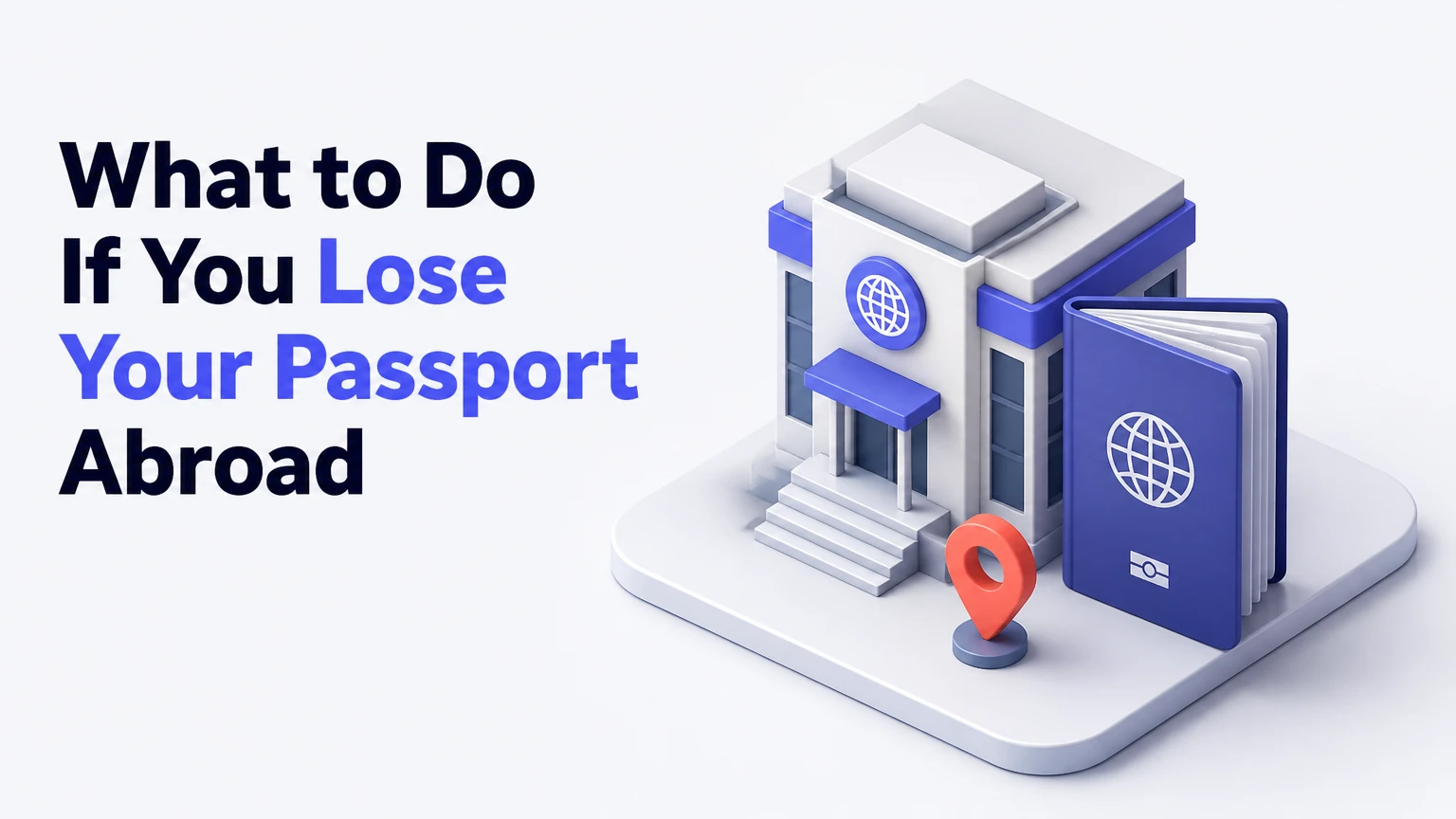
What to Do If You Lose Your Passport Abroad
What to do if you lose your passport abroad starts with securing yourself, reporting the loss locally, and contacting your country’s embassy or consulate. The mission can verify citizenship and issue a replacement passport or emergency travel document, but local immigration authorities may also need to transfer visas or authorize departure.
Key Facts / Quick Answer
Report theft or loss to local police and obtain a report number or written report.
Notify the nearest embassy or consulate before booking a replacement flight.
A reported passport is normally canceled and should not be used if recovered.
Typical emergency-document processing takes 1-3 business days, but identity verification and local holidays can extend it.
Typical direct replacement expenses range from USD 135-190, plus photos, transport, police fees, visa work, and possible airline charges.
Ask whether the document permits entry into your destination, transit through connecting countries, or only return to your country of citizenship.
What to Do If You Lose Your Passport Abroad
If a passport disappears overseas, stop searching after a short, organized check and begin the official process. Confirm the loss, protect your remaining belongings, file a local police report, contact the diplomatic mission, and tell the airline or travel provider that your document status may change.
The first 60 minutes
- Move to a secure place, such as a hotel reception, police facility, airport help desk, or staffed transport station.
- Check the last controlled locations: hotel safe, airport security tray, taxi, train, restaurant, and accommodation reception.
- Freeze payment cards and secure your phone if the passport was stolen with a wallet or bag.
- Record the passport number, issue country, expiry date, loss location, and approximate time if you know them.
- Call the nearest embassy or consulate and ask about emergency appointments, accepted evidence, fees, and local immigration requirements.
- Avoid crossing an international border until the mission and immigration authority confirm that your replacement document is accepted.
The US Department of State instructs US travelers to report a lost or stolen passport immediately because the document can no longer be used once canceled. That principle applies broadly, although each issuing government controls its own cancellation and replacement rules.
Expert insight: The mistake most travelers make is changing a flight before asking about transit eligibility. An emergency document may permit return to the issuing country but fail to meet the entry or transit rules of a country on the itinerary.
What Happens After a Passport Is Lost?
A lost passport becomes a document-security and border-control problem, not merely a missing item. After the issuing authority records the loss or theft, the passport is generally canceled in its database, so a later recovery does not normally restore its validity.
Report the loss even if you suspect the passport will turn up. A police report documents the event, while the embassy or passport authority performs the official cancellation and replacement work. Keep the cancellation confirmation or receipt with your travel records.
A passport can contain visas, residence permits, entry stamps, and personal information. Cancellation of the booklet does not automatically cancel every visa or immigration status connected with it. The country that issued the visa decides whether it can be transferred, reissued, or linked to a replacement passport.
| Event | Responsible organization | Immediate consequence | Typical evidence |
|---|---|---|---|
| Suspected theft | Local police | Creates an incident record | Police report or reference number |
| Passport cancellation | Issuing government | Original booklet becomes unusable | Loss declaration or consular receipt |
| Replacement application | Embassy or consulate | Identity and citizenship review begins | Application form, photo, identity evidence |
| Visa replacement | Visa-issuing government | New visa, transfer, or exit procedure may be required | Old visa copy, replacement passport, police report |
| Flight disruption | Airline or travel agent | Boarding may be refused until document rules are verified | Itinerary and carrier confirmation |
If the booklet is found after cancellation, do not present it at an airport or border. Give it to the issuing mission or follow its destruction and return instructions.
Which Replacement Document Do You Need?
The appropriate replacement depends on whether you need one-way repatriation, continued travel, or a durable passport for residence abroad. An emergency travel document can be faster, but it may have limited destinations, validity, pages, or visa acceptance.
Terminology differs by government. Some authorities issue an emergency passport, temporary passport, emergency travel document, or limited-validity passport. These names do not guarantee identical features.
- Full-validity replacement passport: Best when you will remain abroad for weeks or need to visit several countries.
- Emergency travel document: Best when an urgent, verified journey requires a travel document quickly.
- Single-trip document: Designed for a specified route, often to the issuing country.
- Temporary passport: May have restricted validity, destination rules, or a special cover that requires advance airline checks.
| Document type | Typical validity | Typical processing | Best use |
|---|---|---|---|
| Full-validity adult passport | 5-10 years | 2-6 weeks | Continued international travel |
| Emergency passport | 3 months-1 year | 1-3 business days | Urgent travel with broader document needs |
| Single-trip emergency document | One journey | Same day to 3 business days | Direct return to issuing country |
| Child emergency document | Case-specific | Same day to 5 business days | Minor’s urgent return or travel |
The issuing authority decides which document you qualify for. A consular officer may issue only a limited-validity document when identity evidence is incomplete, a police report is pending, or an urgent itinerary cannot be independently verified.
Can You Board a Flight Without a Passport?
Airlines normally require a valid passport or another document accepted for the specific route. A police report, passport photocopy, driver’s license, or photograph of the lost passport usually proves identity for the application, but it does not replace a border-crossing document.
Ask the embassy whether the proposed document is valid for:
- Direct entry into your country of citizenship.
- Transit through every connecting country.
- Exit from the country where the loss occurred.
- Entry into any country you planned to visit afterward.
- The airline’s document-checking system.
Obtain the answer in writing when possible. The International Air Transport Association’s Timatic system is commonly used by airlines to check travel-document rules, but the carrier still makes the boarding decision at check-in.
How Do You Replace a Lost Passport Overseas?
Replacing a passport overseas requires a local incident record, a consular application, identity and citizenship evidence, a compliant photograph, and payment. The embassy or consulate may interview you, verify records with the passport authority, and limit the replacement’s validity according to the evidence and travel need.
1. File a local police report
Go to the police station responsible for the loss location. Ask for the report in English or the local language, the case number, the officer’s contact details, and instructions for obtaining a certified copy.
A police report is often required for stolen documents and commonly requested by insurers. Some missions do not require one for an accidental loss, but filing one remains useful when the facts are uncertain.
2. Find the correct diplomatic mission
Use the official website of your passport-issuing government, not an unaffiliated agency offering appointment services. A consulate may have jurisdiction over only certain cities or regions, while an embassy may direct routine applications to a consular section elsewhere.
For official starting points:
- US citizens should use the US Department of State’s country pages and passport-services guidance.
- UK citizens should use GOV.UK’s “Get help abroad” and passport guidance.
- Canadian citizens should use Canada.ca’s travel assistance and office directory.
- Australian citizens should use Smartraveller and the Department of Foreign Affairs and Trade.
- Citizens of European Union countries should contact their own mission first; an EU member state may assist an unrepresented EU citizen in limited circumstances.
3. Request an urgent appointment
State your location, nationality, loss date, intended destination, flight date, and whether the passport was stolen. Ask whether the mission accepts walk-ins, has an after-hours number, or can refer you to another office.
Do not assume a flight within 24 hours guarantees same-day service. Security checks, citizenship-record retrieval, staffing, local holidays, and photo requirements determine the real timeline.
4. Complete the loss declaration and application
US citizens may be asked for Form DS-64 and Form DS-11. Other countries use different forms and may require a statutory declaration, affidavit, witness statement, or additional identity questionnaire.
Tell the officer about every lost travel document, including a passport card, national identity card, residence card, or child’s passport. Omitting a second document can create a later border or immigration discrepancy.
5. Attend the interview and pay
Bring originals where available, digital copies where originals are unavailable, and evidence of the planned journey. The consular officer may ask questions about family details, previous passports, addresses, travel history, and the circumstances of the loss.
Pay only through the official mission’s accepted method. Fees and payment methods differ significantly by nationality and location.
What Documents Should You Gather?
The strongest application combines a police record, citizenship evidence, identity evidence, compliant photographs, and a documented itinerary. If all identification was lost, the consulate can often investigate its records, but verification may take longer and may require a guarantor or witness.
| Evidence | Examples | Priority when available | What it proves |
|---|---|---|---|
| Citizenship record | Birth certificate, naturalization certificate | High | Nationality or citizenship |
| Identity document | Driver’s license, national ID, work ID | High | Personal identity |
| Passport copy | Data-page scan, photocopy, passport number | High | Previous passport details |
| Travel proof | Airline booking, rail ticket, hotel record | Medium | Urgency and itinerary |
| Local report | Police case number or written report | Medium to high | Circumstances of loss |
| Supporting witness | Relative, employer, national guarantor | Case-specific | Identity confirmation |
Prepare these items:
- Two passport-compliant photographs, unless the mission provides biometric photography.
- A copy of the police report or its reference number.
- The lost passport number and a copy of its data page, if available.
- Proof of citizenship and identity.
- A flight or transport itinerary.
- Evidence of lawful entry and current immigration status.
- A payment card or cash in the form accepted by the mission.
- Contact details for a family member who can confirm identity if requested.
A cloud copy helps, but it does not automatically satisfy an original-document requirement. Store scans in an encrypted account and use a strong password with multi-factor authentication, because an exposed passport scan can support identity fraud.
How Much Does Passport Replacement Cost?
A replacement passport abroad commonly costs about USD 135-190 for the government application in many higher-income passport systems, but that range is not universal. The final budget may include police documentation, photographs, transport, visa work, courier delivery, and an airline change.
The US State Department, for example, publishes separate passport application and execution fees, while other governments publish different overseas schedules. Check the mission’s current fee page before attending because consular fees can change with exchange rates and local currency rules.
| Expense category | Typical USD amount | When charged | Can insurance reimburse it? |
|---|---|---|---|
| Replacement application | USD 100-190 | At consular application | Often, subject to policy |
| Passport photographs | USD 10-20 | Before appointment | Sometimes |
| Police report or copies | USD 0-25 | At local station or records office | Sometimes |
| Local transport | USD 10-80 | Each mission visit | Rarely or policy-dependent |
| Flight change or rebooking | USD 50-500+ | If document timing changes travel | Sometimes |
| Visa or immigration work | USD 0-200+ | If visa transfer is required | Policy-dependent |
Travel insurance often covers reasonable document-replacement expenses, but policies differ on theft, negligence, deductibles, sublimits, and missed transport. Request a claim number before discarding receipts and ask whether preapproval is required for a new flight.
How Long Does a Replacement Take?
An emergency document may take same day to 3 business days when the mission can verify identity and the itinerary is urgent. A full replacement passport commonly takes 2-6 weeks overseas, although printing, courier delivery, security checks, local holidays, and incomplete evidence can extend the estimate.
Treat every timeframe as a planning range, not a promise. A Friday afternoon loss before a national holiday can effectively add several calendar days, even when the office’s published processing time is short.
| Situation | Typical response time | Main delay risk | Practical action |
|---|---|---|---|
| Verified identity, direct flight in 72 hours | 1-3 business days | Appointment capacity | Call before rebooking |
| Limited identity evidence | 3-10 business days | Record verification | Contact family or guarantor |
| Full-validity passport printed centrally | 2-6 weeks | Production and courier | Use a secure local address |
| Visa transfer required | 2-15 business days | Immigration authority | Contact visa office early |
| Weekend or public holiday | 1-5 extra calendar days | Closed offices | Use emergency phone service |
Ask the mission whether it can issue a document before the booking deadline, whether you must remain in the country during processing, and whether collection is in person or by courier.
How Do You Handle Visas and Immigration Status?
A replacement passport does not automatically recreate the visa or immigration record in the lost booklet. Contact the immigration authority, visa center, or border agency of the country where you are staying before departure, particularly when the lost passport contained an entry visa, residence permit, or departure stamp.
Possible outcomes include:
- A visa is electronically linked to the new passport after the old number is canceled.
- A physical visa must be transferred or reissued.
- Immigration officials issue an exit permit or departure confirmation.
- A residence card remains valid but must be presented with the new passport.
- An overstay or missing entry record requires a separate investigation.
Carry the police report, replacement document, accommodation records, entry evidence, and any digital visa copy to the immigration appointment. Do not leave the country solely because an airline agent says the route looks acceptable. Immigration permission and airline boarding eligibility are separate decisions.
Expert insight: The most expensive delay often comes from replacing the passport but ignoring the visa. A traveler can possess a valid emergency document and still be unable to depart legally until the host country reconciles the old passport number.
What If the Passport Was Stolen?
A stolen passport requires the same replacement process plus immediate protection against identity and financial abuse. Report the theft to police, cancel the passport through the issuing authority, freeze stolen cards, change exposed account passwords, and preserve evidence such as CCTV details or theft messages.
If the stolen bag contained a phone, laptop, residence card, or bank cards, contact each provider separately. A passport cancellation protects border use, but it does not erase copies already photographed or uploaded by criminals.
Tell the consulate whether the theft involved:
- Blank checks, bank cards, or cash.
- A residence permit or national identity card.
- A work badge or employer credentials.
- A phone containing email, banking, or cloud access.
- Documents belonging to children or travel companions.
Avoid posting a full passport scan, police report, or replacement document publicly. Share copies only through the official mission, insurer, airline, or immigration authority.
What If the Embassy Is Closed?
When a diplomatic mission is closed, use its published emergency citizen-services number rather than waiting for the next business day. Emergency assistance may provide instructions, confirm whether a walk-in is possible, or direct you to an alternative mission, although routine replacement work may still wait for office hours.
Take these steps:
- Call the official after-hours number and leave a concise message if required.
- Ask hotel staff or local police to help identify the responsible jurisdiction.
- Contact the airline before the airport journey if departure is imminent.
- Check whether a neighboring city has an open consular office.
- Keep the police report, booking, and remaining identity evidence ready.
- Do not use unofficial “fast passport” intermediaries that request payment or account credentials.
If you are detained, injured, under 18, traveling with a child, or at immediate personal risk, state that fact clearly during the emergency call. Consular assistance can coordinate support, but it cannot usually pay private hotel, legal, medical, or travel costs.
Can You Travel Within the Country?
A missing passport may not prevent every domestic journey, but the host country’s police, hotels, transport operators, and immigration officials can require proof of identity and lawful stay. Carry the police report, a copy of the lost passport, the consular application receipt, and any replacement document.
Avoid domestic travel to remote regions while a replacement is pending if a police checkpoint, hotel check-in, or internal flight requires a passport. Ask the embassy and local immigration office whether a receipt or temporary document is accepted.
For a border region, treat every land crossing as international travel. A replacement document that works at an airport may have different requirements at a land border, especially where visas and exit stamps are checked manually.
Insurance, Refunds, and Prevention
A well-documented insurance claim usually needs the police report, consular receipt, itemized replacement costs, proof of the original trip, airline invoices, and evidence that the loss was reported promptly. Policies may exclude unattended baggage, alcohol-related incidents, unsecured documents, or claims above a stated sublimit.
Before traveling, use a layered document system:
- Keep the physical passport in a zippered, concealed holder.
- Store one encrypted scan in a secure cloud account.
- Keep a second copy offline or with a trusted person.
- Record the passport number separately from the scan.
- Carry two compliant photos when visiting countries with limited services.
- Save the embassy’s official contact page for every destination.
- Keep visas and residence permits separate from the passport when permitted.
Expert insight: Do not store every backup in the same bag. A cloud copy, paper copy, and trusted-contact copy are useful only when theft, fire, or device loss cannot remove all three at once.
Frequently Asked Questions About What to Do If You Lose Your Passport Abroad
Can I use a photocopy of my passport to return home?
A photocopy normally cannot replace a valid travel document at an international border. It can help the consulate verify your passport number and citizenship, while the embassy issues an emergency document or replacement passport that the airline and border authorities can assess.
What happens if I find my passport after reporting it lost?
A passport reported lost or stolen is normally canceled and should not be used. Give the recovered booklet to the issuing authority or follow its instructions. Attempting to present a canceled passport can cause airline refusal, border questioning, or detention while officials verify its status.
Can my embassy pay for a hotel or new flight?
Most embassies do not routinely pay private travel, accommodation, meals, legal, or medical expenses. Consular officers can explain local procedures, contact relatives, and issue travel documents, but travelers generally pay replacement and rebooking costs or use insurance and family assistance.
What if I lost my passport and visa together?
Report both documents to police and the consulate, then contact the host country’s immigration or visa authority. The visa may be transferable, electronically linked, reissued, or replaced with an exit authorization. Do not assume a new passport restores permission to remain or depart.
Can a minor receive an emergency travel document?
A minor may need parental consent, proof of citizenship, identity evidence, custody documents, and evidence that the accompanying adult is authorized to travel. Requirements differ by issuing country, so contact the mission before bringing the child to an appointment.
Should I cancel my trip after losing my passport?
Canceling is not always necessary, but postpone or rebook when the consulate cannot verify a document before departure, a transit country rejects the emergency document, or host-country immigration requires action first. Confirm the complete route, not only the final destination, before paying a change fee.
Conclusion
What to do if you lose your passport abroad is a coordinated process: secure yourself, file a local report, contact the issuing government, obtain the correct replacement document, and resolve visas before departure. Budget at least USD 135-190 for typical consular costs, then verify airline, transit, and immigration rules before rebooking.