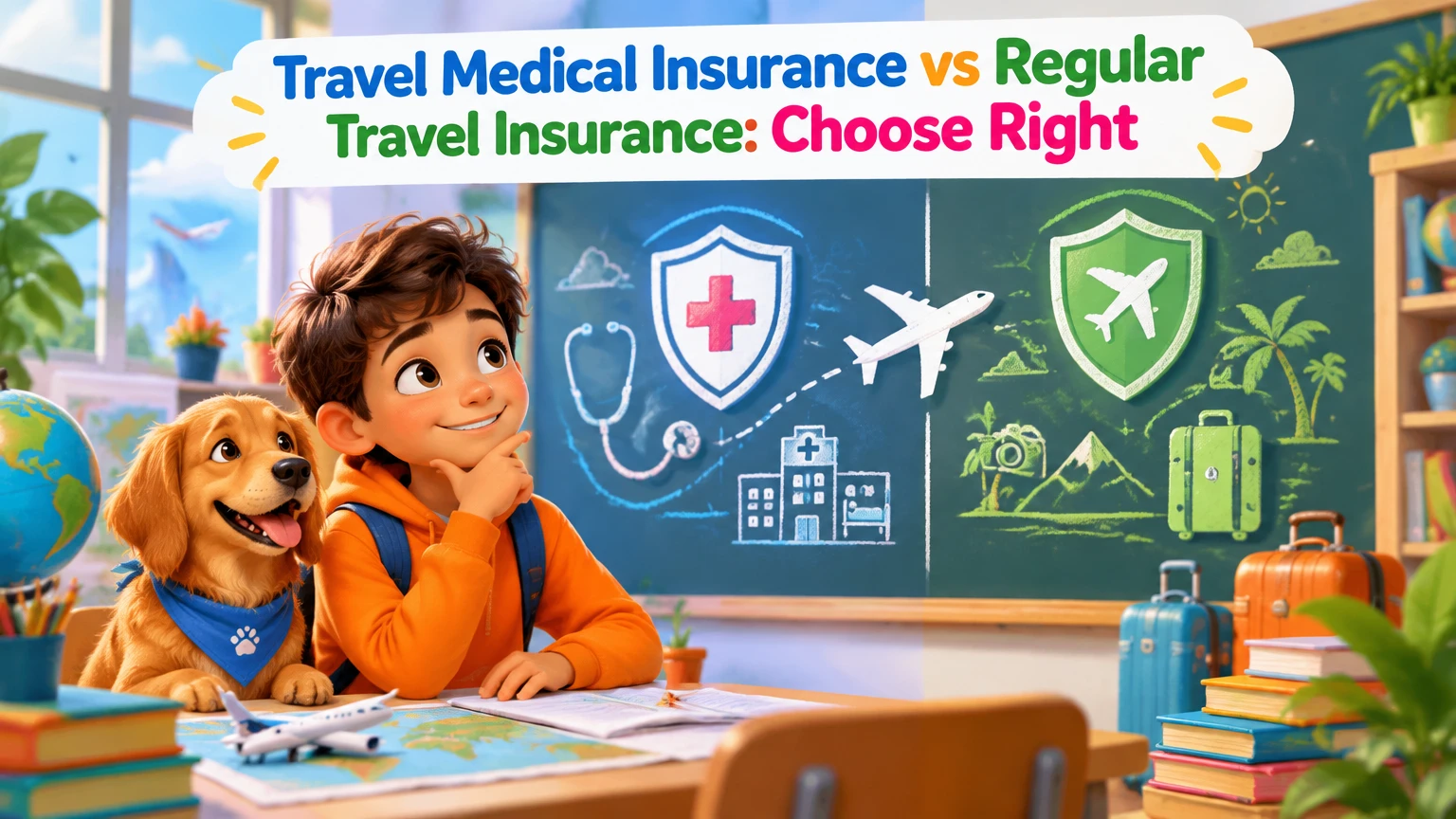
Travel Medical Insurance covers unexpected medical treatment, emergency evacuation, and related assistance abroad, while Regular Travel Insurance protects prepaid trip costs against covered cancellations, interruptions, delays, and baggage losses. Regular policies usually include medical benefits, but standalone medical plans generally devote more of their limits and price to healthcare rather than booking protection.
Key Facts at a Glance
- Travel Medical Insurance is designed primarily for emergency healthcare outside the traveler’s home country.
- Regular Travel Insurance, also called comprehensive trip insurance, protects non-refundable trip deposits and logistics.
- Trip cancellation is normally absent from medical-only policies and central to comprehensive policies.
- A policy’s medical limit is less important than its exclusions, deductible, primary or secondary status, and evacuation wording.
- Typical medical-only premiums are priced mainly by age, destination, duration, and limit; comprehensive premiums are strongly affected by insured trip cost.
- Neither policy automatically covers routine healthcare, elective treatment, every pre-existing condition, or every adventure activity.
What Is the Difference Between Travel Medical Insurance and Regular Travel Insurance?
Travel Medical Insurance is short-term international emergency health coverage. Regular Travel Insurance is a broader financial-protection package that may reimburse covered cancellation, interruption, delay, baggage, and emergency medical losses. The correct choice depends on whether the larger risk is a hospital bill or losing money committed to flights, hotels, tours, and cruises.
The distinction is about the policy’s center of gravity. A medical plan may have a high emergency medical limit and substantial evacuation benefit while offering no cancellation reimbursement. A comprehensive plan may reimburse up to the covered trip cost, but its medical limit can be materially lower than a specialized medical policy.
“Regular travel insurance” is not a standardized legal product name in every country. Insurers may call the broader version comprehensive travel insurance, trip protection, vacation insurance, or package travel insurance. The certificate of insurance, not the product label, controls a claim.
Master Comparison: Which Policy Covers What?
| Feature | Travel Medical Insurance | Regular Travel Insurance |
|---|---|---|
| Main purpose | Emergency healthcare abroad | Trip-cost and disruption protection |
| Cancellation benefit | Usually $0 | Commonly up to 100% of insured non-refundable cost |
| Emergency medical limit | Typical range: $50,000-$2 million | Typical range: $25,000-$250,000 |
| Medical evacuation limit | Typical range: $100,000-$1 million | Typical range: $50,000-$250,000 |
| Premium basis | Age, destination, duration, limit | Trip cost, age, destination, duration |
| Baggage benefit | Often $0 or limited | Commonly $500-$3,000, subject to item caps |
| Delay benefit | Often excluded | Commonly $100-$300 per day after a waiting period |
| Typical use | Backpacking or low-cost international travel | Expensive, prepaid, or complex vacations |
The ranges above are market-oriented planning figures, not guaranteed benefits. Policies vary by residence, insurer, destination, age, deductible, and underwriting rules. A $1 million evacuation headline may still exclude mountain rescue, non-emergency repatriation, or transport to the traveler’s preferred hospital.
How Does Travel Medical Insurance Work?
Travel Medical Insurance responds to an acute illness or injury during the covered travel period. The assistance company assesses the emergency, directs the traveler to an appropriate facility, and may arrange a guarantee of payment or later reimbursement, depending on the provider and treatment setting.
A typical medical claim follows this sequence:
- Seek emergency care. Call local emergency services when delay would threaten life or safety.
- Contact the assistance center. Use the 24-hour number on the insurance card as soon as practical.
- Confirm authorization. Ask whether the insurer requires preauthorization, particularly for admission, surgery, or evacuation.
- Keep evidence. Save medical reports, prescriptions, invoices, payment receipts, and transport records.
- Follow the claim process. Submit documents through the insurer’s portal, email, or claims address.
Guarantee of payment is not the same as automatic cashless treatment. Some hospitals require a deposit, some do not accept foreign insurers, and some emergency departments treat first and resolve billing later. Travelers should never delay life-saving care while waiting for an insurer’s approval.
What Does Travel Medical Insurance Usually Cover?
| Benefit | Typical covered event | Important limit or condition |
|---|---|---|
| Emergency treatment | Sudden illness or accidental injury | Must meet the policy’s emergency definition |
| Emergency dental | Acute pain or accidental tooth damage | Commonly capped at $500-$1,000 |
| Medical evacuation | Transport to a suitable medical facility | May not include transport home automatically |
| Repatriation of remains | Death during the insured trip | Requires coordination and documentation |
| Prescription medication | Medication required for a covered emergency | Routine refills commonly excluded |
| Hospital admission | Medically necessary inpatient treatment | Preauthorization may be required |
Travel medical coverage is not a replacement for ordinary health insurance. It generally does not pay for routine checkups, preventive care, elective procedures, long-term rehabilitation, or predictable treatment that could safely wait until the traveler returns home.
How Does Regular Travel Insurance Work?
Regular Travel Insurance reimburses specified financial losses caused by covered events. The traveler normally contacts airlines, hotels, tour companies, and cruise operators first, then claims only the non-refundable amount that remains after refunds, credits, or alternative arrangements.
A cancellation claim may require:
- the original itinerary and payment receipts;
- the insurer’s schedule of benefits;
- a physician’s statement for illness;
- a death certificate for a covered bereavement;
- airline or carrier documentation for a qualifying disruption;
- proof of refunds, credits, or denied reimbursement;
- evidence that the event occurred during the relevant policy period.
Comprehensive cover does not mean every reason is insured. Standard cancellation wording lists covered causes, such as a serious unforeseen illness, certain family emergencies, jury duty, or a carrier shutdown. Canceling because the traveler changed their mind normally does not qualify unless a valid Cancel For Any Reason endorsement applies.
What Benefits Are Usually Included?
| Benefit | Typical amount or rule | Claim trigger |
|---|---|---|
| Trip cancellation | Up to 100% of insured trip cost | Listed covered reason before departure |
| Trip interruption | Often 100%-150% of insured trip cost | Covered event after departure |
| Travel delay | $100-$300 per day, often after 3-12 hours | Covered carrier or travel disruption |
| Baggage loss | $500-$3,000 total | Carrier loss or covered theft |
| Baggage delay | $100-$500 | Delay beyond a stated period |
| Emergency medical | $25,000-$250,000 typical range | Covered illness or injury |
| Evacuation | $50,000-$250,000 typical range | Medical necessity and assistance approval |
Benefit limits often include sublimits. A $2,500 baggage limit might impose a $500 limit per item, while electronics may have a lower category cap. Travelers carrying cameras, laptops, or jewelry should check whether scheduled-item coverage or a separate policy is required.
Which Policy Offers Better Medical Protection?
Travel Medical Insurance usually offers stronger emergency medical and evacuation protection than Regular Travel Insurance. The specialized policy is usually preferable when the traveler’s main concern is hospitalization, especially in the United States, remote regions, or destinations where private treatment requires substantial deposits.
| Scenario | Medical-only planning priority | Comprehensive planning priority |
|---|---|---|
| United States hospital visit | $250,000-$1 million medical limit | At least $100,000 medical limit if available |
| Remote trekking | $500,000 or more evacuation benefit | Search-and-rescue wording plus evacuation |
| European city break | $100,000-$250,000 medical limit | Cancellation and interruption benefits |
| Cruise with prepaid excursions | Medical and maritime evacuation wording | Cancellation, missed connection, and interruption |
| Older traveler with conditions | Stability clause and waiver review | Medical benefits plus condition waiver |
| Ski or scooter trip | Activity endorsement | Activity endorsement and cancellation cover |
No universal minimum applies to every destination. A $50,000 limit may be adequate for some countries but inadequate for a prolonged hospital admission in the United States. The US Department of State warns travelers that overseas medical care may require payment and that evacuation can cost tens of thousands of dollars or more, depending on location and transport.
The best practical rule is to match the limit to the worst plausible event, not the average clinic visit. Emergency surgery, intensive care, air ambulance transport, and a companion’s travel can create separate costs.
Which Policy Protects Your Money Better?
Regular Travel Insurance is the clear choice when a large amount of prepaid, non-refundable money is at risk. Travel Medical Insurance generally cannot recover an unused hotel reservation, a canceled expedition deposit, or a non-refundable business-class airfare.
Consider a $6,000 trip with $4,800 already paid and only $1,000 refundable. A comprehensive policy may insure $4,800, subject to its covered reasons and terms. A $6,000 medical-only policy would normally provide no cancellation recovery, even if the traveler becomes ill before departure.
Trip interruption requires different calculations. The benefit may cover unused prepaid arrangements and reasonable additional transport, but it may not cover every change fee or luxury replacement. Travelers should read whether the policy uses “reasonable and necessary” expenses, fixed limits, or both.
How Much Does Each Type Cost?
Travel Medical Insurance commonly costs about $1.50-$5 per person per day for many international trips, while comprehensive travel insurance often costs about 4%-10% of the insured prepaid trip cost. Age, destination, duration, medical limits, deductible, and optional endorsements can move either figure substantially.
| Example traveler | Medical-only typical range | Comprehensive typical range |
|---|---|---|
| 30-year-old, 10-day trip, $1,500 bookings | $15-$60 | $60-$150 |
| 45-year-old, 17-day trip, $5,000 bookings | $30-$120 | $200-$500 |
| 70-year-old, 14-day trip, $6,000 bookings | $100-$350 | $500-$1,200 |
| Family of four, 14-day trip, $8,000 bookings | $80-$300 | $320-$800 |
| Annual medical plan | $100-$500 typical | Annual package varies widely |
These are planning ranges, not quotes. The same trip can produce different premiums because insurers apply different age bands, risk classifications, maximum-trip durations, and definitions of “insured trip cost.”
A medical-only premium usually does not rise in direct proportion to the price of airfare or hotels. A comprehensive premium often does, because cancellation and interruption exposure is tied to the declared trip value.
Is Primary or Secondary Medical Coverage Better?
Primary travel medical coverage usually pays eligible medical claims without requiring the traveler to submit first to domestic health insurance. Secondary coverage generally requires another applicable insurer to process the claim first, after which the travel policy may pay eligible remaining costs.
Primary coverage can reduce coordination delays and protect travelers whose domestic plan excludes international care. Secondary coverage may cost less, but it can create additional paperwork and may interact with employer plans, Medicare, Medicaid, national health systems, or other travel policies.
Primary does not mean unlimited or automatic. The claim still must satisfy medical necessity, eligibility, exclusions, authorization, and documentation requirements. A primary policy can deny an excluded scooter injury just as a secondary policy can.
When Should You Buy Travel Insurance?
Buy Regular Travel Insurance soon after the first trip payment if you want time-sensitive benefits such as a pre-existing-condition waiver or Cancel For Any Reason. Many insurers impose a purchase window of about 14-21 days, but the exact deadline is policy-specific and may begin on the initial deposit date rather than the final payment date.
Travel Medical Insurance may remain available until shortly before departure, but late purchase does not retroactively cover symptoms, known events, or losses that began before the effective date. The policy must be active when the covered event occurs.
What Is CFAR Coverage?
Cancel For Any Reason coverage can reimburse part of a trip cost when the reason is not listed in standard cancellation wording. CFAR commonly reimburses 50%-75% of eligible non-refundable costs, usually requires purchase within a short initial-deposit window, and often requires cancellation at least 48-72 hours before departure.
CFAR is expensive and imperfect. It may increase the premium by roughly 40%-100%, require coverage of the full eligible trip cost, and exclude taxes, credits, or late cancellations. It is useful when the traveler values flexibility more than maximum reimbursement.
What Exclusions Cause the Most Claim Problems?
The most common claim failures involve known conditions, unsupported cancellation reasons, unapproved evacuation, intoxication, excluded activities, and missing evidence. A high policy limit does not overcome an exclusion.
Pre-existing medical conditions
Many policies exclude conditions that existed, changed, or were treated during a look-back period, often 60-180 days. A waiver may restore some coverage if the traveler buys promptly, insures the full trip cost, and meets stability requirements.
“Stable” may mean no new diagnosis, medication change, treatment change, or worsening symptoms during the stated period. Travelers should request written clarification for cancer, cardiac conditions, diabetes complications, pregnancy, and recent hospitalization.
Scooters and adventure sports
Motorized two-wheelers, skiing, scuba diving, climbing, zip-lining, and trekking above a stated altitude may require an activity endorsement. A valid motorcycle license, helmet, passenger status, engine-size limit, and local-law compliance may all affect eligibility.
A policy that covers a beach vacation does not necessarily cover a rented scooter in Thailand or a high-altitude trek in Nepal.
Alcohol and illegal activity
Many policies exclude losses occurring while the traveler is intoxicated or participating in illegal activity. The wording may rely on local law, medical records, or the insurer’s assessment of causation, so travelers should not assume that a minor drinking-related detail is irrelevant.
Evacuation destination
Medical evacuation often means transport to the nearest suitable facility, not repatriation to the traveler’s home city. Some plans cover repatriation only after stabilization, while others cover transport to the home country when medically necessary and approved.
Are Annual Policies Better Than Single-Trip Policies?
Annual multi-trip policies can be economical for frequent travelers, but they usually limit each trip to 30, 45, or 60 days and may provide less trip-cancellation protection than a single-trip comprehensive plan. Single-trip coverage is more flexible for one expensive vacation or a longer journey.
| Policy type | Trip limit | Best fit | Common limitation |
|---|---|---|---|
| Single-trip medical | Policy-defined trip dates | One international journey | No cover outside listed dates |
| Annual multi-trip medical | 30-60 days per trip | Three or more trips yearly | Each journey has a duration cap |
| Single-trip comprehensive | One booked itinerary | Cruise, tour, expensive vacation | Premium tied to trip cost |
| Annual comprehensive | Varies by insurer | Frequent business travelers | Cancellation limits may be per trip |
| Student or long-stay plan | 3-12 months | Study abroad or extended travel | Different visa and healthcare rules |
Annual cover does not necessarily mean unlimited medical treatment, unlimited evacuation, or unlimited cancellation protection. Read the maximum duration per journey and whether the policy requires a return to the home country between trips.
Is Travel Medical Insurance Enough for Students, Expats, or Digital Nomads?
Travel Medical Insurance is often inadequate for people living abroad for months because it is built around acute emergencies rather than continuous healthcare. Students and expatriates commonly need routine consultations, prescription management, mental-health support, preventive care, and chronic-condition treatment.
International Private Medical Insurance, commonly called IPMI, is designed for longer-term residence and may include outpatient treatment, maternity, specialist care, and regional or worldwide provider access. IPMI costs more and may impose underwriting, waiting periods, area-of-cover restrictions, or exclusions.
Digital nomads should also verify coverage for repeated one-way travel, remote work, equipment, liability, and uninterrupted residence outside the home country. A policy written for a 30-day vacation can fail when the traveler remains abroad for six months.
Does Credit-Card Travel Insurance Replace a Policy?
Credit-card travel insurance rarely replaces a carefully selected medical policy for international travel. Card benefits may cover trip delay, baggage, rental vehicles, or cancellation, but medical limits, evacuation benefits, activation rules, and covered reasons can be narrow.
Check these conditions before relying on a card:
- Whether the entire fare or only part of the fare must be paid with the card.
- Whether coverage applies to family members and authorized travelers.
- Whether medical benefits are primary or secondary.
- The medical and evacuation dollar limits.
- Whether cancellation is limited to named causes.
- Whether the card excludes pre-existing conditions or adventure activities.
- Whether claims require receipts, carrier notices, or a specific reporting deadline.
A credit card can complement a medical plan. It should not be treated as sufficient merely because the card advertises “travel protection.”
Which Policy Should You Choose?
Choose Travel Medical Insurance for a budget trip
Choose standalone medical cover when flights and accommodation are inexpensive, refundable, or financially replaceable, but a hospital or evacuation bill would be unaffordable. Backpackers, independent travelers, and travelers visiting countries with low booking exposure often fit this profile.
Prioritize emergency medical, evacuation, repatriation wording, primary claims handling, and activity coverage. Baggage cover may be less important if valuable electronics already have separate protection.
Choose Regular Travel Insurance for an expensive vacation
Choose comprehensive cover when a cruise, tour, honeymoon, safari, or family vacation contains substantial non-refundable deposits. The cancellation and interruption benefits can protect more money than a higher medical limit would protect in an ordinary city trip.
Check supplier default, missed-connection, quarantine, hurricane, and emergency-return provisions. A policy should cover the actual prepaid cost rather than an artificially low amount.
Consider both for the United States or remote travel
Some travelers need comprehensive trip protection and unusually high medical or evacuation limits. A package policy with weak medical benefits may be supplemented by a separate medical plan, but travelers must confirm whether duplicate insurance coordinates benefits or creates conflicting claim procedures.
Choose IPMI for long-term residence
Choose international health insurance when the trip involves study, employment, relocation, or extended residence. Routine care and chronic-condition management are the deciding needs, not simply the length of the flight.
Senior travelers need wording, not only high limits
Travelers over 65 should compare stability clauses, medication changes, age bands, medical questionnaires, emergency dental limits, and direct-payment arrangements. A lower-cost plan with a restrictive pre-existing-condition definition may provide less usable protection than a more expensive plan with a clear waiver.
A Practical Policy-Selection Method
Use the following sequence before purchasing:
- Calculate irrecoverable trip money. Include deposits, airfare, tours, cruises, and prepaid transport after expected refunds.
- Identify the worst medical event. Consider destination costs, remote access, activities, age, and known conditions.
- Set medical and evacuation limits. Use higher limits for the United States, remote travel, and adventure activities.
- Check payment status. Confirm primary or secondary medical coverage and direct-billing procedures.
- Read exclusions. Search the certificate for “pre-existing,” “motorized,” “intoxication,” “reasonable care,” “evacuation,” and “unstable.”
- Confirm deadlines. Record the first deposit date and purchase windows for waivers or CFAR.
- Verify supplier remedies. Insurance generally pays remaining eligible losses, not amounts already refunded by a carrier.
- Save the policy and assistance number offline. Internet access may fail during an emergency.
An expert rule of thumb is to insure only money that would materially affect the trip decision. Do not inflate the insured trip cost to include refundable bookings, because premiums may rise without increasing the recoverable loss.
Common Mistakes and Better Fixes
| Mistake | Likely consequence | Better action |
|---|---|---|
| Buying medical-only cover for a $12,000 cruise | No cancellation reimbursement | Insure the non-refundable cruise and flights |
| Choosing a $25,000 medical limit for US travel | Large hospital balance remains | Compare limits of $250,000 or more |
| Assuming evacuation means flying home | Transport ends at nearest suitable facility | Read destination and repatriation wording |
| Waiting until symptoms appear | Known condition or event exclusion | Buy after the first deposit |
| Ignoring scooter exclusions | Injury claim denied | Add an activity endorsement and meet licensing rules |
| Relying on card protection without checking activation | Claim fails for payment-method reasons | Read the guide to benefits before departure |
Frequently Asked Questions
Does travel medical insurance cover trip cancellation?
Travel Medical Insurance usually does not cover trip cancellation because its purpose is emergency healthcare during travel. Some medical products may include limited interruption or return benefits, but travelers seeking reimbursement for non-refundable bookings generally need comprehensive trip insurance with a covered cancellation reason or CFAR endorsement.
Can I buy travel medical insurance after booking my trip?
Yes, many standalone medical policies can be purchased after booking and shortly before departure, subject to the insurer’s cutoff. Buying later does not cover a known illness, existing dispute, previously canceled flight, or event that began before the policy effective date.
Does Medicare cover medical treatment outside the United States?
Original Medicare generally provides very limited foreign-travel coverage, with narrow exceptions and geographic conditions. Medicare Advantage policies differ. Travelers should check their plan documents and consider international medical coverage rather than assuming domestic benefits will pay overseas claims.
Do I need travel insurance for a domestic trip?
Domestic travelers may still benefit from cancellation, interruption, delay, and baggage coverage, particularly when prepaid costs are high. Travel Medical Insurance is less useful when the traveler’s domestic health plan has adequate in-network or emergency coverage at the destination.
What deductible should I choose?
A $0 deductible reduces the traveler’s cost at claim time but usually increases the premium. A $250-$500 deductible can reduce the premium for travelers able to absorb smaller bills, provided the deductible applies separately to medical, baggage, and other benefits rather than once per policy.
Will travel insurance cover a missed cruise departure?
Coverage may apply when a covered carrier delay, severe weather event, or other listed cause prevents timely arrival. Policies commonly exclude a missed departure caused by the traveler’s late departure from home or insufficient connection time, so cruise travelers should check the minimum connection and delay provisions.
The Bottom Line
Travel Medical Insurance is the better fit when emergency treatment and evacuation create the largest financial danger. Regular Travel Insurance is the better fit when non-refundable bookings, cancellation, interruption, baggage, and delays represent the larger exposure. For an expensive international trip, especially to the United States or a remote destination, travelers may need comprehensive trip protection with strong medical benefits rather than choosing on price alone.
The right decision in Travel Medical Insurance vs Regular Travel Insurance comes from comparing the policy certificate’s limits, exclusions, payment order, deadlines, and covered causes against the actual trip. A low premium is useful only when the policy responds to the event most likely to damage the traveler financially.
Rimon · Travel With Rimon
More articles by this author →