How to Travel With a Dog on a Plane Safely
How to travel with a dog on a plane means choosing an eligible airline and transport method, reserving the dog’s space, completing veterinary and destination paperwork, and preparing a compliant carrier. Small dogs usually travel under the seat in the cabin, while larger dogs may require airline cargo or a specialized pet shipper.
Key Facts / Quick Answer
Reserve the dog with the airline after confirming pet capacity, because a purchased passenger ticket does not create a pet reservation.
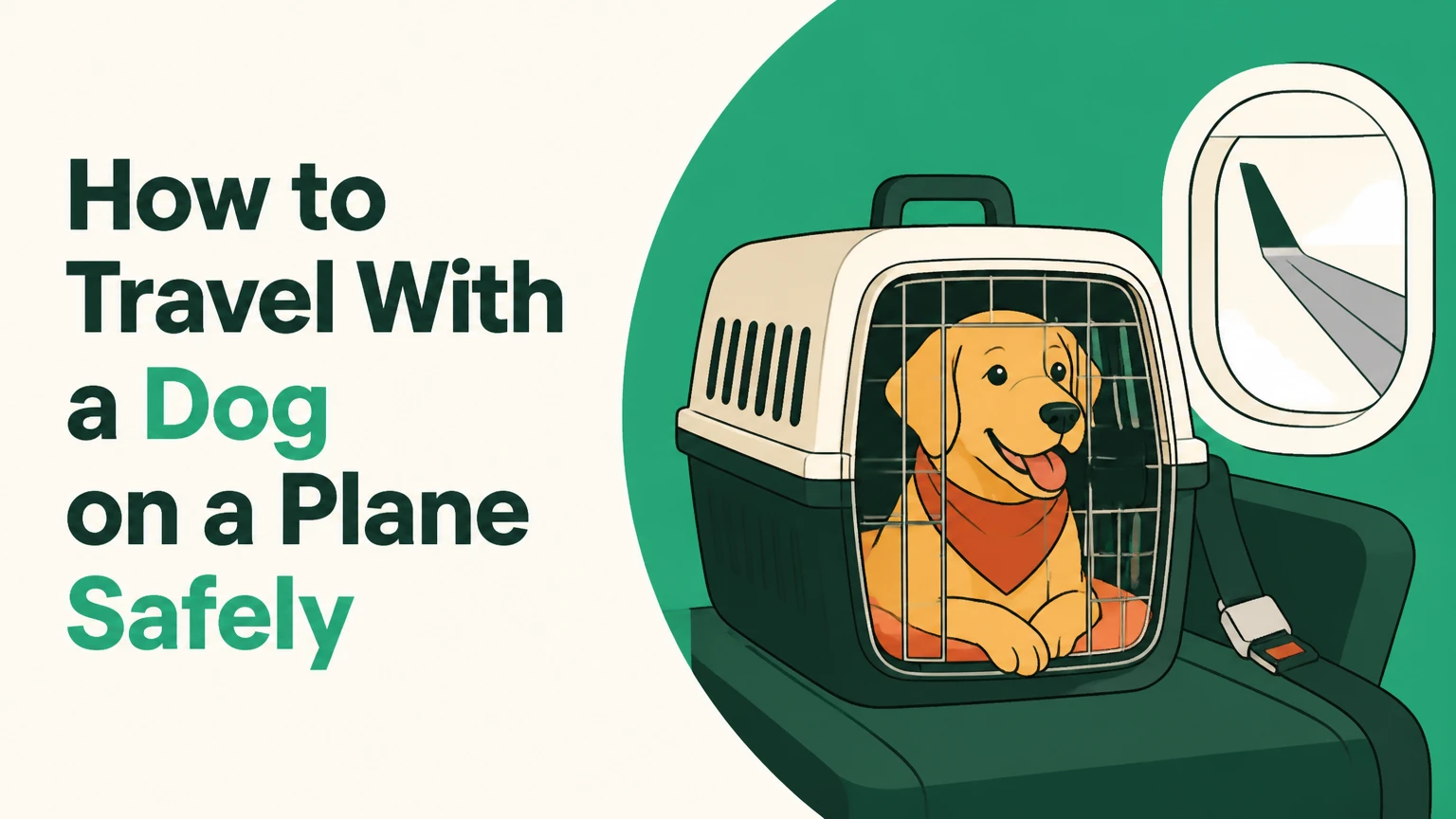
Cabin travel usually requires a dog and carrier that fit beneath the seat; typical combined limits are about 20 pounds, but dimensions matter more than weight.
A dog must remain secured in its carrier during the flight, and cabin pets normally require counter check-in and separate pet fees.
Typical one-way costs range from $95-$150 for cabin travel and $200-$500 or more for cargo, excluding veterinary, crate, and ground-transport expenses.
International routes can require microchips, rabies timing, health certificates, import permits, laboratory tests, and quarantine.
Avoid air travel for a medically unstable, heat-sensitive, or severely anxious dog unless a veterinarian and the carrier provide a safer plan.
What Does Flying With a Dog Involve?
Flying with a dog involves a chain of airline, veterinary, security, and destination controls rather than a single booking. The airline determines whether the dog travels in the cabin, an aircraft hold, or manifest cargo; government agencies determine whether the animal can legally enter the destination.
The dog’s size, breed, health, age, behavior, route, season, and connection schedule all affect the decision. A policy that permits pets generally may still reject a particular aircraft, route, carrier size, or breed.
For United States departures, airline rules operate alongside requirements from the Transportation Security Administration, the United States Department of Agriculture Animal and Plant Health Inspection Service, and the destination state or country. International travelers must check both outbound and return requirements because a dog can meet entry rules in one direction and fail re-entry rules later.
The five-part travel sequence
- Check eligibility: Compare airlines, aircraft, route restrictions, dog age, breed limitations, and carrier dimensions.
- Confirm the pet space: Contact the airline before relying on the passenger reservation. Ask for written confirmation or a pet reservation number.
- Complete veterinary work: Schedule vaccinations, examinations, microchipping, laboratory tests, and certificates according to the destination’s deadlines.
- Prepare the dog and carrier: Crate train gradually, measure the dog, label the carrier, and rehearse airport handling.
- Complete airport and arrival procedures: Use the relief area, check in with an agent, pass security correctly, and collect or clear the dog at the destination.
Which Air-Travel Option Fits Your Dog?
The best transport option depends on whether the dog fits safely under the seat, whether the airline accepts the breed and route, and whether the dog can tolerate confinement. Cabin travel generally provides the greatest owner oversight, while cargo may be the only commercial option for a large dog but carries more handling and temperature-management concerns.
| Transport method | Typical eligibility | Typical one-way price | Main limitation | Suitable situation |
|---|---|---|---|---|
| In-cabin pet | Dog and carrier fit under seat; often about 20 pounds combined | $95-$150 | Carrier remains under seat throughout flight | Small, calm dog on an approved route |
| Accompanied checked pet | Airline accepts live animals and dog fits an airline crate | $200-$500+ | Seasonal, aircraft, breed, and temperature restrictions | Larger dog traveling with owner |
| Manifest cargo | Unaccompanied dog or route requiring cargo booking | $200-$1,000+ including handling, typical range | Separate cargo process and stricter paperwork | International relocation or unsupported passenger route |
| Service dog | Individually trained task-performing service dog | Usually no pet fee | Documentation and behavior requirements still apply | Disability-related assistance |
| Emotional support animal | Usually treated as a standard pet | Standard pet fee | ESA status alone rarely creates cabin access | Only when the dog meets ordinary pet rules |
Airline terminology is inconsistent. “Cargo” can mean an airline’s specialized live-animal service or a hold associated with checked baggage, so ask who accepts the dog, where the dog is transferred, and who handles delays.
Service dogs have a separate legal category from pets. In the United States, the Air Carrier Access Act covers trained service dogs that perform work or tasks for a person with a disability. Emotional support animals do not automatically receive the same treatment, and airlines commonly apply standard pet rules to them.
How Do You Book a Dog’s Flight?
Booking a dog’s flight requires confirming pet availability before finalizing an itinerary that cannot accommodate the animal. Many airlines limit cabin pets by flight, aircraft, class, and destination, with typical cabin caps of two to six animals.
Use this airline verification script:
- Does this exact flight and aircraft accept dogs in the cabin or hold?
- Is the dog reservation confirmed, and what is its reference number?
- What are the maximum carrier dimensions and combined dog-carrier weight?
- Are there breed, age, temperature, or seasonal restrictions?
- What documents must be presented at departure and arrival?
- Does a connection require reclaiming and rechecking the dog?
- What happens if the flight changes, diverts, or is canceled?
Book the simplest itinerary available. A nonstop flight removes one transfer, one loading cycle, one opportunity for a misrouted carrier, and one period of uncertainty during a connection. If a connection is unavoidable, select a generous legal connection window and verify whether the airline accepts pets on every segment.
A passenger ticket does not guarantee a pet position. The pet reservation is a separate inventory item, and a reservation can disappear after an aircraft swap. Reconfirm the dog’s acceptance after any schedule, aircraft, or seat change.
What happens at the airport?
Airport check-in for a cabin dog normally occurs at the staffed counter rather than entirely online. The agent checks the reservation, carrier, documents, and sometimes the dog’s condition before issuing boarding documents.
Arrive about two to four hours before departure, using the airline’s stated minimum as the floor rather than the target. Before entering the terminal, give the dog a calm relief opportunity and avoid a large meal immediately before departure.
At a United States Transportation Security Administration checkpoint, remove the dog from the carrier before the carrier enters the X-ray machine. The dog may be carried or led through the metal detector, but never send the dog through the X-ray unit. A private screening room is available if the dog is frightened or likely to escape.
After security, the dog returns to the secured carrier. Cabin animals normally remain inside it at the gate, during boarding, in flight, and during disembarkation.
How Should You Choose and Train the Carrier?
A compliant carrier must allow the dog to remain in a natural position as required by the airline, fit within the aircraft’s under-seat space for cabin travel, and provide ventilation, leak protection, and secure closures. For hold transport, use the airline’s stated hard-sided or IATA-compatible specifications rather than assuming a retail crate is acceptable.
| Carrier factor | Cabin travel requirement | Hold or cargo requirement | Practical check |
|---|---|---|---|
| Maximum size | Airline-specific under-seat dimensions, often about 18 x 11 x 11 inches | Airline crate dimensions based on dog measurements | Measure the assigned aircraft, not only the website average |
| Dog posture | Dog can turn, lie down, and remain contained | Dog can stand, turn, sit, and lie naturally | Measure nose to tail base and floor to head or ear |
| Ventilation | Multiple mesh panels with secure zippers | Ventilation on several sides with protected openings | Ensure airflow remains open when handled |
| Base | Waterproof, leak-resistant floor | Absorbent bedding over a leak-resistant floor | Use a thin, familiar pad that cannot bunch |
| Security | Closed zippers and escape-resistant structure | Metal fasteners and crate hardware specified by airline | Never rely on a clip or improvised tie |
Carrier training should begin at least four to six weeks before departure, and longer for an anxious dog. Feed meals near the carrier, then inside it with the door open, then practice short closed-door intervals before adding car rides and airport-like noise.
Do not choose a carrier solely by the dog’s weight. A long-backed 15-pound dog may need more floor area than a compact 20-pound dog, while an airline may reject a carrier that exceeds the under-seat envelope even when the dog fits comfortably.
Expert insight: The most common carrier failure occurs at the aircraft seat, not the ticket counter. A soft carrier that passes the airport’s measurement frame can still fail when the seat’s power box reduces usable height, so ask the airline about the specific aircraft and select a flexible top only when its policy permits one.
How Much Does Flying With a Dog Cost?
Flying with a dog commonly costs $250-$900 for a domestic trip when the owner includes the pet fee, compliant carrier, veterinary visit, food, ground transport, and possible airport relief or boarding expenses. International relocation can exceed $1,000 because laboratory tests, permits, customs handling, and professional transport may be required.
| Expense | Cabin dog, typical USD | Cargo dog, typical USD | Cost driver |
|---|---|---|---|
| Airline pet charge | $95-$150 | $200-$500+ | Route, airline, carrier size, and service |
| Carrier or crate | $40-$150 | $100-$250 | Soft cabin carrier versus hard travel crate |
| Veterinary examination | $50-$150 | $50-$200 | Examination, vaccines, and certificate |
| Rabies or other vaccine | $20-$60 per dose | $20-$60 per dose | Local clinic pricing and vaccine status |
| International testing or permit | $0 domestic | $100-$600+ | Rabies titer, import permit, laboratory, destination |
| Ground transport | $0-$150 | $50-$500+ | Airport transfer or cargo-terminal handling |
Airline fees are usually charged per direction, not per entire itinerary. A connection may involve one pet fee on a single ticket, but a separately ticketed segment can create a second reservation and a second charge.
Budget for a compliant certificate even when an airline agent does not request it at check-in. A destination authority can still require the document, and a missing certificate can cause refusal, quarantine, return shipment, or expensive delay.
Expert insight: Cabin travel looks cheaper because its headline fee is visible, but cargo travel often adds crate construction, terminal transport, customs brokerage, and arrival handling. Compare the complete door-to-door cost, not the pet fee alone.
What Health and Entry Documents Does a Dog Need?
A dog’s required documents depend on the departure jurisdiction, destination, transit countries, vaccination history, and travel date. Domestic flights may require an airline-accepted health certificate, while international travel can require a microchip, rabies vaccination, certificate endorsement, import permit, parasite treatment, and a rabies antibody test.
| Document or condition | Typical timing | Common authority | Why it matters |
|---|---|---|---|
| Microchip | Before qualifying rabies vaccination | Destination authority | Links the identity to the vaccination record |
| Rabies vaccination | Often weeks before arrival | Licensed veterinarian | Destination may reject an improperly timed dose |
| Health examination | Often within 10 days of entry or travel | Licensed veterinarian | Confirms fitness and records clinical findings |
| USDA-endorsed certificate | Destination-specific deadline | USDA APHIS | Required for many international departures from the USA |
| Rabies titer test | Often 30 days to several months before entry | Approved laboratory | Some countries use antibody results and waiting periods |
| Import permit | Before departure when required | Destination government | Authorizes entry before the dog travels |
The United States Department of Agriculture Animal and Plant Health Inspection Service states, “It is the responsibility of the pet owner to meet all entry requirements of the destination country.” That rule has a practical consequence: an airline employee cannot replace the destination authority’s approval.
Start international research at least six months ahead when the destination may require a titer test or waiting period. Japan, the United Kingdom, Australia, New Zealand, Hawaii, and several island jurisdictions can impose sequencing rules that make last-minute travel impossible.
Confirm the rules directly with the destination’s agriculture or veterinary authority and USDA APHIS, then ask the veterinarian which forms must be issued, signed, or digitally endorsed. A generic certificate from a clinic may not satisfy a country-specific form.
When Should You Avoid Flying With a Dog?
Avoid flying when a veterinarian identifies unstable heart or lung disease, severe anxiety, recent surgery, uncontrolled seizures, dehydration risk, or another condition that could worsen with confinement and cabin pressure. Avoid hold transport for many brachycephalic dogs because short muzzles can impair heat release and breathing under stress.
| Dog factor | Cabin concern | Cargo concern | Better decision |
|---|---|---|---|
| Brachycephalic anatomy | Limited airline acceptance | Higher respiratory and heat risk | Ground travel or specialist relocation |
| Puppy under airline minimum age | Vaccination and stress exposure | Immature temperature regulation | Delay travel or use a qualified alternative |
| Senior dog | Arthritis, anxiety, medication timing | Greater recovery and handling burden | Veterinary assessment and cabin preference |
| Chronic disease | Access to care during flight is limited | Observation and treatment are less immediate | Do not fly until the condition is stable |
| Severe fear or escape behavior | Panic in carrier or terminal | Risk of injury during handling | Behavior plan, ground travel, or boarding |
The American Veterinary Medical Association advises against sedating or tranquilizing pets for air travel because altered balance, breathing, and cardiovascular response can create additional risk. A veterinarian may prescribe a tested anxiety-management plan in selected cases, but never administer an untested medication for the first time at the airport.
Airlines can prohibit breeds or individual dogs even when a government rule permits them. Ask for the current policy by breed and route, and disclose a snub nose, airway surgery, or relevant medical history rather than relying on a general breed label.
Expert insight: “Cargo” is not one uniform risk category. A temperature-controlled, pressurized hold on a nonstop route differs materially from a cargo-terminal transfer during a heat advisory, but the owner must verify the complete handling chain because the highest risk may occur on the ground.
How Do Weather, Meals, and Connections Change the Plan?
Weather changes whether an airline will accept a dog, especially for hold transport, because the animal may spend time outside the aircraft during loading or unloading. Choose moderate departure and arrival temperatures, avoid exposed tarmac periods, and confirm seasonal embargoes several days before departure.
| Planning variable | Cabin recommendation | Cargo recommendation | Reason |
|---|---|---|---|
| Extreme heat | Use climate-controlled terminal routes | Avoid or reschedule when possible | Ground exposure can exceed aircraft hold conditions |
| Extreme cold | Limit terminal waiting | Verify airline temperature thresholds | Loading and unloading can expose the crate |
| Meal timing | Small familiar meal about 4-6 hours before flight | Follow veterinarian and airline instructions | Reduces vomiting without prolonged fasting |
| Water | Offer normally before travel | Use an airline-approved attached dish | Dehydration and spills both create problems |
| Connection | Prefer nonstop | Avoid tight or multi-airline transfers | Each transfer adds handling and delay risk |
Do not deliberately dehydrate a dog to prevent accidents. Offer normal access before departure, use absorbent bedding, and follow the airline’s water-dish requirements. Avoid new treats, rich food, and unfamiliar supplements on travel day.
A missed connection requires a prearranged response. Ask the airline where the dog will be held, who provides water and feeding, whether the dog remains on the original aircraft, and how you will be reunited if the passenger and dog are separated.
What Should You Pack and Do After Landing?
A dog travel kit should contain identification, documents, cleaning supplies, food, water equipment, medication, and a leash that can be attached before the carrier opens. After landing, take the dog directly to a quiet relief area, offer water, inspect paws and breathing, and delay a large meal until the dog settles.
Pack these items in your carry-on or crate documentation pouch:
- Printed health certificate, vaccination record, import permit, and airline reservation
- Two identification tags, microchip details, and destination contact information
- Leash, harness, spare collar, waste bags, absorbent pads, and cleaning wipes
- Familiar food portioned for 24 hours, collapsible bowl, and approved medication
- Recent photograph of the dog and a second copy of the owner’s itinerary
- Emergency veterinarian information for the destination
Never open a cabin carrier in a public terminal unless airport staff directs you to a secure area. At the destination, attach the leash before opening the carrier and use a quiet enclosed space when possible.
For cargo arrival, inspect the dog before leaving the collection point. Record unusual breathing, weakness, vomiting, bleeding, heat stress, or injuries, and seek veterinary care immediately when symptoms persist or appear severe.
When Is Flying the Wrong Choice?
Flying is often the wrong choice when a road journey is practical, the dog is medically fragile, the destination lacks pet housing, or the trip is short enough that boarding creates less disruption. A sitter or boarding facility eliminates aviation exposure, although separation and care quality remain trade-offs.
| Option | Typical travel duration | Typical dog-size access | Typical cost pattern | Best use |
|---|---|---|---|---|
| Commercial flight | 3-12 hours door to door | Small cabin dogs, selected larger dogs | $250-$900 domestic total | Cross-country move or urgent distance |
| Private car | 6-24 hours per travel day | Almost any safely restrained dog | Fuel, lodging, and meals | Domestic route with flexible stops |
| Train | 2-20 hours | Often small pets only | Ticket plus pet fee | Short regional journey |
| Pet sitter | No transport time | Any dog | $30-$100 per day, typical | Vacation without a pet-friendly destination |
| Boarding facility | No transport time | Any dog meeting facility rules | $35-$100 per night, typical | Structured care during travel |
For domestic distances under roughly 10-12 driving hours, a car can be less stressful because the dog controls the pace, receives regular breaks, and avoids airport handling. Use a crash-tested harness or secured crate, never an unrestrained lap position.
The destination also matters. Confirm pet-friendly lodging, local leash rules, emergency veterinary access, and transportation from the airport before booking the flight. A technically successful flight can still fail if the dog has nowhere safe to decompress.
Frequently Asked Questions About How to travel with a dog on a plane
Can a dog fly in the cabin without a service-animal designation?
A dog can fly in the cabin as a pet when the airline permits pets, the dog and carrier meet its size rules, and the owner pays the applicable fee. Calling the dog an emotional support animal does not generally bypass ordinary pet limits or carrier requirements.
Can a puppy fly on a commercial airplane?
A puppy can fly only when its age, vaccination status, health certificate, and destination rules meet the airline and government requirements. Many airlines set a minimum age around eight weeks, while international destinations may require a longer rabies and waiting-period sequence.
Is cargo safe for a large dog?
Cargo safety depends on the dog’s anatomy and health, the crate, weather, route, ground handling, and airline procedures. A healthy, non-brachycephalic dog on a nonstop route may be accepted, but owners should choose ground travel when practical and avoid cargo during temperature extremes.
What if the airline loses or delays my dog?
If a dog is delayed, contact the airline’s baggage or cargo team immediately, request the location and handling status, and document every reference number. Do not leave the airport until staff explains the recovery plan, feeding and watering arrangements, and the procedure for veterinary evaluation.
Can I give my dog Benadryl or a prescription sedative before flying?
Do not give a sedative, antihistamine, or calming product solely because a flight is approaching without veterinary direction. Medication can change breathing, blood pressure, balance, and temperature regulation. A veterinarian should decide whether medication is appropriate and supervise a trial before travel.
How early should international dog travel preparation begin?
Begin international preparation six months before departure when the destination may require a rabies titer, import permit, or extended waiting period. Confirm the exact certificate window shortly before travel because a health certificate issued too early or too late can invalidate an otherwise complete file.
Final Pre-Booking Decision
How to travel with a dog on a plane safely starts with a go or no-go assessment, not a ticket purchase. Confirm the route, aircraft, pet reservation, carrier dimensions, veterinary timeline, weather, total budget, and destination entry process before committing.
For a small, healthy, calm dog, nonstop cabin travel is usually the simplest commercial option. For a large or medically vulnerable dog, compare a secured car journey, professional relocation service, or high-quality boarding before accepting cargo risk. A carrier confirmation number and complete paperwork are more valuable than an inexpensive fare.