How to Return a Rental Car After Hours Safely
How to return a rental car after hours depends on the branch’s approved key-drop or automated-return process. Confirm permission, park only in the designated area, record mileage and fuel or charge, photograph the vehicle and location, lock every door, and deposit the keys exactly as instructed. The rental company usually completes its inspection when the branch reopens.
Key Facts / Quick Answer
After-hours return is permitted only when the specific branch provides a key drop, kiosk, or automated return system.
The rental company may treat the vehicle as your responsibility until an employee checks it in, even if you deposited the keys.
Typical after-hours documentation takes 5-10 minutes: photograph all sides, the odometer, fuel or charge level, and the parked location.
A 29-minute grace period is common in rental contracts, but it is not universal and may not protect a late return.
Final charges commonly appear within 24-48 hours after inspection; card authorization holds can remain for 3-10 business days.
Never place keys in an unmarked box or leave a vehicle where the branch has not authorized parking.
How Does an After-Hours Rental Return Work?
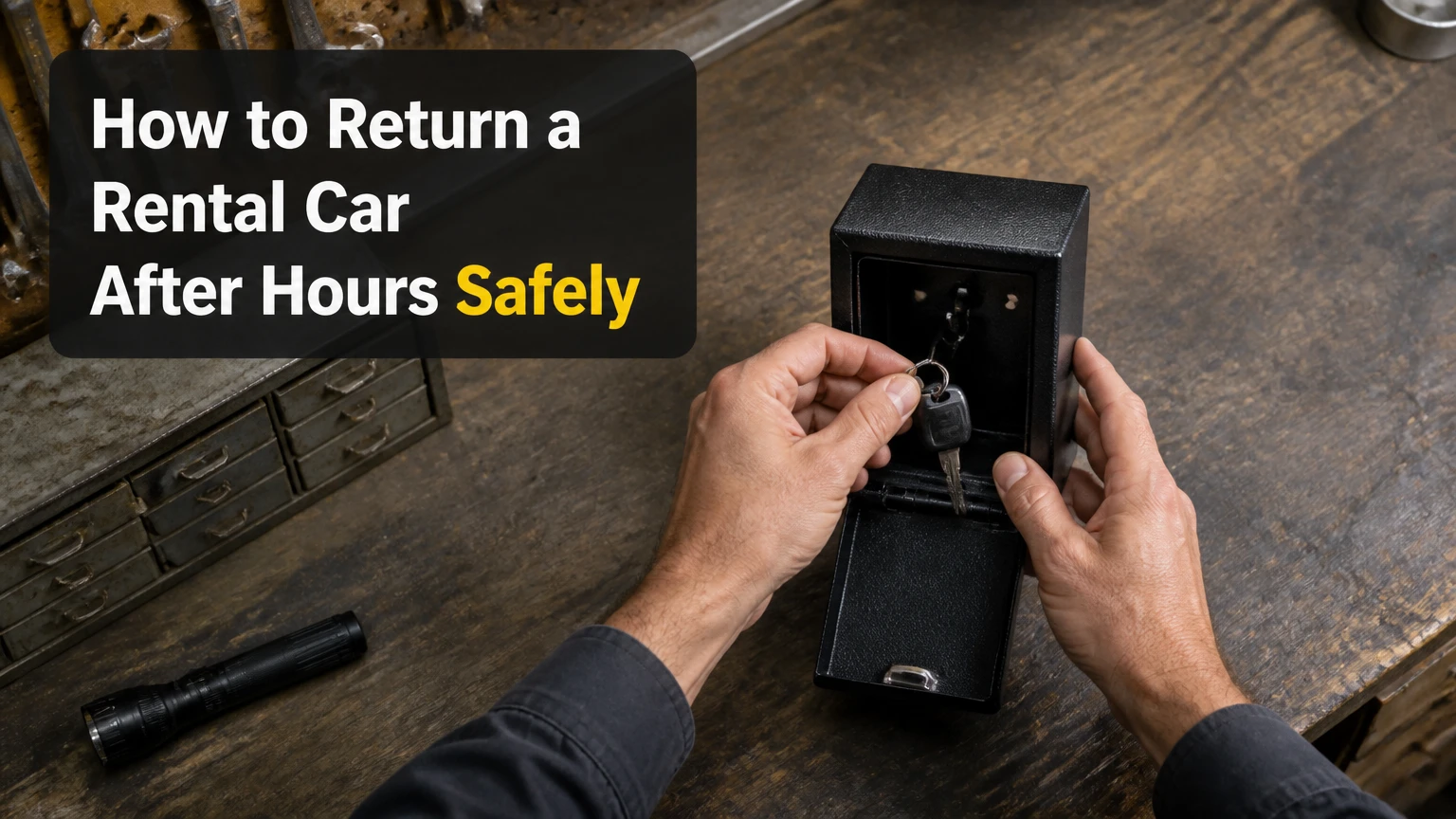
An after-hours rental return transfers the vehicle to the company’s custody process without an employee completing an immediate inspection. The renter parks in an approved space, documents the vehicle’s condition, secures the car, and places the keys in a designated locked receptacle or automated device.
The exact sequence differs between an airport garage, neighborhood branch, hotel desk, and independent franchise. A key box may be beside the counter, inside a return lane, or near a garage exit. Some locations require a rental agreement number on an envelope, while others connect the key electronically to the reservation.
The return time has two meanings. Your photographs and key-deposit record establish when you attempted to return the vehicle, but the company’s contract may define liability as ending only when staff accepts or inspects it. Read the rental agreement rather than assuming the key-drop timestamp ends every obligation.
Seven-Step After-Hours Return Procedure
- Confirm authorization before driving to the branch. Call the exact location, not only the national reservation number, and ask where after-hours vehicles must be parked.
- Follow return signs to the correct lane or garage level. Airport rental centers often separate returns by company and may use different floors for compact cars, trucks, and one-way vehicles.
- Park entirely inside the assigned space. Do not block a gate, charging point, fire lane, traffic aisle, or space reserved for another fleet.
- Record the closeout information. Photograph the odometer, fuel gauge or battery percentage, dashboard warning lights, and the vehicle’s exact parking position.
- Inspect and photograph the exterior and interior. Capture each corner, windshield, wheels, roof if practical, cabin, trunk, and any pre-existing damage.
- Remove personal property and rental equipment. Check seat pockets, door bins, glove compartment, center console, cargo area, child-seat anchors, and the spare-tire compartment.
- Lock the vehicle and deposit the keys correctly. Photograph the sealed envelope or key slot, retain the receipt, and note the date, time, branch, parking space, and employee instructions.
In practice, the most expensive mistake is treating “keys in the box” as proof that every contract obligation ended at that instant. The evidence proves your action; it may not by itself settle fuel, mileage, toll, damage, or late-return questions.
Which After-Hours Return Methods Are Available?
Rental companies use three main after-hours return systems: a physical key drop, an automated kiosk, or an unattended lot with digital or RFID recognition. Each method has a different evidence trail, and the system available at one branch may not exist at another branch operated under the same brand.
| Return method | Typical location | Renter action | Main limitation |
|---|---|---|---|
| Metal key box | Counter wall, garage, return booth | Seal keys and agreement in envelope | No instant condition inspection |
| Automated kiosk | Airport garage, branch entrance | Scan agreement and follow screen prompts | May reject keys or payment outside staffed support |
| RFID or plate-recognition lot | Unmanned airport return lane | Enter assigned lane and park in fleet space | System record may not show interior condition |
| Staffed late-night return | Airport or downtown branch | Hand keys to employee | Requires posted staffing and may incur location fees |
| Mobile or app return | Selected urban branches | Upload photos and confirm location | App eligibility, signal, and timestamp requirements apply |
A physical drop box is the simplest method, but it creates the weakest immediate record unless you photograph the box and the deposited envelope. A kiosk usually produces a stronger digital event, although a successful scan does not prove that the vehicle was free of new damage.
An unattended lot can create an automatic entry record through a windshield tag, license-plate camera, or gate system. Those systems identify arrival, not necessarily the exact fuel level, mileage, or condition, so the renter should still create independent photographs.
What Must Be Confirmed With the Branch?
Ask the branch five operational questions before returning:
- Is after-hours return allowed for this reservation and vehicle class?
- Which entrance, floor, lane, or parking space should be used?
- Where is the key box, kiosk, or envelope supply?
- Does the branch require a completed mileage and fuel statement?
- When does responsibility transfer under this location’s rental agreement?
Record the employee’s name and the time of the call. If the branch is closed, use the company’s official roadside or location number, then save the call log and any written instructions in the app or email.
What Should You Photograph Before Leaving?
Photographs should establish four facts: the vehicle’s condition, the closeout readings, the parking location, and the key handoff. A complete set normally requires 12-20 images, depending on the vehicle and lighting.
| Evidence item | Minimum image or record | Why it matters | Practical target |
|---|---|---|---|
| Odometer | Clear dashboard photo | Supports mileage calculation | Digits readable at 1x zoom |
| Fuel or battery | Gauge plus dashboard | Supports refueling or charging dispute | Gauge and warning light visible |
| Exterior | Front, rear, left, right, roofline | Records new scratches or dents | 4-6 wide images |
| Wheels and glass | Each wheel, windshield, side glass | Detects curb, tire, or glass damage | 4-8 close images |
| Interior and cargo | Front seats, rear seats, trunk | Proves cleanliness and belongings removed | 3-5 images |
| Parking and key drop | Space number, box, receipt | Establishes return location and handoff | 2-3 images |
| Time and metadata | Original files and call log | Supports chronology | Preserve unedited originals |
Photograph the dashboard while the vehicle is still running if the rental company’s instructions require the ignition on. Take a second image after switching off if the first photograph does not show the final time or warning-light status.
Do not rely solely on a smartphone’s displayed timestamp because images can be edited or transferred between devices. Preserve original files, cloud-upload records, app confirmations, and the rental company’s email receipt together.
Expert insight: A single four-corner photograph rarely proves wheel, windshield, roof, or interior condition. Damage assessors often compare specific panels and components, so close images of tires, glass, bumpers, and the cabin provide more useful evidence than artistic wide shots.
How Do Fuel, Mileage, Tolls, and Charging Affect the Final Bill?
Fuel, mileage, tolls, and charging are separate closeout categories. A return can satisfy the time requirement while still generating later charges for missing fuel, excess mileage, electronic tolls, refueling service, or an insufficient battery level.
| Charge category | Common contract trigger | Typical amount or timing | Documentation to retain |
|---|---|---|---|
| Fuel replacement | Gauge below dispatch level | Local pump price plus service fee, often $10-$40 | Final gauge photo and fuel receipt |
| Excess mileage | Contract mileage cap exceeded | About $0.20-$1.00 per extra mile, contract-specific | Odometer and agreement page |
| Toll processing | Electronic toll recorded | Toll amount plus $3-$15 administrative charge | Toll statement and route record |
| EV charging | Battery below required return level | Electricity cost plus service fee, often $20-$50 | Charge percentage and station receipt |
| Cleaning | Excessive dirt, smoke, or pet residue | About $50-$500, severity-dependent | Interior photos and condition notes |
| Late return | Vehicle crosses contract deadline | Extra hourly or daily rate, taxes included | Key-drop timestamp and agreement |
The fuel gauge is not a precise measurement. A needle at the same apparent position can represent different gallons depending on the vehicle, slope, and dashboard calibration, so refuel to the contract’s stated level and keep a time-stamped station receipt when feasible.
Electric vehicles create a separate problem: a battery percentage does not identify charging speed, usable range, or the company’s required return state. Photograph the percentage, odometer, and charging-port status, then save the charging receipt or app session.
Toll transponders can continue recording trips after you leave if the device remains active. Follow the contract’s instructions for switching the transponder to “closed,” placing it in its shielded sleeve, or accepting the agency’s toll program.
Is the 29-Minute Grace Period Guaranteed?
A 29-minute grace period is common in United States rental agreements, but it is not a universal legal entitlement or a guarantee against all charges. Some companies apply an hourly rate after the grace period, while others charge a full extra day when the vehicle crosses a stated threshold.
| Return timing | Possible contract treatment | Best renter action | Financial risk |
|---|---|---|---|
| 1-29 minutes late | Grace period at some brands | Call branch and document arrival | Usually low, not guaranteed |
| 30-59 minutes late | Hourly charge or late fee | Request written approval | Moderate |
| 1-3 hours late | Several hourly increments | Ask whether a new rental day applies | Moderate to high |
| More than one rental day | Additional daily rate and taxes | Extend before deadline | High |
| Early return | Usually no refund of unused days | Check prepaid terms first | Lost prepaid amount |
| Different branch return | One-way or unauthorized-return fee | Obtain written authorization | High and contract-specific |
The booking confirmation may display one return time while the rental agreement controls grace periods, after-hours liability, and extra-day calculations. Check both documents.
How Long Does Check-In and Refund Processing Take?
Most after-hours vehicles are inspected after the branch reopens, not when the key enters the box. A final receipt may arrive within 24-48 hours, but the timing depends on branch workload, fleet movement, damage review, toll data, and whether the rental used a deposit authorization.
| Event | Typical timeframe | What can delay it | What the renter should do |
|---|---|---|---|
| Key deposited | Immediate | Wrong box or inaccessible facility | Photograph box and location |
| Vehicle located | Same night to next opening | Crowded garage or missing parking details | Save space number and lane |
| Basic check-in | 1-4 hours after opening | Queue, weather, fleet movement | Wait for official receipt |
| Final rental receipt | 24-48 hours | Fuel, toll, damage, or manual review | Compare against agreement |
| Toll or citation posting | 1-8 weeks | Government processing | Retain trip records |
| Authorization release | 3-10 business days, typical | Bank policy or open charges | Contact card issuer after receipt |
A credit-card authorization hold is not the same as a final charge. The agency may release the original hold and submit a smaller or larger settled transaction, while the issuing bank controls when available credit returns.
If no receipt appears after 48 hours, contact the branch or company customer service with the reservation number, return time, key-drop evidence, odometer, and photographs. Prompt contact reduces the chance that a disputed timestamp becomes the company’s default record.
Is After-Hours Return Better Than the Alternatives?
After-hours drop-off is usually best when the branch has explicitly approved it, the parking area is secure, and avoiding an additional rental day matters more than immediate inspection. Extending the rental is safer for disputed condition or liability concerns, while a staffed 24-hour branch provides the clearest handoff.
| Option | Typical direct cost | Liability endpoint | Best use case |
|---|---|---|---|
| After-hours key drop | $0 service fee at many branches | Contract-specific, often next inspection | Flight or schedule before opening |
| Extend until morning | One hourly or daily rate | Employee accepts vehicle | Damage concern or uncertain instructions |
| Staffed 24-hour branch | Possible higher airport rate | Immediate employee handoff | High-value vehicle or complex return |
| Alternate branch | $50-$500 possible drop fee | Receiving branch check-in | Original branch inaccessible |
| Leave vehicle and retain keys | Unauthorized charge exposure | No reliable transfer | Never use without written approval |
After-hours return does not automatically cost nothing. A branch may impose an unauthorized-return charge, airport concession fee, late fee, or one-way fee even when the physical key box is available.
The lowest-risk option is often to extend the rental briefly and return during staffed hours when the vehicle has visible damage, a missing accessory, a mechanical warning, or a disagreement over fuel. The extra hourly cost can be smaller than a later damage investigation.
Expert insight: The key-drop time and the liability endpoint are different contractual events. A renter can prove that the keys were deposited at 11:05 p.m. while the agreement still assigns overnight theft or damage risk until the next inspection.
What Changes by Location?
Airport, downtown, hotel, and independent rental locations have different access controls and parking rules. A key drop can exist while the return lane is inaccessible, the garage closes, or an airport shuttle stops operating.
| Location type | Access constraint | Typical after-hours instruction | Main failure point |
|---|---|---|---|
| Airport rental center | Garage entry, terminal hours, shuttle schedule | Use company return lane and note floor or space | Wrong terminal or locked pedestrian route |
| Downtown branch | Street parking and local restrictions | Use assigned curb or private lot only | Ticket, towing, or unauthorized space |
| Hotel desk | Hotel security and valet control | Leave vehicle only through approved valet process | Keys reach hotel staff, not rental company |
| Rail station branch | Gate access and overnight closures | Confirm vehicle gate and key receptacle | Return lane closes with station |
| Independent franchise | Local policy variation | Obtain written branch-specific instructions | National policy does not apply |
At Los Angeles International Airport, O’Hare, and John F. Kennedy International Airport, rental returns generally use consolidated facilities or designated airport lanes, but the correct entrance and floor vary by company and terminal. Airport signs and the reservation’s return address take precedence over a map pin.
Never leave a vehicle on a public street because the storefront is closed. A legally parked car can still be an unauthorized return, and towing or theft can occur before the rental company records possession.
What If the Lot or Key Box Is Inaccessible?
If the approved lane, garage, kiosk, or key box is inaccessible, do not improvise. Call the branch, roadside service, airport parking office, or the number on the rental agreement, and record the time, barrier, gate number, and instructions received.
Use this contingency sequence:
- Photograph the closed entrance, signage, vehicle location, and dashboard readings.
- Move only to a location the company or airport authority authorizes.
- Keep the keys with you unless an identified company employee accepts them.
- Send written confirmation through the rental app, email, or text channel.
- Request a case number and retain the call log.
- Do not hand keys to hotel, airport, or parking staff unless the rental company confirms that person’s authority.
Leaving keys inside an unlocked car is not a substitute for a secure drop. It can create theft exposure and may invalidate the company’s after-hours process.
What Problems Can Occur After the Keys Are Dropped?
The most common post-return disputes involve damage, fuel, mileage, tolls, and the recorded return time. The company may contact you after inspection, sometimes days later when toll or citation data arrives.
| Problem | Evidence that helps | First response | Escalation point |
|---|---|---|---|
| New damage allegation | Timestamped exterior and interior images | Ask for inspection photos and claim number | Written dispute to damage department |
| Fuel charge | Gauge photo and fuel receipt | Compare return level with dispatch level | Billing review |
| Late-return charge | Key-drop image, call log, app timestamp | Request contract calculation | Branch manager or corporate support |
| Missing accessory | Inventory photo and dispatch record | Ask for signed checkout record | Formal billing dispute |
| Toll or citation | Route, toll statement, rental dates | Verify date and vehicle plate | Toll agency and rental company |
| Cleaning fee | Interior images before locking | Request itemized assessment | Written challenge with evidence |
A damage notice should identify the alleged panel, inspection date, estimated repair, and applicable contract process. Ask whether the company has photographs from both checkout and check-in, because a charge without a clear condition comparison is difficult to evaluate.
Do not delete photographs after receiving a clean receipt. A receipt confirms recorded billing at that point; it may not cover tolls, citations, or later administrative transactions.
Does Rental Insurance Cover Overnight After-Hours Risk?
Rental insurance may cover certain collision or theft losses, but coverage depends on the policy, vehicle, jurisdiction, exclusions, deductible, and contractual definition of possession. A credit-card benefit may require the renter to decline the agency’s collision damage waiver and follow notice procedures.
The renter remains responsible for compliance with the rental agreement even when an insurer might reimburse a covered loss. Personal auto policies, credit cards, travel policies, and the rental company’s damage waiver can overlap or exclude one another.
If damage or theft occurs before check-in, report it immediately to the rental company, police when required, the credit-card benefits administrator, and the personal insurer. Do not assume that a photograph prevents liability; photographs document condition but do not replace required claims reporting.
What Mistakes Should Renters Avoid?
After-hours failures are usually procedural rather than mechanical. The renter parks in the wrong place, assumes a national policy applies locally, or leaves without preserving evidence.
- Returning to a branch that does not accept after-hours vehicles
- Parking outside the company’s controlled lot or assigned spaces
- Using another company’s key box
- Leaving keys in the car instead of a secure receptacle
- Forgetting the fuel, battery, mileage, or warning-light photographs
- Failing to photograph the key deposit and space number
- Leaving luggage, charging cables, toll devices, or child seats
- Assuming a 29-minute grace period applies to a prepaid or specialty rental
- Giving keys to an unauthorised hotel, valet, or parking employee
- Treating a final receipt as proof that tolls and citations are closed
- Returning an electric vehicle without checking the required charge level
- Waiting several days to challenge an incorrect charge
Expert insight: Personal belongings are easiest to recover before the key enters the box. Once the facility is locked, retrieval may require a morning employee, an airport escort, or a formal lost-property process, and the company cannot guarantee that another customer or cleaner will not move the item.
What Should You Do If You Already Returned the Car?
If the keys are already deposited, create a return file immediately. Save the reservation, rental agreement, photographs, fuel or charging receipt, call history, app confirmation, key-drop image, parking-space number, and any automated email.
Contact the branch if you omitted a required step, such as recording mileage or identifying the parking space. State the facts in chronological order and request written confirmation that the vehicle was located.
If a charge appears, compare the invoice with the contract before disputing it. Identify the exact amount, date, category, and evidence gap, then request an itemized explanation rather than making a general complaint.
For a credit-card dispute, first ask the rental company for a billing review and keep the case number. If the response does not resolve an unauthorized or incorrectly calculated charge, provide the card issuer with the agreement, correspondence, receipt, and time-stamped evidence.
Frequently Asked Questions About How to return a rental car after hours
Can I return a rental car early when the branch is closed?
You can return a vehicle early only if the location permits after-hours returns and provides an approved drop process. Early return may not reduce a prepaid rental price, and some contracts recalculate weekly or promotional rates. Confirm the financial effect before depositing the keys.
Can another person drop off my rental car?
Another person should return the vehicle only when the rental agreement or branch authorizes that person. An unauthorised driver may create insurance and contract problems, even if the vehicle reaches the correct parking space. Obtain written approval and give the driver the exact key-drop instructions.
What happens if I forget to photograph the car?
The company can still inspect and charge the vehicle under the rental agreement, but your evidence is weaker without photographs. Collect any available location, fuel, mileage, app, and call records, then request the company’s checkout and check-in images if a dispute arises.
Can I return a rental car to a different location overnight?
A different location is usually an unauthorized return unless the rental company approves it. Possible consequences include a one-way fee, towing, late billing, or delayed check-in. Call the original and proposed receiving branches, obtain the approval in writing, and follow the receiving branch’s parking instructions.
How do I return a rental car after an accident at night?
After an accident, contact emergency services when required, the rental company’s accident or roadside number, and your insurer. Do not simply place damaged-vehicle keys in a drop box. Follow towing, police-report, documentation, and secure-storage instructions because ordinary after-hours return procedures may not apply.
Can I leave an electric rental car without charging it?
You can leave an electric rental car without charging only if the contract permits the final battery level. Many agencies apply a charging fee when the battery is below the stated threshold. Photograph the percentage, charging status, odometer, and parking location before locking the vehicle.
Conclusion
How to return a rental car after hours safely requires more than putting keys into a box. Confirm branch permission, use the authorized parking area, document mileage, fuel or charge, and condition, preserve proof of the key deposit, and keep every record until the final billing window closes. When the location or liability terms are unclear, a staffed return or written branch instruction is the safer choice.