How to Get Through TSA Faster: A Practical Airport Plan
How to get through TSA faster depends on reducing both queues: identity verification and physical screening. TSA PreCheck lowers the physical-screening burden for approved travelers, while CLEAR Plus can shorten identity verification at participating airports. Without membership, accurate flight preparation, an appropriate checkpoint, organized belongings, and off-peak timing usually produce the biggest gains.
Key Facts
TSA PreCheck usually allows enrolled travelers to keep shoes, belts, light jackets, laptops, and compliant liquids packed, although TSA can impose additional screening.
Global Entry includes TSA PreCheck eligibility and adds expedited U.S. customs processing after international travel.
CLEAR Plus verifies identity through biometrics but does not provide PreCheck’s relaxed physical-screening rules.
A Known Traveler Number must match the reservation, and the boarding pass must display a TSA PreCheck indicator.
A free airport reservation may reduce queueing at participating checkpoints, but availability, terminal access, and time slots vary by airport.
The fastest reliable routine is to check the checkpoint, pack for inspection, arrive with a boarding pass ready, and follow the lane-specific instructions.
How Airport Security Time Is Actually Spent
Airport security time has four stages: reaching the correct checkpoint, waiting for identity verification, preparing belongings, and completing screening. A traveler with CLEAR may reduce the second stage, while TSA PreCheck mainly reduces the third and fourth stages. Neither program eliminates checkpoint closures, document problems, bag searches, or unpredictable security measures.
TSA states that it uses “unpredictable security measures, both seen and unseen, to counteract evolving threats.” That policy explains why no membership guarantees a fixed screening time or a permanent exemption from additional inspection.
The Two Queues Travelers Need to Separate
The identity queue checks the traveler’s boarding pass and identification. The physical-screening queue processes carry-on bags, shoes, outerwear, electronics, and the traveler’s body.
| Checkpoint stage | Standard-lane task | PreCheck-lane task | CLEAR Plus effect |
|---|---|---|---|
| Identity check | Government ID and boarding pass | Boarding pass and ID verification | Biometrics may replace much of the ID-check queue |
| Carry-on preparation | Remove many electronics and liquids | Keep approved items inside the bag | No change by itself |
| Clothing removal | Shoes and jackets commonly removed | Shoes, belts, and light jackets commonly remain on | No change by itself |
| Screening outcome | X-ray, scanner, or inspection | Risk-based screening with possible exceptions | Does not waive screening |
A short CLEAR line can still lead to a long physical-screening queue. Conversely, a long standard identity line may move quickly when several document-check positions open. Compare the entire route, not the first visible line.
What TSA PreCheck, Global Entry, CLEAR, NEXUS, and SENTRI Do
TSA PreCheck is the direct choice for frequent domestic flyers who want a simpler checkpoint process. Global Entry is a U.S. Customs and Border Protection program that includes TSA PreCheck eligibility for approved members and adds expedited processing when returning to the United States.
CLEAR Plus is a private, paid identity-verification service. NEXUS supports certain travelers who regularly cross the United States and Canada, while SENTRI focuses on expedited entry into the United States from Mexico. Program approval, citizenship or residency requirements, interview availability, and airport participation differ.
| Program | Primary use | Listed fee and term | Screening or border benefit |
|---|---|---|---|
| TSA PreCheck | U.S. airport departures | About $78-$85 for 5 years, provider-dependent | Dedicated lanes and reduced removal requirements |
| Global Entry | International arrivals plus departures | $120 for 5 years | Expedited U.S. customs and TSA PreCheck eligibility |
| CLEAR Plus | Participating airport identity queue | About $199 per year, subject to pricing changes | Biometric identity verification before physical screening |
| NEXUS | U.S.-Canada travel | $120 for 5 years | Expedited border processing and TSA PreCheck eligibility |
| SENTRI | U.S.-Mexico land travel | About $120 for 5 years, with vehicle-related costs possible | Expedited southern-border processing and TSA PreCheck eligibility |
Fees and processing times change. Confirm the amount on the official TSA, CBP, or CLEAR website before applying.
TSA PreCheck Versus Global Entry
TSA PreCheck is usually the better fit for travelers who fly within the United States and rarely cross an international border. Global Entry generally has greater value for travelers who return to the United States internationally, because the membership addresses customs processing as well as airport departure screening.
Global Entry applications can take substantially longer because CBP must complete an eligibility review and schedule an interview. TSA PreCheck enrollment is often quicker, but appointment availability depends on the enrollment provider and location.
One important limitation is frequently missed: Global Entry does not automatically make every traveling companion eligible. Each traveler who wants Global Entry benefits must meet the program’s requirements and have the appropriate membership.
CLEAR Plus Versus TSA PreCheck
TSA PreCheck changes the physical-screening process. CLEAR Plus primarily changes identity verification. Travelers who use both may move through both bottlenecks faster, but the combination is expensive and useful only where the airport operates both services with compatible lanes.
CLEAR alone is a weak choice for travelers whose main delay occurs at bag screening. TSA PreCheck alone is often sufficient when the standard ID queue is short. In practice, compare the CLEAR annual price with how often you use airports that have an operating CLEAR lane.
NEXUS and SENTRI Use Cases
NEXUS can be attractive for eligible travelers who cross the Canadian border frequently, but the application involves U.S. and Canadian authorities and may require a joint interview process. SENTRI is designed around southern-border entry and may involve additional vehicle registration costs.
Neither program should be selected solely because it includes airport benefits. Select NEXUS for recurring U.S.-Canada travel, SENTRI for recurring U.S.-Mexico border use, Global Entry for international air arrivals, and TSA PreCheck for a simpler domestic-airport focus.
How to Get Through TSA Faster Without Memberships
Travelers without expedited memberships can still reduce avoidable waiting by selecting the correct checkpoint, using official airport tools, and preparing every item before reaching the divestiture area. These steps do not create a guaranteed priority lane, but they prevent common delays that add several minutes per traveler.
Airport security operations vary by terminal. A reservation at Orlando International Airport, Seattle-Tacoma International Airport, or Los Angeles International Airport may apply only to a named checkpoint, terminal, or time window.
Free and Low-Cost Options
- Airport security reservations: Participating airports may offer free timed appointments through systems such as TSA Reserve or a local airport partner.
- Airline priority access: Business-class tickets, first-class tickets, and elite status may provide a priority security lane, although the benefit varies by airline and airport.
- Mobile Passport Control: The free CBP app can shorten eligible international-arrival processing, but it does not speed departure security.
- Airport-specific programs: Some airports publish checkpoint wait estimates or terminal-specific reservation options.
- Credit-card reimbursement: Travel cards may reimburse an eligible TSA PreCheck or Global Entry fee, often once every four or five years.
| Free or lower-cost method | Typical availability | What it skips | Main limitation |
|---|---|---|---|
| TSA Reserve-style appointment | Selected U.S. airports | Part of the security queue | Appointment and checkpoint restrictions |
| Airline priority lane | Premium tickets or elite status | Often the identity queue | Airline and airport dependent |
| Mobile Passport Control | Participating U.S. international arrivals | Part of customs processing | Not an outbound TSA benefit |
| MyTSA or airport wait tool | Many U.S. airports | No queue directly | Estimates may lag actual conditions |
| Credit-card fee credit | Eligible card accounts | Application cost, not the queue | Benefit frequency and enrollment rules vary |
When Airport Reservations Are Worth Using
A free reservation is most useful at a busy airport where the program operates in your terminal and your schedule allows a buffer. It is less useful when the checkpoint has no separate appointment lane, when a terminal transfer is required, or when the airport has several checkpoints with different operating hours.
Treat a reservation as a queue-management tool, not a promise that security will take five minutes. Arrive early enough to absorb a closed lane, a missed slot, or an airline document check.
The Fastest Checkpoint Routine, Step by Step
The most reliable way to reduce security time is to complete decisions before joining the line. A prepared traveler should know the terminal, checkpoint, boarding-pass status, liquids location, electronics location, and footwear plan before approaching the document checker.
- Check the departure terminal and checkpoint. Use the airline app and airport website because a nearby checkpoint may not serve every concourse.
- Review the boarding pass. Look for the TSA PreCheck indicator if you are enrolled. A membership card does not substitute for the indicator.
- Confirm the reservation data. Your legal name, date of birth, and Known Traveler Number should match the airline profile and booking.
- Check operating conditions. Review airport wait information, checkpoint hours, weather disruption, and expected departure volume.
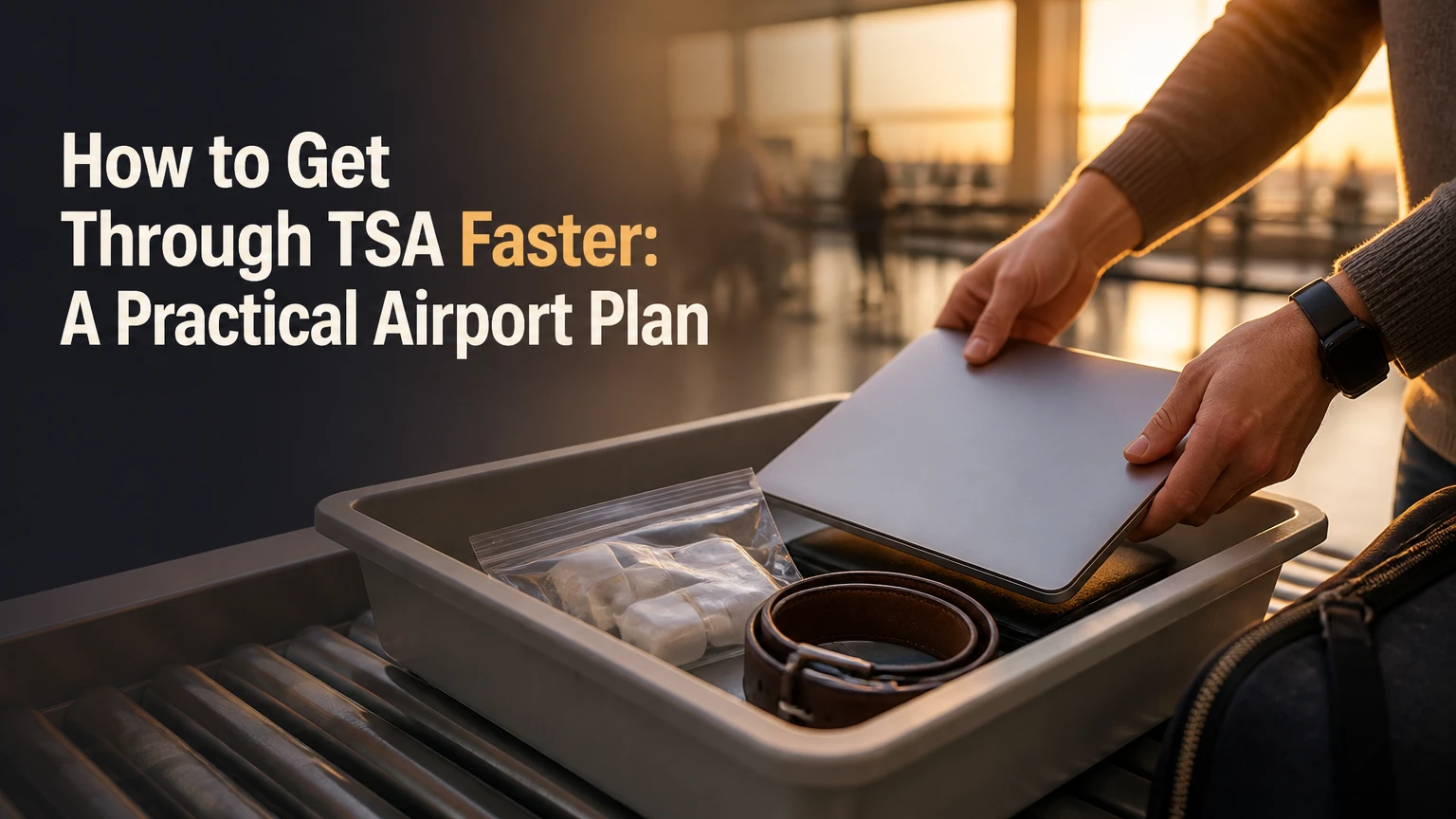
- Pack liquids and electronics for the applicable lane. Keep the 3-1-1 bag accessible for standard screening and follow the current instructions at the checkpoint.
- Empty pockets before the queue. Put phones, coins, keys, and loose metal into a closed bag pocket, not a tray at the last second.
- Join the correct lane. Do not enter a PreCheck, CLEAR, priority, or reservation lane unless your boarding pass and eligibility support it.
- Follow the officer’s current direction. Procedures can change because of equipment, threat information, airport layout, or the contents of a bag.
- Repack away from the conveyor. Move to the designated area after screening so the next traveler can collect belongings without congestion.
The boarding-pass check is the highest-value step. A traveler can hold a valid membership and still lose access because the KTN was omitted, the name differs, the airline did not transmit the data, or the flight is not eligible for the lane.
Packing Rules That Prevent Secondary Screening
The Transportation Security Administration generally permits liquids, aerosols, gels, creams, and pastes in containers of 3.4 ounces, or 100 milliliters, or less, packed in one quart-sized bag for standard carry-on screening. The container size matters even when the container is partly empty.
TSA PreCheck passengers commonly keep compliant liquids and laptops in their bags, but officers can still instruct travelers to remove items. Medical liquids, infant or child nourishment, and other exceptions may receive different treatment when declared for inspection.
| Item category | Standard carry-on limit or action | PreCheck expectation | Delay risk |
|---|---|---|---|
| Liquids, gels, aerosols | Containers up to 3.4 oz or 100 ml in a quart bag | Usually remains packed | Oversized container or unclear contents |
| Laptop computer | Often removed from carry-on | Usually remains packed | Dense electronics or damaged bag |
| Power bank | Carry-on only, not checked baggage | Keep accessible if requested | Confusion about watt-hours or placement |
| Medication | Declare medically necessary liquids when required | Follow officer instructions | Unlabeled or inaccessible medical supplies |
| Food | Solid food commonly permitted | Usually remains packed | Spreads, sauces, or gel-like foods |
| Sharp objects | Check or leave prohibited items behind | Same restriction applies | Confiscation and bag inspection |
Pack dense electronics, unusual tools, powders, and food so an officer can inspect them without emptying the entire bag. A transparent toiletry bag helps, but it does not make an oversized liquid permissible.
Expert insight: the fastest bag is not the one with the fewest objects. It is the bag whose contents are predictable, separated, and easy to remove when an officer asks. A tightly compressed bag can create more delay than a larger, orderly bag.
Timing, Clothing, and Airport Operations
Timing matters because security demand is uneven. Morning departure banks, Monday travel, holidays, school breaks, and major events can create concentrated queues, while a quiet checkpoint can become slow if one screening lane closes.
Airport wait-time estimates are useful for trend detection, not precise arrival planning. Add time for parking, shuttle buses, checked baggage, airline document checks, accessibility assistance, and the walk from security to the gate.
| Travel condition | Typical extra planning time | Why it matters | Practical response |
|---|---|---|---|
| Carry-on only, familiar airport | 60-90 minutes before departure | Few pre-security tasks | Check the active checkpoint before leaving |
| Checked bag, domestic flight | 90-120 minutes | Bag-drop cutoff adds risk | Confirm airline cutoff and terminal |
| International departure | 120-180 minutes | Check-in, documents, and long walking routes | Arrive before the airline’s stated cutoff |
| Holiday or major event | Add 30-60 minutes | Higher passenger volume | Reserve a slot where available |
| Traveling with children or mobility equipment | Add 20-45 minutes | More belongings and assistance steps | Request help and explain equipment early |
Wear shoes that come off quickly, avoid unnecessary metal hardware, and keep jewelry in a bag before reaching the conveyor. PreCheck reduces removal requirements, but bulky outerwear and unusual accessories can still prompt additional inspection.
The 24-Hour Preparation Plan
The day before departure, verify the terminal, flight status, identification, boarding pass, KTN, and airport checkpoint. Remove prohibited items from the carry-on before packing, then place liquids and electronics where the applicable lane requires them.
At home, weigh or measure unusual bags and confirm that batteries and power banks are in carry-on baggage. At the airport, do not wait until the front of the line to open apps, search for identification, or reorganize a backpack.
What Happens If PreCheck Is Missing?
A missing TSA PreCheck indicator means you generally cannot use the PreCheck lane for that boarding pass, even when your membership is active. First check whether the KTN and name are correct in the airline reservation, then ask the airline to refresh or reissue the boarding pass if appropriate.
The airline controls whether the indicator appears on the boarding pass. TSA officers cannot add the designation at the checkpoint. If the information is correct and the marker remains absent, use the standard lane and contact the airline or TSA after the trip to investigate.
| Problem | Likely cause | Immediate action | Future prevention |
|---|---|---|---|
| No PreCheck marker | Missing or incorrect KTN | Check reservation and ask airline | Save KTN in airline profile |
| Name mismatch | Booking differs from enrollment record | Request airline correction | Use the enrolled legal name |
| Child lacks marker | Family eligibility rule not met | Ask airline, then use standard lane if needed | Check each boarding pass |
| Closed PreCheck lane | Airport staffing or operating hours | Use another authorized lane | Check checkpoint hours |
| Unexpected bag search | Item density or prohibited contents | Follow officer instructions | Pack accessible, permitted items |
Children age 12 and under can generally accompany an enrolled parent or guardian in the PreCheck lane when the required indicator appears, while teenagers aged 13-17 may need the indicator on their own boarding pass or must follow the current family-travel rules. Confirm current TSA policy before departure because eligibility rules can change.
Special Situations and Honest Limitations
TSA PreCheck is not a substitute for arriving on time. It does not accelerate airline check-in, checked-bag acceptance, aircraft boarding, customs inspections in another country, or a long walk between terminals.
CLEAR Plus is also not universally faster. A busy CLEAR enrollment or verification area, limited operating hours, or a long shared physical-screening queue can erase its advantage. A traveler who visits airports without CLEAR receives no value from that membership.
Travelers with medical devices, mobility aids, service animals, prostheses, unusual equipment, or medically necessary liquids should plan for communication rather than concealment. TSA Cares can provide information and assistance planning, but the checkpoint still determines the screening procedure.
International travelers should separate departure and arrival benefits. TSA PreCheck applies to eligible security screening when departing from participating U.S. airports. Global Entry and Mobile Passport Control concern U.S. arrival processing and do not remove foreign airport security requirements.
Expert insight: stacking programs is not automatically rational. A traveler who flies twice annually from an airport with short identity queues may gain more from careful packing than from paying for CLEAR, while a weekly traveler at a hub with both CLEAR and PreCheck may value the time saved.
Which Option Fits Your Travel Pattern?
Choose the program based on where delay occurs and where you travel, not on the largest advertised benefit.
| Traveler profile | Best first option | Secondary option | Reasonable decision rule |
|---|---|---|---|
| Domestic flights, 4 or more per year | TSA PreCheck | CLEAR at a home hub | Buy PreCheck before considering biometrics |
| International trip every 1-2 years | Global Entry | CLEAR at frequent airports | Customs benefit can justify the higher application fee |
| Weekly hub traveler | TSA PreCheck | CLEAR Plus | Consider both only when both lanes operate regularly |
| Frequent U.S.-Canada crossings | NEXUS | Global Entry | Confirm eligibility and interview logistics first |
| Frequent U.S.-Mexico land crossings | SENTRI | Global Entry | Include vehicle and border-use requirements |
| Occasional traveler without membership | Airport reservation | Mobile Passport Control for arrivals | Use free tools and organize the carry-on |
If you travel internationally once a year, Global Entry may provide better total value than TSA PreCheck alone, but the longer application process makes timing important. Apply well before the intended trip rather than assuming approval will arrive before departure.
Frequently Asked Questions About How to Get Through TSA Faster
How early should I arrive for airport security?
For a familiar domestic airport with only a carry-on, 60-90 minutes before departure is a typical planning range. Checked bags, international flights, holiday periods, parking shuttles, and unfamiliar terminals require more time. Use the airline’s cutoff times as hard constraints, not as a recommended arrival target.
Can I bring a water bottle through TSA?
An empty reusable water bottle can generally pass through the checkpoint, while a full bottle contains a liquid above the standard 3.4-ounce or 100-milliliter limit. Empty the bottle before screening and refill it after security. Medical and infant-related liquids may follow separate procedures when declared.
Does TSA PreCheck work for every airline?
TSA PreCheck works only when the airline participates, the flight is eligible, the traveler’s reservation contains the correct KTN, and the boarding pass displays the indicator. An active membership alone is insufficient. Check the boarding pass before entering the lane, especially after changing or rebooking a flight.
Can I use a different airport terminal’s security checkpoint?
Sometimes, but terminal access depends on the airport’s post-security connections and operating layout. A checkpoint in another terminal may not lead to your gate without leaving the secure area. Confirm the airport map, checkpoint hours, and airside connection before choosing a shorter-looking line.
Is CLEAR faster than TSA PreCheck?
CLEAR and TSA PreCheck speed different stages, so neither is universally faster. CLEAR can shorten biometric identity verification, while PreCheck reduces physical preparation and screening requirements. CLEAR alone may provide little benefit when bag screening is congested; the combination can help frequent travelers at participating airports.
Conclusion
The practical answer to how to get through TSA faster is to remove preventable decisions from the checkpoint. Use TSA PreCheck for recurring domestic travel, Global Entry when international returns justify the longer application, and CLEAR Plus only when its airport coverage matches your routine. Without a membership, verify the checkpoint, reserve a free time slot when available, pack within the 3.4-ounce rule, confirm the boarding-pass indicator, and arrive with a measured buffer.