How to Get a Passport for a Newborn: U.S. Guide
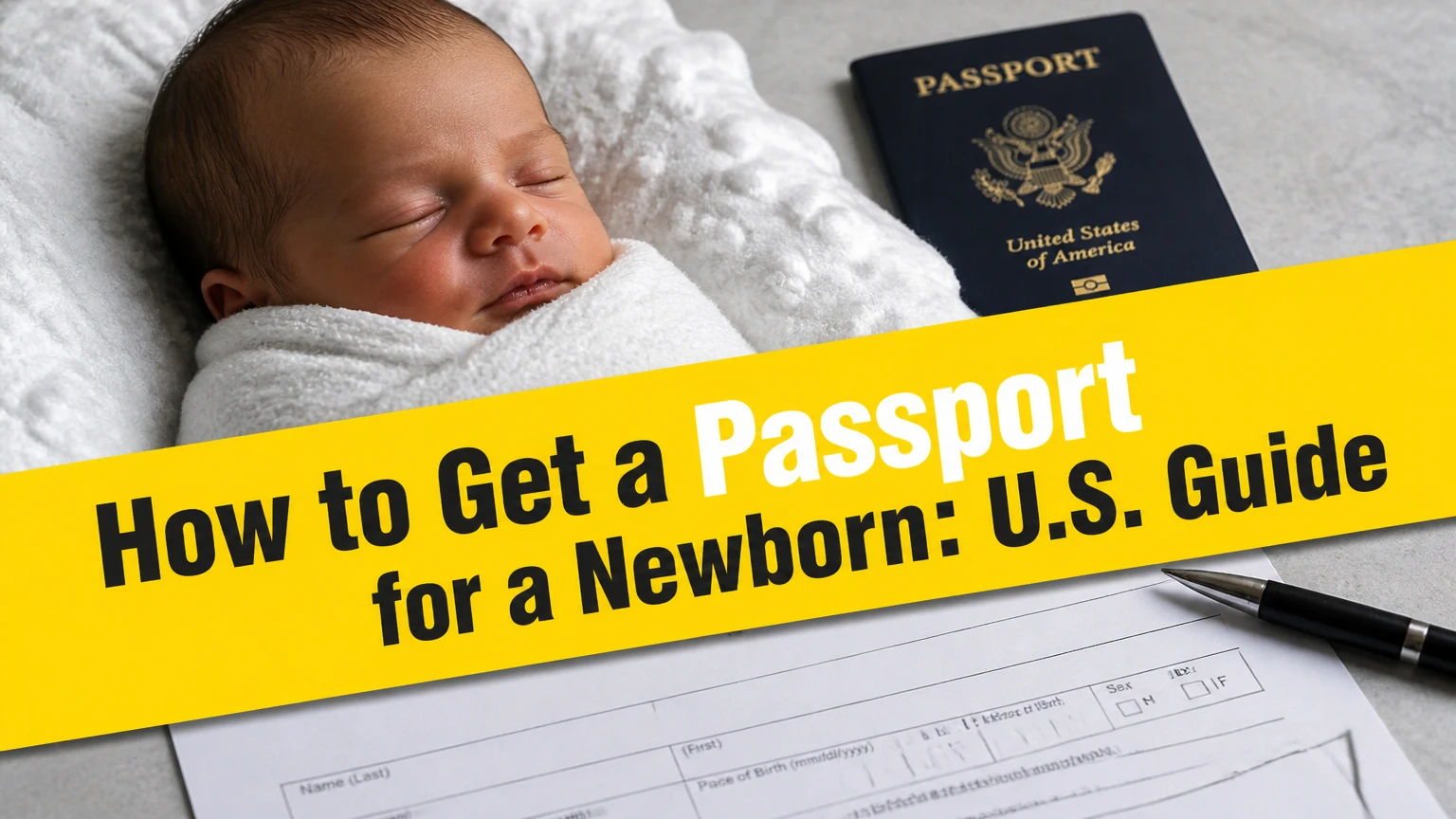
How to get a passport for a newborn in the United States begins with Form DS-11, a certified citizenship record, an acceptable infant photo, and an in-person appointment. The baby must appear, and parents or guardians must prove identity, relationship, and consent before a passport acceptance facility can submit the application.
Key Facts / Quick Answer
A child under 16 normally applies with Form DS-11 in person, even if the child has had a passport before.
A passport book is required for international air travel; a passport card is not valid for international flights.
A child passport is valid for five years, and the child cannot renew it by mail using the adult renewal process.
The standard U.S. application usually requires the original certified birth certificate, evidence of citizenship, parental identification, photocopies, and a 2-by-2-inch photo.
Both parents should attend. If one cannot attend, Form DS-3053 or qualifying custody evidence is generally required.
Routine processing commonly takes 4-6 weeks at the agency, excluding mailing time. Confirm current fees and timelines at travel.state.gov.
What a Newborn Passport Is
A newborn passport is a U.S. travel document issued to a citizen child, including a baby who is only days old. The document confirms identity and citizenship for international travel, but it does not replace a visa, airline-required entry authorization, or the destination country’s immigration rules.
The U.S. Department of State issues passports to minors under age 16 under stricter consent procedures than adult applicants. The child’s legal relationship to the applying adults must be documented, and the child must appear in person at submission.
A hospital keepsake certificate, footprint card, or birth announcement is not evidence of citizenship. The application normally requires a certified birth certificate issued by the relevant vital-records authority, although other citizenship evidence can apply to children born abroad or in unusual custody situations.
The State Department’s minor-passport rule is direct: “The child must be present when applying.” That requirement applies even when the baby cannot speak, sign, or understand the application.
Who Must Attend the Appointment?
The newborn and both parents or legal guardians should attend the appointment. One parent may sometimes be absent, but the attending adult must provide the absent parent’s notarized consent or legally sufficient evidence explaining why consent is unnecessary or impossible.
The acceptance agent does not decide every custody dispute. The agent checks whether the submitted evidence satisfies the passport rules and may refer uncertain cases to the State Department.
| Family situation | Typical evidence | Practical result |
|---|---|---|
| Both legal parents attend | Government identification from both parents | Joint consent is documented at the appointment |
| One parent cannot attend temporarily | Form DS-3053, notarized within the required period, plus ID copy | Application may proceed with documented consent |
| One parent has sole legal custody | Court order or custody judgment | Sole authority may replace the other parent’s consent |
| One parent is deceased | Certified death certificate | Death record may establish why consent is unavailable |
| Parent’s location is unknown or consent is unsafe | Form DS-5525 and supporting evidence | State Department reviews the special-circumstance claim |
| Legal guardian applies | Court order or guardianship documentation | Guardian proves authority and follows minor rules |
A photocopy of the absent parent’s identification is generally required with Form DS-3053. The form must be completed correctly and notarized; an informal letter, text message, or email usually does not substitute for the official consent form.
Which Passport Document Should You Request?
A passport book is the correct choice for a newborn who may travel internationally by air or whose itinerary could change. A passport card costs less, but it is restricted to qualifying land and sea travel and cannot be used for an international flight.
The passport book has blank visa pages and broad international acceptance. The passport card is a wallet-sized citizenship and travel document for limited routes, primarily involving land-border or sea-border entry from Canada, Mexico, Bermuda, and certain Caribbean destinations.
| Document | Typical government fee for a child | International air travel | Validity for a child under 16 |
|---|---|---|---|
| Passport book only | $100 application fee plus $35 execution fee | Accepted, subject to destination rules | 5 years |
| Passport card only | $15 application fee plus $35 execution fee | Not accepted for international flights | 5 years |
| Book and card | $115 application fee plus $35 execution fee | Book is accepted; card remains restricted | 5 years |
| Emergency consular document | Varies by embassy and circumstance | Usually limited to approved emergency itinerary | Often short-term or route-specific |
Fees can change, and some facilities impose appointment or photo charges. Check the State Department fee page immediately before applying because the government fee and acceptance-facility fee are separate payments.
When Is a Passport Card a Poor Choice?
A passport card is a poor sole document when a family might need to fly home from a cruise, cross a border by air, or accept an itinerary change. A cruise that begins and ends in the same country may have different documentation rules from a cruise that returns through a foreign port.
For most families, the book provides the safer margin. The card can be added for the incremental application fee when frequent land-border travel justifies it.
How Much Does a Newborn Passport Cost?
A newborn passport normally costs the child’s application fee plus a $35 execution fee paid to the acceptance facility. Expedited service, faster return delivery, photographs, certified records, notarization, and overnight mailing can increase the total budget.
The figures below reflect the commonly published U.S. fee structure for a first passport application by a child under 16. Verify every amount at the State Department before payment because fees and delivery prices may change.
| Cost item | Passport book | Passport card | Both documents |
|---|---|---|---|
| State Department application fee | $100 | $15 | $115 |
| Acceptance-facility execution fee | $35 | $35 | $35 |
| Base government total | $135 | $50 | $150 |
| Expedited processing add-on | $60 | $60 | $60 |
| Faster 1-2 day return delivery | Additional fee | Usually unavailable or restricted | Additional fee for book |
Payment instructions vary by location. Many acceptance facilities require a check or money order payable to the U.S. Department of State for the application fee, while the facility’s execution fee may accept a different payment method.
What Extra Costs Should You Budget?
Typical additional expenses include $10-$25 for commercial photographs, $10-$30 for certified record copies, and $5-$20 for notarization or mailing. These are practical estimates, not universal government charges.
Do not combine the two required payments unless the facility specifically instructs you to do so. A correctly completed application can be delayed when the payment is payable to the wrong recipient or uses an unaccepted method.
How Long Does a Newborn Passport Take?
Routine processing commonly takes 4-6 weeks after the State Department receives the application, while expedited processing commonly takes 2-3 weeks. Mailing time can add as much as four weeks in total, so a travel date should include delivery buffer rather than relying only on the agency estimate.
The processing clock is not always the time between the appointment and the mailbox. It can begin after the acceptance facility sends the package, and incomplete evidence can pause or extend the case.
| Service path | Agency estimate | Possible total with mailing | Appropriate planning window |
|---|---|---|---|
| Routine | 4-6 weeks | 6-10 weeks | Apply well before booking or departure |
| Expedited | 2-3 weeks | 4-7 weeks | Use when travel is approaching |
| Urgent appointment | Case-specific | Depends on appointment and evidence | International travel generally within 14 days |
| Life-or-death emergency | Case-specific, sometimes within 3 business days | Depends on document production and delivery | Documented qualifying family emergency |
The State Department’s processing-time page is the controlling source. Processing estimates are not guarantees, and an acceptance facility cannot promise that a passport will arrive before a flight.
Can You Get One in an Emergency?
A regional passport agency may help when qualifying urgent travel is near, often within 14 calendar days, or when a documented life-or-death emergency requires immediate travel. An appointment, proof of travel, citizenship evidence, identity documents, and emergency documentation are normally required.
A commercial expeditor cannot bypass the legal requirements. The baby still needs acceptable citizenship evidence, parental consent, and physical presence.
What Documents Do You Need?
A child passport application generally needs Form DS-11, evidence of the baby’s U.S. citizenship, evidence of the parent-child relationship, parental identification, photocopies, and one compliant photograph. Originals or certified copies are usually presented at the appointment and returned separately from the new passport.
Prepare a document packet before booking. The following checklist covers the standard U.S.-born newborn case:
- Completed Form DS-11, printed single-sided and unsigned.
- Certified U.S. birth certificate showing the child’s name and parentage.
- Photocopy of the birth certificate on standard letter-size paper.
- Government-issued photo identification for each attending parent.
- Single-sided photocopies of the front and back of each identification document.
- Evidence of name changes, such as a marriage certificate or court order, when names differ.
- One 2-by-2-inch color passport photograph.
- Form DS-3053 and the required identification copy if one parent is absent.
- Form DS-5525 and supporting evidence for a special family circumstance when applicable.
- Separate payments in the amounts and formats required by the State Department and facility.
The acceptance agent may ask for additional evidence if the birth certificate is amended, incomplete, recently issued, or inconsistent with the application. Bring every relevant original, but do not attach extra documents that do not clarify the case.
What If the Birth Certificate Is Not Ready?
A U.S.-born child usually needs a certified birth certificate for a routine passport application. A hospital record or souvenir certificate does not meet that standard.
If urgent travel occurs before the birth certificate arrives, contact the State Department or the relevant passport agency before the appointment. The agency may explain whether alternative citizenship evidence, a birth record search, or emergency documentation could apply, but approval is case-specific.
What If the Baby Does Not Have a Social Security Number?
If the child has never been issued a Social Security number, the parent generally provides a signed statement declaring that fact. If the number exists but is unavailable, contact the State Department for the correct statement and supporting procedure before submission.
An SSN application made through a hospital does not guarantee that the number will arrive before the passport appointment. The passport application and Social Security process are related but separate government procedures.
What If the Baby Was Born Abroad?
A child born abroad to a U.S. citizen parent may need a Consular Report of Birth Abroad, commonly called a CRBA, or another approved citizenship record. A foreign birth certificate alone does not prove U.S. citizenship.
The U.S. embassy or consulate handling the birth registration can explain the order of operations. Some families obtain the CRBA and passport through the same overseas consular system, while others must first establish citizenship eligibility.
How to Take a Newborn Passport Photo
A newborn passport photo must be a color image measuring 2 by 2 inches, with the baby facing the camera against a plain white or off-white background. The baby does not need to smile, and an infant’s eyes may be closed under U.S. photo guidance, although an open-eyed image often reduces review questions.
The photo must show only the baby. No pacifier, hat, adult hand, car-seat edge, blanket pattern, shadow, or other person should appear in the final image.
| Photo requirement | Acceptable target | Common rejection problem |
|---|---|---|
| Image size | 2 by 2 inches | Incorrect crop or nonstandard dimensions |
| Background | Plain white or off-white | Gray shadows, texture, toys, or furniture |
| Position | Face centered, camera level | Head tilted or excessive empty space |
| Clothing | Everyday clothing, no uniform | Hat, costume, or head covering without exception |
| Support | Hidden support outside the crop | Parent’s hand, strap, or car-seat hardware visible |
| Print quality | Sharp color print | Blur, glare, pixelation, or dark exposure |
In practice, place the baby on a plain white sheet and photograph from directly above only when the baby is safely lying down and supervised. Never place a newborn on an elevated surface for a photograph, and do not compromise safe positioning to improve the image.
A commercial passport-photo provider can reduce cropping errors, but the provider’s acceptance does not guarantee State Department approval. Inspect the final print yourself before submitting it.
How to Apply for the Passport
The application process has seven practical stages. Completing the evidence packet before the appointment prevents the most common avoidable delay, which is discovering that a copy, payment, or consent document does not meet the facility’s requirements.
- Order the certified birth certificate. Request the official vital-record document from the state, county, or city authority.
- Resolve the SSN issue. Confirm whether the baby has a number or prepare the required no-SSN statement.
- Complete Form DS-11. Enter the child’s information, print the form, and leave the signature blank until the agent directs you.
- Prepare originals and copies. Bring citizenship evidence, relationship evidence, parent IDs, and clear single-sided copies.
- Obtain the photograph. Check size, background, visibility of support, and image sharpness.
- Book an acceptance appointment. Use an authorized USPS facility, courthouse, county office, or other listed acceptance location.
- Attend and submit. Bring the newborn, required adults, documents, payments, and appointment confirmation.
At the appointment, the agent reviews the packet, witnesses the parent’s signature, accepts the application, and forwards the materials. The baby’s presence is mandatory even when the baby is asleep.
What Happens After Submission?
The application may show no online status for several days or longer after acceptance. Once the State Department scans the case, use the Online Passport Status System to monitor progress and respond promptly if the agency requests more information.
The birth certificate and other original evidence may arrive separately from the passport. Keep the tracking information and inspect each returned document before discarding any mail.
Birth Certificate, Passport Card, or Passport Book?
A birth certificate can support certain land or sea crossings for U.S. citizen children, but it is not a universal international travel document. A passport book provides the broadest practical coverage, while the passport card offers a lower-cost option for limited routes.
| Document option | Air travel abroad | Land or sea travel | Emergency flight home | Main limitation |
|---|---|---|---|---|
| Certified birth certificate | No | Some qualifying routes | No | Acceptance depends on route and citizenship rules |
| Passport card | No | Certain neighboring countries and territories | No | Not valid for international air travel |
| Passport book | Yes, subject to visa rules | Yes, subject to entry rules | Usually yes | Higher cost and longer application process |
| Emergency travel document | Usually limited to approved trip | Case-specific | Designed for qualifying emergencies | Temporary, embassy-issued, route-specific |
A passport does not guarantee admission to another country. Parents may also need a visa, electronic travel authorization, vaccination record, consent letter, or evidence of onward travel.
Common Mistakes That Delay a Child Passport
The most frequent errors involve consent, signatures, photographs, and payment rather than the child’s age. A newborn can receive a passport, but a missing certified record or defective parental-consent form can stop the application.
- Signing DS-11 before the acceptance agent instructs you.
- Bringing a hospital certificate instead of a certified vital record.
- Using a photocopy printed on both sides when single-sided copies are requested.
- Forgetting the back of a parent’s identification card.
- Submitting a DS-3053 without notarization or without the absent parent’s ID copy.
- Showing a parent’s hand, blanket, pacifier, or car-seat strap in the photo.
- Paying the State Department fee to the acceptance facility.
- Assuming a passport card can be used for an international flight.
- Booking nonrefundable travel before the passport is physically delivered.
- Applying under a name that does not match the citizenship evidence without proof of the legal name change.
Expert insight: The safest appointment packet contains a second photocopy set, although the official requirement may be only one copy. Facilities sometimes retain documents or identify a copy problem during intake, and a spare set can prevent a second appointment.
Expert insight: Infant passport photos are often rejected because the supporting surface is visible, not because the baby’s eyes are closed. A clean crop, even lighting, and no adult body parts matter more than forcing a newborn into an unnatural pose.
Expert insight: Expedited service shortens agency handling, not every part of the process. A late appointment, weekend mailing, missing document, or delivery delay can consume the time saved by paying the expedite fee.
After the Passport Arrives
Check the newborn’s name, date of birth, place of birth, sex marker, photograph, and passport number as soon as the document arrives. Report a printing or data error promptly through the State Department’s correction process rather than waiting until the airport.
A child’s passport is valid for five years from issuance. It cannot be renewed through the standard adult mail-in renewal process, so the child generally applies again in person with Form DS-11 and updated parental-consent documentation.
Airlines and border officials may apply rules beyond passport validity. Some destinations require a passport to remain valid for six months after arrival, and some countries require a visa even when the U.S. passport itself is valid.
Frequently Asked Questions About How to get a passport for a newborn
Can a newborn travel internationally without a passport?
A newborn generally needs a passport book for international air travel. A certified birth certificate may work for certain land or sea crossings under specific U.S. and destination-country rules, but it is not a dependable substitute for a passport when an itinerary includes flying.
Do both parents need to sign the newborn’s passport application?
Both parents normally provide consent for a child under 16. If one parent cannot attend, the absent parent generally submits notarized Form DS-3053 and an identification copy, unless a court order, death certificate, or approved special-circumstance procedure establishes another legal basis.
Can I apply for a baby passport before receiving the SSN?
Parents can often apply when the newborn has not yet received an SSN, but the application must include the State Department’s required written declaration. Confirm the current wording before attending because the procedure differs when an SSN was issued but the number is unknown.
Can I use a digital photo for a newborn passport?
A digital camera can produce the image, but the submitted passport photograph must meet the required printed format and dimensions. Use a compliant 2-by-2-inch color print, inspect the crop, and remove every visible hand, support, shadow, pacifier, and unrelated object.
Does a baby passport expire sooner than an adult passport?
A U.S. passport issued to a child under 16 is valid for five years, regardless of whether the child is a newborn or several years old. The child must apply in person again because the adult renewal process does not apply to minor passports.
Should I get a passport book and card for my child?
Choose the book when the child may fly internationally, visit destinations outside neighboring-country routes, or need a flexible emergency return option. Add the card when its land and sea uses justify the extra fee, but do not treat it as an air-travel substitute.
Conclusion
How to get a passport for a newborn is a document-and-consent process, not a simplified adult renewal. Obtain certified citizenship evidence, complete DS-11 without signing early, prepare parent identification copies, submit a compliant photo, and bring the baby and required consenting adults to an authorized facility. For international air travel, request the passport book and allow routine processing plus mailing time.