How to Deal with Turbulence Anxiety on Flights
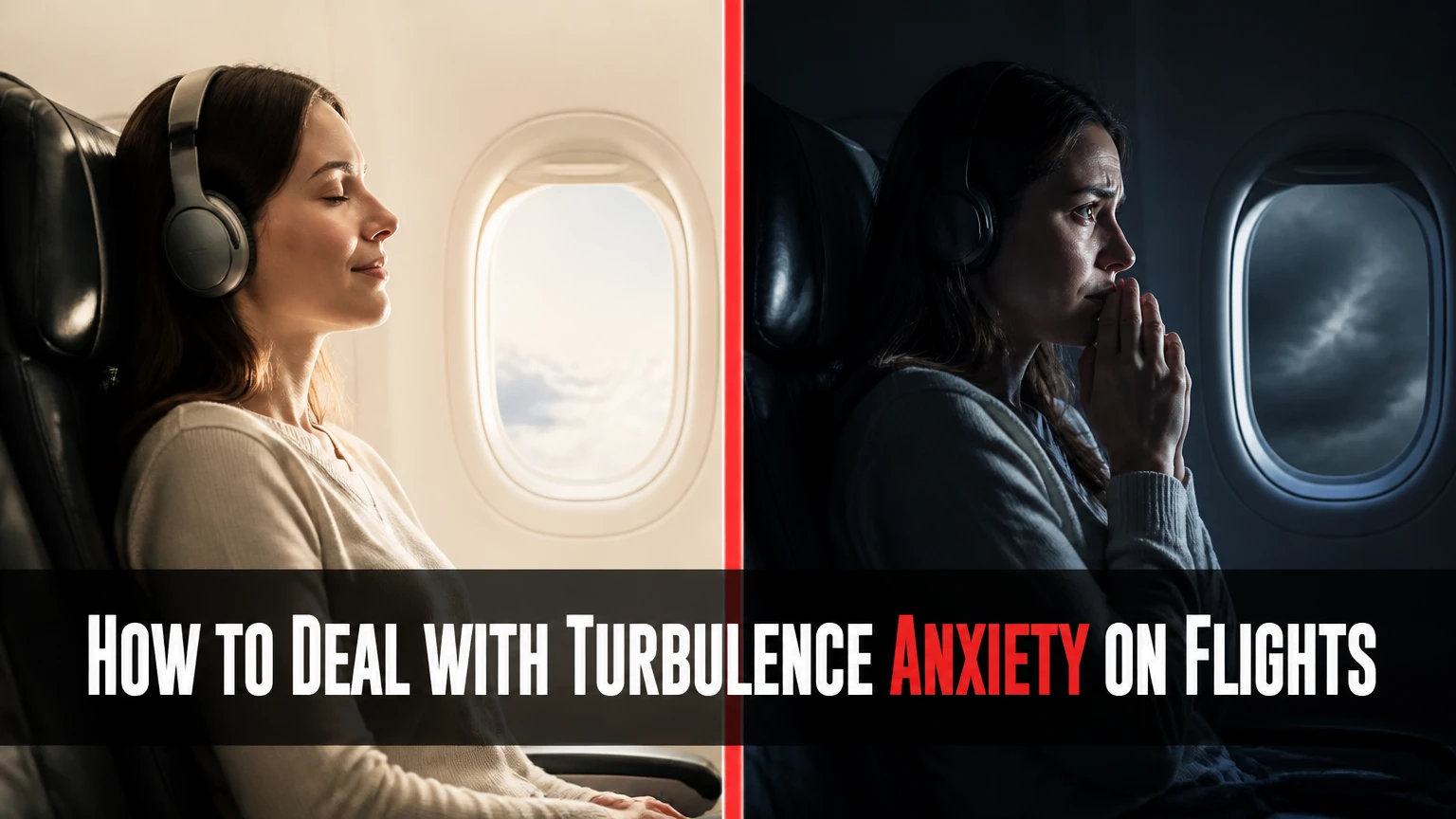
Turbulence anxiety is fear or panic triggered by irregular aircraft movement, often involving catastrophic thoughts, muscle tension, and rapid breathing. To deal with turbulence anxiety, learn what the motion means, keep your body secured and flexible, interrupt the fear cycle, and use CBT or exposure therapy when self-help is insufficient.
Key Facts / Quick Answer
Turbulence is irregular airflow, not a hole or empty space in the sky.
Commercial aircraft are designed and tested for loads beyond ordinary passenger turbulence.
The main immediate risk is an unsecured person being injured, so keep the seatbelt fastened whenever seated.
Seats near the wings usually feel less vertical and pitching movement than seats at the rear.
A longer patch of bumps does not automatically mean worsening danger; pilots may slow the aircraft, change altitude, or alter course.
CBT-based treatment commonly takes several sessions, while a typical US therapy session costs about $100-$250 before insurance.
What Is Turbulence Anxiety?
Turbulence anxiety is a situational fear response in which ordinary aircraft movement is interpreted as evidence of imminent danger. The trigger may be a sudden drop sensation, lateral rocking, engine-power change, cabin noise, or another passenger’s reaction, and the resulting adrenaline can make the feared interpretation feel physically certain.
The anxiety often follows a predictable sequence:
- Sensation: The aircraft jolts, rolls slightly, rises, or descends.
- Prediction: The mind rapidly supplies a meaning, such as “the plane is falling.”
- Alarm: Adrenaline increases heart rate, breathing rate, sweating, and muscle tension.
- Confirmation: Those bodily sensations are treated as proof that the aircraft is unsafe.
- Escalation: Attention narrows toward sounds, crew behavior, and every movement.
The movement is real. The catastrophic meaning is an interpretation.
The FAA describes turbulence as “an irregular motion of the atmosphere” caused by disturbances in airflow. That definition matters because turbulence is an atmospheric condition, not a mechanical diagnosis. A passenger can feel intense movement while the aircraft remains within its normal operating envelope.
Turbulence anxiety can occur without a broader fear of flying. Some passengers tolerate takeoff, landing, and altitude but panic when the aircraft moves unexpectedly. Others have panic disorder, claustrophobia, post-traumatic stress, a previous bad flight, or health anxiety that becomes attached to turbulence.
Why does turbulence feel like falling?
Turbulence feels like falling because the inner ear detects acceleration and the body loses familiar visual references. A brief downward acceleration can produce a stomach-lift sensation even when the aircraft has changed altitude only slightly, while a bank or vertical gust can make the cabin feel as though it has dropped farther than it has.
Air travel also removes useful control signals. On a road, a driver can see the bump and slow down; in an aircraft cabin, passengers cannot see the airflow or judge distance from the ground. That information gap encourages the brain to substitute sound, motion, and facial expressions as danger signals.
How Turbulence Affects an Aircraft
Turbulence changes airflow around the aircraft and can produce short-term variations in altitude, airspeed, or attitude. Pilots manage the condition by following forecasts and reports, reducing speed when appropriate, requesting a different altitude, avoiding storm cells, and maintaining separation from other aircraft.
Turbulence does not push an aircraft straight downward through an empty void. An airplane remains supported by aerodynamic lift while its flight path and acceleration change. The cabin can move sharply relative to passengers, but the aircraft is not behaving like a car whose wheels have left a road.
| Turbulence type | Main cause | Typical location | Passenger implication |
|---|---|---|---|
| Thermal or convective | Rising warm air | Hot land, deserts, storm surroundings | Bumps may increase near strong convection |
| Mechanical | Wind disrupted by terrain or structures | Mountains, ridges, low-level urban areas | Often anticipated near terrain |
| Frontal | Contrasting air masses | Weather fronts | May accompany cloud and wind changes |
| Clear-air | Wind shear near jet streams | High cruise altitudes | Can occur without visible clouds |
| Wake turbulence | Wingtip vortices from another aircraft | Near departure or arrival paths | Air traffic control provides separation |
Clear-air turbulence is harder for conventional onboard weather radar to show because radar detects precipitation more readily than dry air movement. Airlines and meteorological services therefore combine forecasts, aircraft reports, pilot observations, and wind data. “Hard to detect” does not mean “impossible to manage.”
The commonly repeated claim that turbulence lasts exactly 10-15 minutes is not reliable. A rough patch may last seconds, several minutes, or longer if the flight remains in the affected region. Duration alone is not a severity measurement.
What do pilots do when turbulence begins?
Pilots normally keep the aircraft on its assigned route unless safety, weather, or traffic requires a change. They may reduce speed to the aircraft’s recommended turbulence penetration speed, ask air traffic control for a new altitude, request a deviation around storms, and coordinate with cabin crew.
A power reduction can sound alarming because the engine note changes. In many situations, that sound indicates a deliberate speed-management action rather than loss of control. Flight attendants sitting down usually indicate that the cabin is no longer safe for service, not that the aircraft has suffered a failure.
What Can Turbulence Do, and What Can It Not Do?
Ordinary commercial-flight turbulence can cause discomfort, spilled items, and injuries to people who are standing or unrestrained. It does not normally flip a modern transport aircraft upside down or break its wings, and the absolute claim that structural damage has a 0% probability is inaccurate because aviation risk is never literally zero.
Aircraft certification includes structural load requirements, operational limits, and inspection programs. The exact margin varies by aircraft model, loading, speed, and turbulence encounter. Passengers should therefore replace “turbulence can never hurt the plane” with a more accurate statement: commercial aircraft are engineered to withstand the turbulence conditions used in normal airline operations, while severe weather and exceedances remain managed hazards.
The Federal Aviation Administration reports that most turbulence-related injuries involve people who are not fastened in their seats. The practical safety rule is simple: keep the lap belt low across the hips whenever seated, even when the sign is off.
| Cabin condition | What a passenger may notice | Primary risk | Best response |
|---|---|---|---|
| Light | Small bumps, gentle altitude changes | Spilled drinks | Stay seated or move carefully |
| Moderate | Definite movement, loose objects shifting | Falls and impact injuries | Fasten belt and follow crew instructions |
| Severe | Abrupt changes, strong restraint forces | Serious injury if unrestrained | Remain belted and do not leave the seat |
| Storm penetration risk | Lightning, heavy rain, rapid changes | Weather-related operational hazard | Trust rerouting, delay, or avoidance decisions |
Is turbulence becoming more dangerous?
Research has found changes in reported clear-air turbulence in some flight corridors, and climate-related atmospheric changes may affect future exposure. That finding does not mean every flight is becoming unsafe. It means airlines, regulators, and weather services continue improving forecasts, route planning, reporting, and aircraft design.
A turbulence forecast predicts increased probability across an area, not the exact moment a particular seat will move. Forecast apps can support planning, but repeatedly checking them can become reassurance-seeking, which often maintains anxiety.
Expert insight: The strongest safety behavior is not trying to predict every bump. It is reducing injury exposure by remaining belted, while allowing pilots and dispatchers to manage the route with information passengers do not have.
What to Do Before and During a Bumpy Flight
The most effective in-flight strategy combines physical safety, slower exhalation, attention control, and accurate interpretation. A passenger should not try to eliminate every anxious sensation; the more useful goal is to experience the sensation without adding a catastrophic story.
A 10-minute turbulence response protocol
- Secure the body. Sit back, place the belt low across the hips, and keep loose objects contained.
- Name the event. Say, “This is turbulence, an airflow change. The aircraft is still flying.”
- Release unnecessary tension. Drop the shoulders, loosen the jaw, and rest the hands rather than gripping the armrests.
- Breathe with a longer exhale. Inhale for four seconds and exhale for six seconds for two minutes. Do not force breath-holding if it makes you dizzy.
- Orient to the cabin. Identify five visible objects, four physical sensations, and three sounds without labeling them as safe or unsafe.
- Use a neutral image. Imagine the aircraft moving through uneven water or gelatin. Treat the image as a reminder that motion can occur without collapse.
- Stop measuring. Do not count every jolt, watch liquid, monitor the crew, or search the flight map for danger.
- Wait for the nervous system to catch up. Anxiety often peaks before the body receives evidence that the event has passed.
- Follow crew instructions. Do not stand to test whether the cabin has become smooth.
- Record the outcome later. Note the prediction, the actual event, and the recovery time.
Box breathing, which uses four-second inhalation, hold, exhalation, and hold phases, helps some people. It is not an instant switch for the parasympathetic nervous system, and breath-holding can intensify panic in others. Longer, comfortable exhalation is a better default when dizziness or air hunger appears.
Lifting the feet from the floor is sometimes recommended to reduce vibration sensations, but it is not a safety requirement and can reduce stability during abrupt movement. Keep both feet supported if that helps balance. Do not use a posture that makes it harder to brace or follow crew directions.
What should you avoid during turbulence?
| Common response | Why it backfires | Better substitute |
|---|---|---|
| Clutching the armrests | Muscle tension amplifies pain and vibration | Rest hands loosely on thighs |
| Watching water in a cup | Visual sloshing exaggerates perceived movement | Look at a fixed cabin feature |
| Tracking the crew | Hypervigilance turns routine work into threat evidence | Follow direct announcements only |
| Drinking alcohol | Can worsen sleep, dehydration, judgment, and rebound anxiety | Use water and a planned coping routine |
| Taking an untested sedative | Side effects and impaired judgment may complicate travel | Discuss medication beforehand with a clinician |
| Repeatedly checking a flight tracker | Reassurance checking reinforces uncertainty | Check once for logistics, then disengage |
Anxiety may produce chest tightness, tingling, sweating, nausea, trembling, and a racing heart. Those symptoms can feel dangerous, but panic symptoms and medical emergencies can overlap. Seek urgent medical help for new severe chest pain, fainting, one-sided weakness, severe breathing difficulty, or symptoms that do not resemble your usual anxiety.
How to Reduce Turbulence Exposure
Seat location changes how much movement a passenger feels, but no seat makes turbulence disappear. Seats near the aircraft’s center of gravity, commonly around the wing, usually experience less pitching and vertical movement than seats near the tail, while a window seat can provide visual orientation and an aisle seat can simplify access to the crew.
| Choice | Typical benefit | Limitation | Practical recommendation |
|---|---|---|---|
| Over the wings | Less pitch and tail movement | May have wing view or engine noise | First choice for motion-sensitive passengers |
| Front cabin | Often smoother than rear rows | May cost more or require status | Choose when available within budget |
| Rear cabin | Usually more noticeable movement | Often easier to access on some aircraft | Avoid if vertical motion is the main trigger |
| Window seat | More visual orientation | Less freedom to leave the row | Useful for passengers who dislike uncertainty |
| Aisle seat | Easier access and crew contact | More exposure to passing activity | Useful for claustrophobia or reassurance needs |
| Seat with extra legroom | Easier posture changes | Does not reduce turbulence itself | Buy for comfort, not for aircraft safety |
Choose a daytime flight if seeing the horizon reduces disorientation. Choose the wing area if physical movement is the dominant trigger. Ask the gate agent or cabin crew for practical support, but avoid requesting constant reassurance because reassurance can become part of the anxiety cycle.
If a flight is delayed or rerouted around weather, treat that decision as evidence of an active safety system. A delay is inconvenient; it is not proof that the aircraft cannot handle its planned route.
Which Treatment Works Best?
CBT is usually the most useful structured treatment for persistent turbulence anxiety because it changes catastrophic interpretations, avoidance patterns, and safety behaviors. Graduated exposure, including virtual reality when properly supervised, adds controlled practice with aircraft sounds, movement, and anticipatory thoughts; medication may reduce symptoms temporarily but does not teach durable skills.
| Option | Typical US cost | Typical lead time | Best use | Main limitation |
|---|---|---|---|---|
| Individual CBT | $100-$250 per session | 4-12 weeks | Persistent fear and panic | Requires repeated practice |
| Exposure therapy or VR | $100-$300 per session | 3-8 sessions | Strong sensory triggers | Quality varies by provider |
| Airline fear-of-flying course | $100-$1,000 per course | 1 day to 8 weeks | Aviation uncertainty and avoidance | Education alone may not change panic |
| Beta-blocker discussion | $15-$50 generic prescription cost, excluding visit | Test before travel | Tremor and rapid heartbeat | Not suitable for everyone |
| Short-term sedative discussion | $10-$50 generic prescription cost, excluding visit | Clinician-dependent | Severe situational anxiety | Sedation, impaired judgment, dependence risk |
| Self-guided practice | $0-$50 for workbook or app | 2-8 weeks | Mild or moderate anxiety | Limited support during setbacks |
Costs are typical US ranges, not quoted prices. Insurance, location, provider credentials, course length, and medication coverage change the total. A clinician should decide whether a beta-blocker or anxiolytic is appropriate, especially with asthma, low blood pressure, heart rhythm conditions, pregnancy, sleep apnea, alcohol use, or other medications.
Never test a new medication for the first time in the air. A prescriber may recommend a supervised trial on the ground, but the passenger should follow the exact prescription and avoid combining sedatives with alcohol or other central nervous system depressants.
When should you seek therapy?
Professional help is appropriate when fear causes flight avoidance, repeated cancellations, panic attacks, major work or family restrictions, or days of distress before travel. Therapy is also warranted when the person uses alcohol, unprescribed medication, or constant checking to get through a flight.
A therapist may assess specific phobia, panic disorder, generalized anxiety, trauma, obsessive reassurance-seeking, and medical contributors. Treatment can then target the actual maintaining mechanism instead of giving generic relaxation advice.
Expert insight: Aviation facts help when uncertainty is the problem. They help less when the core problem is panic conditioning. A passenger who knows turbulence is usually survivable can still need exposure practice because knowledge and nervous-system learning are different systems.
How to Rebuild Confidence After a Flight
Post-flight review turns a frightening event into usable evidence. Write down what you predicted, what physically happened, what the pilots and crew did, how long the intense phase lasted, and how your anxiety changed without an escape behavior.
| Review item | Example record | Why it matters |
|---|---|---|
| Prediction | “The next drop means a crash” | Identifies the catastrophic thought |
| Observable event | “Three minutes of bumps, no altitude alarm” | Separates sensation from interpretation |
| Safety behavior | “Kept belt fastened, did not check tracker” | Shows what coping action worked |
| Peak anxiety | 8 out of 10 | Measures intensity without judging it |
| Recovery time | 12 minutes after smoothing | Tracks nervous-system recovery |
| Next experiment | Sit over wing and use longer exhale | Creates a specific plan |
Do not grade the flight only as “good” or “bad.” A flight can feel highly anxious and still represent progress if you remained aboard, reduced checking, avoided alcohol, or recovered without fleeing. The target is functional behavior under discomfort, not a perfectly calm body.
Common Situations and Practical Decisions
A long period of turbulence does not automatically require an emergency landing. Pilots evaluate weather, aircraft systems, fuel, route options, passenger injuries, and airport suitability, then coordinate with air traffic control and airline operations.
A loud bang does not automatically indicate structural damage. Engine thrust changes, landing-gear movement, flap settings, airflow over control surfaces, and cabin fixtures can all create unfamiliar sounds. Passengers should respond to crew instructions rather than diagnose aircraft systems from the cabin.
Children often borrow an adult’s interpretation of movement. Use concrete language such as “the air is uneven, and your belt keeps you secure,” avoid promising that the flight will be perfectly smooth, and give the child a simple job such as counting breaths or naming objects.
If you are already panicking, do not search for a perfect fact. Put both feet where they are stable, fasten the belt, lengthen the exhale, and tell a crew member clearly, “I am having a panic response and may need help staying calm.” Crew members cannot provide medical treatment, but they can offer practical support and coordinate assistance.
Frequently Asked Questions About How to Deal with Turbulence Anxiety
Can turbulence make a plane crash?
Turbulence can injure unrestrained passengers, but ordinary airline turbulence is not usually a threat to the aircraft’s structural integrity. Commercial aircraft undergo certification testing and operate with speed, weather, and routing procedures designed to manage turbulence. Keep the belt fastened because passenger injury is the more relevant cabin risk.
Should I cancel a flight because turbulence is forecast?
A turbulence forecast alone is not a sound reason to cancel a flight. Forecasts describe probability across an area and can change as pilots receive updated observations. If anxiety is driving the decision, consult a clinician or fear-of-flying program rather than allowing avoidance to strengthen the phobia.
What is the best seat for a nervous flyer?
A seat over or slightly forward of the wings usually produces less pitching and vertical movement than a rear seat. Choose a window seat if visual orientation helps, or an aisle seat if access and crew contact matter more. Every passenger should prioritize a functioning seatbelt over a particular row.
Can I take a beta-blocker for flight anxiety?
A beta-blocker may reduce physical symptoms such as tremor or a racing heartbeat, but suitability depends on medical history and other medicines. Speak with a prescriber before travel, follow the prescribed dose, and test only as directed on the ground. Do not use someone else’s medication.
How long does turbulence anxiety treatment take?
Some people improve after several targeted sessions, while others need longer treatment for panic, trauma, or severe avoidance. A typical CBT course may run 4-12 weeks, with between-session exposure practice. Progress is better measured by reduced avoidance and faster recovery than by the total absence of fear.
Is virtual reality exposure therapy effective?
Virtual reality can reproduce aircraft visuals, sounds, takeoff, cabin movement, and turbulence in a controlled sequence. It is most useful when guided by a trained clinician who prevents exposure from becoming overwhelming or a reassurance exercise. VR is an option, not a guarantee, and availability and cost vary.
Conclusion
To deal with turbulence anxiety, secure your seatbelt, interpret the movement as irregular airflow rather than falling, regulate breathing without forcing it, and stop behaviors that magnify threat perception. For recurring panic or avoidance, CBT and graduated exposure offer more durable change than alcohol, untested sedatives, or repeated reassurance. Your goal is not to feel nothing, but to remain safe and capable while the aircraft moves.