How to Choose Luggage for International Travel: A Practical Guide
How to choose luggage for international travel depends on your airlines, route surfaces, packing weight, and tolerance for carrying or checking a bag. The right suitcase or travel pack fits the strictest flight limit, protects its contents, rolls or carries well across your actual route, and leaves enough weight capacity for what you pack.
Key Facts and Quick Answer
- Measure the bag from the floor, including wheels and handles, because airlines evaluate external dimensions.
- A common checked-bag limit is 62 linear inches and 50 pounds, or 23 kilograms, but the operating airline controls the rule.
- A compact two-wheel roller handles cobblestones and carpet better than an exposed-wheel spinner.
- Polycarbonate generally offers a better checked-bag durability balance than brittle ABS, while aluminum adds impact resistance at a higher empty weight.
- An expandable cabin bag can become illegal when opened, even if its unexpanded dimensions comply.
- For a multi-city trip, select luggage for the strictest airline and the least forgiving transport segment.
What Makes International Luggage Different?
International luggage is travel equipment designed to move clothing and personal items through airline systems, border inspections, public transport, and varied outdoor surfaces. International travel places four simultaneous demands on a bag: external size compliance, low empty weight, reliable mobility, and enough structural protection for repeated handling.
Domestic travel can involve one airline and a familiar airport. An international itinerary may include a long-haul carrier, a regional partner, a low-cost airline, airport trains, taxis, hotel stairs, and uneven pavement. The best bag therefore depends on the whole journey rather than the outbound aircraft alone.
Airline rules are route-specific. IATA publishes industry guidance, but IATA does not impose one universal passenger baggage allowance on every airline. The International Air Transport Association’s cabin-bag reference has commonly used a 56 x 45 x 25 cm framework, while many carriers publish smaller limits such as 55 x 40 x 20 cm. The airline operating each flight has the final rule.
Start With the Route, Not the Brand
Write down five variables before comparing products:
- Operating airlines, including separate regional or low-cost flights
- Number of connections and probability of a gate check
- Walking distance, stairs, trains, and cobblestones
- Expected packed weight and access to laundry
- Fragile, wet, valuable, or unusually shaped equipment
A traveler flying between major airports with hotel taxis can prioritize a four-wheel spinner. A traveler using metro systems in Rome, Paris, or Kyoto may value recessed wheels, a stable two-wheel pull, or a backpack with a supportive hip belt more than silent terminal rolling.
Expert insight: The strictest segment controls your practical luggage size. A bag that fits a transatlantic carrier may fail on the 55 x 40 x 20 cm aircraft used for the final regional connection.
How Do Materials Affect Performance?
Polycarbonate, polypropylene, ABS, aluminum, nylon, and polyester create different balances among weight, impact behavior, water resistance, repairability, and price. Material choice should follow baggage treatment and route conditions, not a general preference for hard or soft luggage.
Polycarbonate is a resilient thermoplastic that flexes under impact and usually provides a strong checked-bag compromise. Polypropylene is lighter and flexible, although very light shells can feel less rigid around hinges and closures. ABS often costs less and looks rigid, but it tends to crack more readily under severe impact and cold conditions.
Soft luggage uses woven nylon or polyester. Ballistic nylon commonly resists abrasion well, while ordinary polyester can reduce price and weight. Fabric absorbs some impact, offers external pockets, and can fit irregular spaces, but seams, zippers, and wet-weather exposure become more important failure points.
Aluminum shells resist crushing and can be repaired in some designs, but they are heavy, dent rather than flex, and often cost more. A strong shell does not protect a suitcase from overweight fees, broken wheels, or poor internal packing.
| Material | Typical Empty Weight for oba 26-Inch Bag | Main Strength | Main Limitation |
|---|---|---|---|
| ABS | 7-10 lb | Low purchase price, rigid shape | Higher cracking risk under severe impact |
| Polycarbonate | 8-12 lb | Flexibility and impact balance | Surface scratches and higher cost |
| Polypropylene | 6-10 lb | Low weight and shell flexibility | Less rigid feel in ultralight models |
| Ballistic nylon | 6-11 lb | Pockets, abrasion resistance, repairable seams | Fabric can absorb water |
| Aluminum | 11-16 lb | Crush resistance and replaceable hardware | High empty weight, dents, premium price |
The figures in this table are typical retail ranges, not a manufacturing standard. Compare the manufacturer’s listed weight for the exact size because a large wheel housing or metal frame can erase the benefit of a lightweight shell.
Which Wheel System Fits Your Route?
Wheel design determines how luggage behaves on smooth floors, carpet, thresholds, curbs, and broken pavement. Four-wheel spinners glide beside the traveler with little wrist force on level surfaces, while two-wheel rollers protect their wheels better and travel more predictably over rough ground.
Spinner wheels swivel in every direction but remain exposed on many cases. Their housings reduce internal capacity and can catch on curbs. Two-wheel inline systems recess the wheel into the case, protecting it during loading and giving the bag a larger main compartment, but the traveler must tilt and pull the full load.
Handle height also matters. A handle that is too short forces a tall traveler to lean; excessive extension increases leverage on the frame. Test a loaded bag, not an empty showroom model.
| Mobility System | Best Surface | Typical Advantage | Typical Failure or Cost |
|---|---|---|---|
| Four-wheel spinner | Airport tile, hotel floors | 360-degree movement, low arm force | Exposed wheels, poor curb performance |
| Two-wheel inline | Carpet, cobblestones, curbs | Recessed wheels, stable pulling | More wrist load, larger turning radius |
| Backpack harness | Stairs, platforms, crowded trains | Hands-free movement | Back and shoulder fatigue |
| Wheeled duffel | Mixed flat surfaces, bulky loads | Large flexible cavity | Awkward when lifted or carried |
Expert insight: On uneven streets, a two-wheel bag can be easier to control than a spinner because its larger recessed wheels cross gaps without swiveling sideways. Spinner convenience is highest on flat flooring, not universally across a trip.
Test These Hardware Points Before Buying
- Load the case with approximately 15-20 pounds and roll it over a threshold.
- Extend the handle fully and push it sideways with moderate hand pressure.
- Check whether the bag tracks straight when pulled two meters.
- Spin each wheel and listen for grinding, scraping, or uneven resistance.
- Inspect wheel clearance so fabric, wheel housings, and zippers cannot rub together.
- Lift the bag using every exterior handle and check for frame flex.
A small amount of telescoping-handle movement is normal. Excessive rattling indicates loose joints or thin mounting structures that may worsen under a 23-kilogram load.
What Size Should You Buy for International Flights?
The correct luggage size is the smallest bag that holds the planned load while meeting the strictest published dimensions. Carry-on compliance depends on external length, width, and height, including wheels, corner guards, handles, and sometimes side pockets.
Linear dimensions mean length plus width plus height. A checked bag measuring 30 x 20 x 12 inches equals 62 linear inches, or approximately 158 cm. Airlines may also impose separate per-side limits, so a 62-inch total does not automatically approve every shape.
| Bag Category | Common Published Limit | Practical Target | Weight Rule to Check |
|---|---|---|---|
| Personal item | 40 x 30 x 15 cm typical | Fits under the seat when full | Often included in cabin allowance |
| Compact cabin bag | 55 x 40 x 20 cm | Use for restrictive regional flights | Commonly 7-10 kg |
| Larger cabin bag | 56 x 45 x 25 cm | Use only where the airline permits it | Often 8-12 kg |
| Standard checked case | 158 cm total | Stay below 62 linear inches | Commonly 23 kg in economy |
| Heavy checked case | Airline-specific | Confirm before paying | Commonly 32 kg maximum per piece |
These are common reference points, not guarantees. Ryanair, easyJet, AirAsia, Japan Airlines, Emirates, Lufthansa, and United Airlines each publish different combinations of dimensions, weight, fare, and status allowances. Measure the exact itinerary at least one week before departure and again after packing.
Expert insight: A nominal 20-inch case can exceed a cabin limit once its wheels and handle housings are measured. Retail size names describe marketing categories, not the airline’s measuring box.
Use the Strictest Airline Rule
For a booking with multiple carriers, check:
- The operating carrier, not only the ticket seller
- Each flight number and aircraft category
- Basic economy or low-cost fare restrictions
- Regional connections after the long-haul flight
- Codeshare baggage rules
- Whether a personal item is separate from the cabin bag
If a carry-on is gate-checked, remove medication, passports, electronics, keys, and one essential change of clothing before handing it over. A compliant bag can still be checked when overhead bins fill.
Which Luggage Format Matches Your Travel Style?
The best luggage format depends on how often you lift the bag, where you walk, and how much access you need during transit. Hardside spinners favor organized protection and smooth floors; softside rollers favor pockets and flexibility; backpacks favor stairs and hands-free movement; duffels favor bulky or irregular equipment.
- Hardside spinner: Choose for airport-heavy trips, fragile contents, and predictable hotel transfers.
- Softside roller: Choose for exterior pockets, flexible packing, and access to documents without opening the main case.
- Travel backpack: Choose for stairs, buses, crowded stations, and routes with frequent short walks.
- Wheeled duffel: Choose for sports equipment, boots, soft goods, or loads that do not stack neatly.
- Hybrid bag: Choose when you need wheels for terminals and backpack straps for stairs, accepting more mechanisms to inspect.
| Format | Typical Capacity | Best Trip Pattern | Avoid When |
|---|---|---|---|
| Hardside spinner | 35-95 L | Airports, taxis, fragile souvenirs | Frequent stairs and rough pavement |
| Softside roller | 40-105 L | Business travel, pockets, flexible loads | Prolonged rain without a cover |
| Travel backpack | 30-60 L | Rail travel, hostels, uneven routes | Heavy loads or back limitations |
| Wheeled duffel | 60-140 L | Adventure gear, relocation, bulky clothing | Frequent lifting into overhead bins |
| Hybrid roller pack | 35-70 L | Mixed terminals and stairs | Minimalist trips requiring low weight |
A backpack is not automatically lighter in practice. A 50-liter pack filled to 12 kilograms may produce more fatigue than a 10-kilogram roller, especially for travelers with shoulder, back, or hip problems. A supportive hip belt transfers load to the pelvis, but only when fitted and tightened correctly.
How Much Should International Luggage Cost?
A reasonable luggage budget is approximately USD 50-150 for occasional travel, USD 150-400 for more frequent use, and USD 400-1,200 or more for premium materials and service. Price predicts materials, warranty administration, and hardware quality imperfectly, so inspect the construction rather than buying a logo.
Calculate cost per trip by dividing the purchase price by realistic usage. A USD 240 case used for 30 trips costs USD 8 per trip before repairs. A USD 90 case that fails after four trips costs USD 22.50 per trip, excluding replacement time and missed connections.
| Price Tier | Typical Price | Common Construction | Suitable Use |
|---|---|---|---|
| Entry | USD 50-150 | ABS, polyester, basic wheels | One or two trips yearly |
| Mid-range | USD 150-400 | Polycarbonate, nylon, stronger wheel units | Several trips yearly |
| Premium | USD 400-1,200+ | Aluminum, refined polycarbonate, replaceable parts | Frequent international travel |
| Repair-first purchase | USD 200-600 | Replaceable wheels, handles, shells, or panels | Long ownership horizon |
Warranty length needs careful reading. Many lifetime warranties cover manufacturing defects but exclude airline damage, normal abrasion, scratches, stains, and overloaded components. A bag with available replacement wheels can be more economical than one with a longer but narrow warranty.
What Features Improve Security and Packing?
Useful security features reduce accidental opening and speed inspection; they do not make luggage theft-proof. A built-in combination lock can hold zipper pulls together, while a separate lock or tamper-evident seal can show whether the bag was opened.
TSA-recognized locks allow Transportation Security Administration officers to open certain locks in the United States with authorized tools. That does not mean every customs agency worldwide has a universal master key. Security screening rules vary by country, and officers may cut a lock or open a bag when necessary.
A Bluetooth tracker can help locate a delayed or misrouted bag, but it cannot replace an exterior identification tag or an airline baggage claim record. Put contact details inside the case as well as outside, because tags can detach.
Internal organization should keep the weight centered and inspection simple. Compression cubes reduce movement and create categories, but they do not reduce mass. A compression panel that makes a case appear closed can also conceal an overweight load.
| Feature | Practical Benefit | Limitation | Best Practice |
|---|---|---|---|
| Built-in combination lock | Keeps zipper pulls together | Does not prevent forced entry | Photograph the combination and register it securely |
| TSA-recognized lock | Facilitates some United States inspections | Not a global customs key | Use only when the lock label is genuine |
| Compression cubes | Faster unpacking and organized inspection | No reduction in packed weight | Assign cubes by clothing category |
| Expandable gusset | Adds approximately 10-20% volume | May exceed cabin depth | Measure after expansion |
| Bluetooth tracker | Helps locate delayed luggage | Needs battery and compatible network | Place inside the case with contact details |
How Should You Pack for Weight and Access?
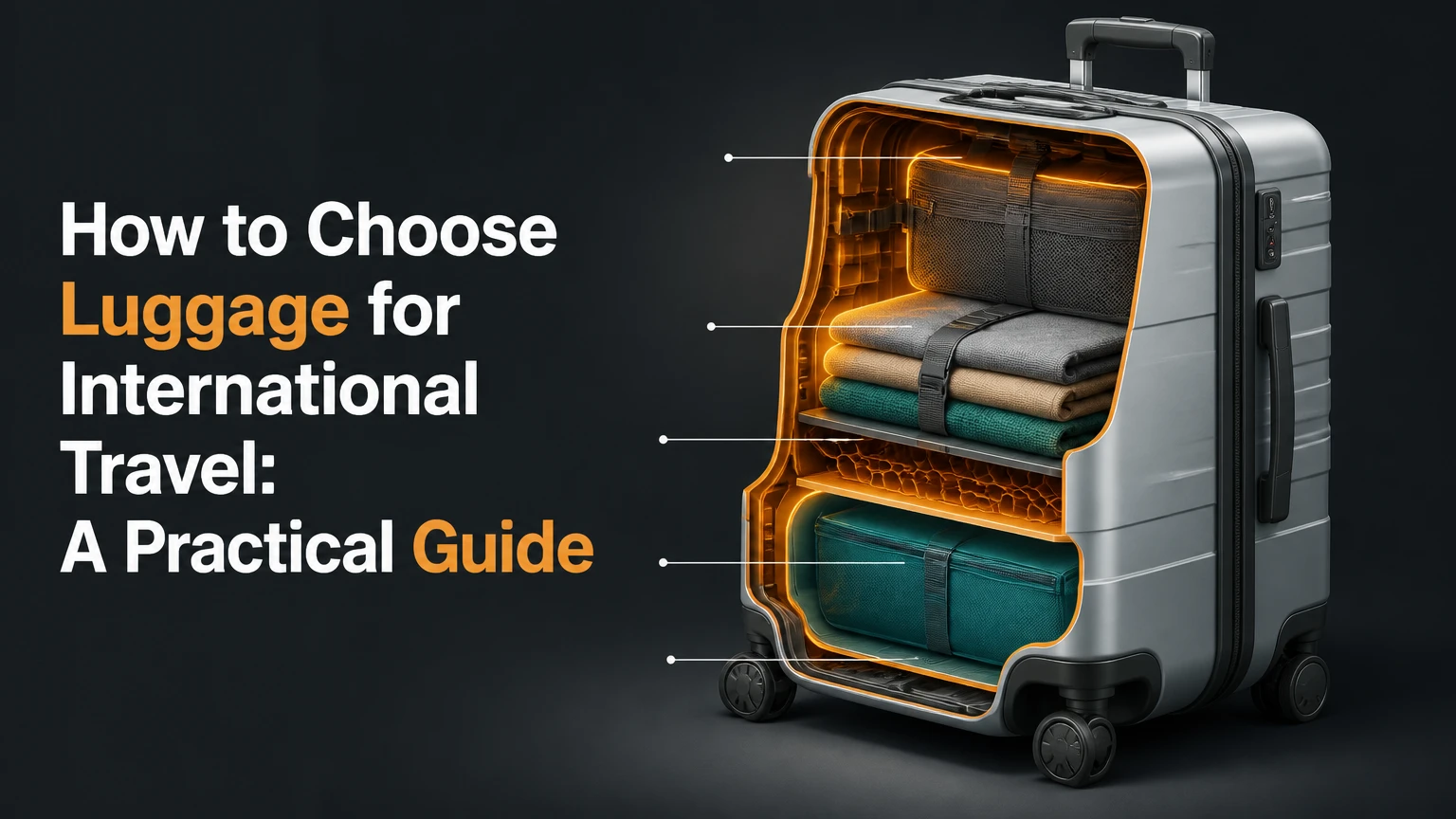
Pack by access priority, weight, and compressibility rather than filling every gap. Place dense items low and near the wheel side of a roller, protect fragile objects in the center, and keep documents, medication, and electronics in the personal item.
A practical sequence is:
- Weigh the empty bag and record its usable allowance.
- Lay out clothing, footwear, toiletries, and special equipment.
- Remove duplicate garments and estimate the final packed weight.
- Place shoes and dense items near the case base or wheel end.
- Put fragile objects between soft clothing layers, away from shell edges.
- Use cubes for categories, leaving inspection access to medication and electronics.
- Zip the case without force, then weigh it again with a luggage scale.
- Measure the expanded or overfilled dimensions against every airline limit.
Keep at least 1-2 kilograms below the published checked allowance when possible. Household scales can differ from airport scales, and a souvenir, wet garment, or last-minute toiletry can push a borderline bag over the limit.
For a one-week trip, a typical clothing system might include five tops, two bottoms, one warm layer, underwear for seven days, and one versatile pair of walking shoes. The exact quantity depends on climate, laundry access, and formal requirements. Compression helps volume, not the scale.
When Should You Replace or Buy the Bag?
Buy new luggage about 30 days before departure when possible, because that leaves time for delivery, return windows, test packing, and an airline-dimension check. Audit current luggage around 60 days before departure, especially when the trip includes checked connections or remote destinations.
Replace a bag when a structural defect threatens containment or mobility:
| Damage | Immediate Risk | Repair Decision |
|---|---|---|
| Shell crack through a panel | Crack can spread under impact | Replace unless a manufacturer approves repair |
| Wheel wobble or flat spot | Case may become uncontrollable | Replace wheel unit if parts are available |
| Zipper teeth separating | Contents can spill during handling | Repair promptly, do not tape as a long-term fix |
| Bent telescoping handle | Handle can jam under load | Replace assembly or case |
| Torn seam near handle | Lifting force can enlarge the tear | Repair before any checked flight |
Test the replacement bag on a loaded practice walk of 15-20 minutes. Roll it over a curb, lift it into a car trunk, and carry it up one flight of stairs. A suitcase that feels excellent empty can become uncomfortable, unstable, or difficult to steer at its actual travel weight.
What Mistakes Cause the Most Travel Problems?
The most expensive luggage mistakes involve dimensions, weight, and terrain rather than cosmetic quality. Travelers commonly buy the largest permissible case, then discover that the bag is too heavy before belongings are added.
Avoid these errors:
- Buying by “20-inch” or “28-inch” labels without measuring external dimensions
- Treating the 62-linear-inch checked standard as a promise from every airline
- Expanding a cabin case and assuming the original measurement still applies
- Packing a heavy shell with dense clothing until the bag exceeds 23 kilograms
- Choosing exposed spinner wheels for a trip dominated by stairs and cobblestones
- Putting passports, prescription medicine, or irreplaceable items in checked baggage
- Assuming a TSA lock protects luggage from all international inspection
- Selecting an indistinguishable black case without a bright strap or identifier
- Relying on a warranty that excludes airline handling damage
- Leaving no weight margin for food, souvenirs, or damp clothing
Color is a functional choice. A bright case, patterned shell, neon handle wrap, or permanent luggage strap reduces carousel confusion. Do not rely on a paper tag alone, because ordinary tags can tear away during handling.
Which Luggage Setup Works for Common Routes?
A route-specific setup is more reliable than a universal “best suitcase.” Match the primary bag to the most difficult movement segment, then use a personal item for high-value essentials and in-transit access.
| Travel Situation | Recommended Setup | Reason | Main Compromise |
|---|---|---|---|
| Long-haul, airport-to-hotel | 4-wheel polycarbonate case | Smooth floors and shell protection | Exposed wheels and limited exterior pockets |
| European rail itinerary | 2-wheel softside roller | Better thresholds, pockets, flexible storage | More fabric exposure and pulling effort |
| Hostel and public transit | 35-50 L travel backpack | Stairs, platforms, hands-free movement | Back load and weaker fragile-item protection |
| Winter or sports equipment | Wheeled duffel | Handles boots and irregular shapes | Poorer organization and lifting difficulty |
| Business trip with one connection | Compact cabin case plus personal item | Fast access and no checked-bag delay | Tight weight and volume limits |
| One-way relocation | Checked case plus durable duffel | Separates dense and bulky possessions | Higher risk of overweight fees |
Travelers with mobility limitations should prioritize handle height, wheel tracking, lift weight, and the availability of assistance over shell fashion. A smaller bag that can be lifted independently may be safer than a larger bag that requires help at every curb.
Frequently Asked Questions About How to Choose Luggage for International Travel
Is a hard or soft suitcase better for international flights?
A hard suitcase generally protects fragile contents and resists rain better, while a soft suitcase offers exterior pockets, flexible capacity, and easier access. Polycarbonate is a practical hard-shell choice for many checked trips. Choose softside luggage when pockets and compressibility matter more than shell protection.
Can I use a domestic carry-on on an international flight?
You can use a domestic carry-on only when its measured external dimensions and packed weight comply with the operating airline. Many United States domestic bags exceed the 55 x 40 x 20 cm limits used by some international and regional carriers. Check the smallest allowance on every flight.
What suitcase size is best for a two-week trip?
A 65-80 liter checked case typically accommodates two weeks of clothing when laundry is available, while a 35-45 liter cabin bag can work with a compact wardrobe and regular washing. Trip duration alone does not determine size. Climate, footwear, equipment, and laundry access often matter more.
Are four wheels better than two wheels on luggage?
Four wheels are better on smooth airport and hotel floors because the case can roll beside you with low arm force. Two wheels are better across curbs, carpet, and cobblestones because their recessed wheels track predictably and receive more protection. Select the system that matches most of your route.
How can I stop luggage from being mistaken on the carousel?
Use a distinctive permanent strap, bright handle cover, patterned tag, or unusual color, then verify the baggage tag before leaving the carousel. Record the case brand, color, dimensions, and identifying marks in your phone. A tracker adds location information but does not prove ownership by itself.
Should I check an expandable suitcase?
Check an expandable suitcase only after measuring and weighing it in its final expanded condition. Expansion usually adds approximately 10-20% of volume, but it can push the case beyond a 158 cm checked limit or a cabin depth restriction. Leave the expansion closed unless the airline permits the extra size.
Final Decision Rule
The best luggage for international travel is the lightest durable format that meets the strictest airline limit and remains manageable on the worst surface of your route. Choose polycarbonate or polypropylene for general checked protection, softside construction for pockets and flexibility, two wheels for rough ground, four wheels for smooth terminals, and a supportive backpack for frequent stairs.
Before purchasing, measure the exact bag, inspect loaded hardware, check the operating airlines, confirm the packed weight, and verify the return and repair policy. That process answers how to choose luggage for international travel with fewer assumptions and reduces the most common costs: overweight charges, gate checks, broken wheels, and bags that cannot handle the journey beyond the airport.