How to Check a Stroller at the Airport Safely
Checking a stroller at the airport means giving the stroller to an airline for transport, either at the ticket counter or at the departure gate. The airline tags, screens, loads, and returns the stroller, while airport security controls inspection requirements. Most airlines accept one stroller per child without a separate fee, but rules vary.
Key Facts
A ticket-counter check sends the stroller into the checked-baggage system before security.
A gate check lets you use the stroller through the terminal, then hand it over near the aircraft door.
Ask for a stroller tag before security if the airline requires one, and keep the claim stub.
TSA may require you to remove your child and fold or separately screen the stroller.
A stroller may return at the aircraft door, an oversize-baggage area, or the normal carousel.
Confirm the operating airline’s policy, especially for large jogging strollers, multi-piece travel systems, international transfers, and cabin storage.
What Happens When You Check a Stroller?
A checked stroller receives an airline baggage tag, passes through security screening, travels in the aircraft hold, and is delivered after landing. The handoff point determines whether the stroller enters the airport baggage network or remains available until boarding, so the choice affects both convenience and damage exposure.
The process normally follows these steps:
- Choose the handoff point. Tell the check-in agent or gate agent that you are traveling with a stroller.
- Remove loose property. Empty the basket, cup holder, parent console, seat pocket, and accessory hooks.
- Fold the frame. Secure the stroller according to the manufacturer’s instructions.
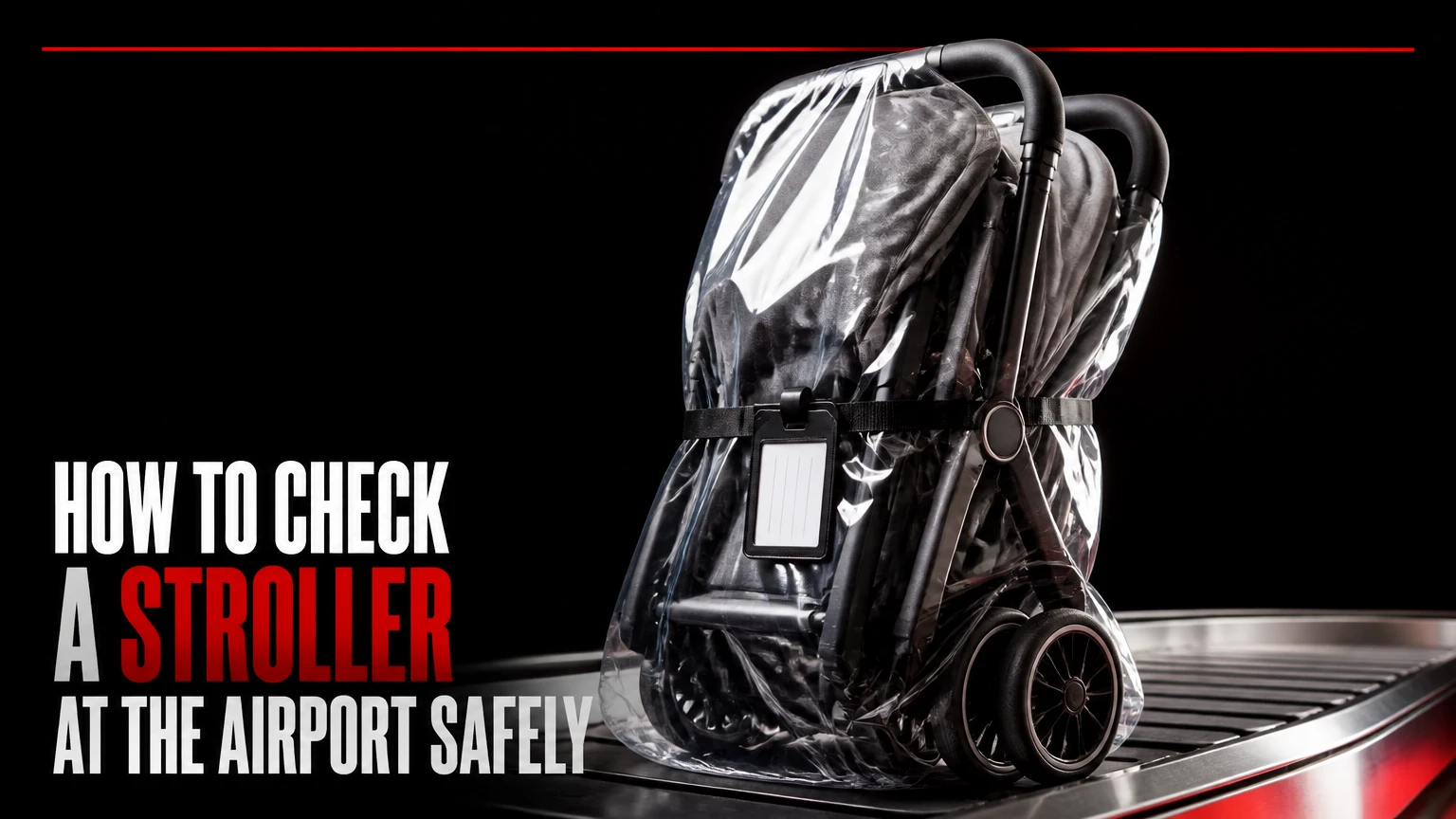
- Receive and attach the tag. Place the barcode tag on the frame or travel bag as directed, then retain the claim receipt.
- Complete screening. Airport security may X-ray the folded stroller, inspect it manually, or direct it to another screening point.
- Hand over the stroller. Counter-checked equipment goes into the baggage system; gate-checked equipment goes to airline or ramp staff near boarding.
- Collect it after landing. Look first at the aircraft door, then the oversize-baggage office or carousel if staff do not return it there.
The Transportation Security Administration says, “Remove children from their strollers and car seats and fold them up” when preparing for screening. TSA procedures can differ by airport, checkpoint equipment, and the child’s size, so follow the officer’s instructions rather than assuming the stroller can roll through the checkpoint.
Should You Check the Stroller at the Counter or Gate?
The best option depends on whether terminal mobility is more valuable than avoiding a jet-bridge handoff. Counter checking is efficient for bulky equipment and travelers who can manage without a stroller, while gate checking is usually better when a child needs containment, a nap space, or storage during a long walk.
| Factor | Ticket-counter check | Gate check | Practical choice |
|---|---|---|---|
| Stroller access before boarding | None after check-in | Available through the terminal | Gate check for toddlers or long walks |
| Handoff location | Main check-in area | Gate or aircraft door | Counter check for heavy equipment |
| Security handling | Stroller is already checked | Family must present it at security | Counter check reduces checkpoint handling |
| Arrival delivery | Usually carousel or baggage area | Often aircraft door, but not guaranteed | Gate check for immediate terminal use |
| Connection risk | Usually transferred with baggage | May require rechecking or waiting | Verify with the operating airline |
| Best stroller type | Full-size, jogging, multi-piece | Compact, foldable, umbrella | Match the method to folded size |
How Counter Checking Works
Counter checking means surrendering the stroller at the airline’s check-in desk before airport security. The agent weighs or measures it when required, attaches a baggage tag, and sends it through the normal checked-equipment process. You will not have the stroller during security, the terminal walk, or most layovers.
Counter check a stroller when:
- The stroller is too large or heavy to carry safely to the gate.
- You are using a baby carrier or carrying the child comfortably.
- The stroller has several detachable pieces that are difficult to manage at boarding.
- The airport has a long security queue and limited space for folding equipment.
- The airline specifically directs large strollers to the ticket counter.
Ask whether the stroller is tagged to the final destination and whether it will be available during a connection. A counter-checked stroller generally follows the baggage itinerary, but a self-transfer, separate-ticket itinerary, or customs requirement can change that process.
How to Gate Check a Stroller
Gate checking means using the stroller after check-in, taking it through security, and handing it to airline staff before boarding. Request the tag at the gate agent’s desk before the boarding process becomes crowded, then fold the stroller at the location the agent identifies.
A reliable gate-check sequence is:
- Arrive at the gate with enough time to ask for the tag, preferably 45 minutes before departure.
- Tell the agent whether the stroller is a single piece or includes a car-seat adapter, bassinet, or second seat.
- Attach the tag to the frame, handle, or travel bag, and photograph the tag number.
- Keep the stroller clear of blankets, toys, food, and personal items.
- Use the stroller until the boarding agent announces the handoff point.
- Remove your child before entering the jet bridge or aircraft doorway.
- Fold and lock the stroller exactly where staff direct you.
- Take the claim stub and confirm the aircraft-door return procedure for arrival.
A gate tag is not permission to take an oversized stroller into the cabin. It identifies the item for ramp handling, and untagged equipment can be delayed because staff cannot match it to the flight.
What Does Stroller Checking Cost?
Stroller checking is commonly free for one stroller per child, and many airlines also allow one car seat without charging it as standard checked baggage. The free allowance is not universal, however, because airlines can apply different rules to oversized strollers, extra children’s equipment, international itineraries, and partner-operated flights.
| Equipment | Common airline treatment | Typical fee range | Main exception |
|---|---|---|---|
| One compact stroller | Free gate check or counter check | USD 0 | Cabin-size rules may apply if carried aboard |
| One full-size stroller | Often free | USD 0 | Oversize or weight limits may apply |
| One car seat | Often free when used for a child | USD 0 | Policy may differ for a separate, unaccompanied item |
| Stroller and car-seat travel system | Usually accepted as separate pieces | USD 0 to standard bag fee | Some carriers count pieces or apply oversize handling |
| Additional stroller | Standard baggage treatment | USD 35-200 typical | Fee depends on route and fare |
| Protective stroller bag | Passenger purchase | USD 20-150 typical | Airline rarely supplies a padded bag |
“Free” does not mean unlimited. Confirm the following before departure:
- Whether the allowance is per child, per reservation, or per family.
- Whether a stroller bag counts as a separate checked item.
- Whether the policy applies to infants traveling without a purchased seat.
- Whether the operating carrier, not the ticket seller, controls the rule.
- Whether a large jogging stroller has a published size or weight limit.
- Whether a codeshare partner accepts the same equipment allowance.
Airline policies change, so use the current baggage or traveling-with-children page for the operating carrier and keep a saved copy or screenshot. A customer-service response with the flight number can help when the published wording is ambiguous.
How Much Extra Time Should You Allow?
Families should allow about 30 extra minutes for counter processing and reach the gate at least 45 minutes before departure when a stroller needs a gate tag. Typical aircraft-door retrieval takes 10-15 minutes after landing, but the wait can be longer when the aircraft parks remotely, weather delays ramp work, or the stroller is sent to baggage claim.
| Travel task | Typical planning time | Why it varies |
|---|---|---|
| Counter tag and handoff | 10-30 minutes | Check-in queue, weighing, and equipment questions |
| Security with folded stroller | 10-25 minutes | Family lane, manual inspection, and checkpoint layout |
| Gate-tag request | 5-10 minutes | Agent availability and boarding-stage congestion |
| Jet-bridge handoff | 5-15 minutes | Aircraft type, gate design, and boarding order |
| Arrival-door retrieval | 10-15 minutes | Ramp staffing and unloading sequence |
| Oversize-baggage retrieval | 15-30 minutes | Separate delivery belt and airport layout |
| Connection buffer | 60-90 minutes preferred | Terminal transfer, security, and stroller delay |
The most common timing error is treating a gate-checked stroller like a carry-on bag. The stroller must be tagged and folded before boarding, and that work competes with boarding deadlines. With a connection shorter than 60 minutes, gate checking becomes less predictable because you may wait for delivery before navigating the next terminal.
How Should You Prepare the Stroller?
Stroller preparation reduces lost parts, accidental damage, and screening delays. Remove every loose accessory, empty every compartment, record the stroller’s condition, and place a visible identification label on the frame even when the stroller travels inside a protective bag.
Use this preparation checklist:
- Remove snack trays, cup holders, toys, phone holders, rain covers, and detachable canopies.
- Empty the under-seat basket and seat-back pockets.
- Deflate nothing unless the manufacturer or airline specifically requires it.
- Fold the stroller and test the latch before travel day.
- Lock the wheels only when staff request it or when the stroller is stationary.
- Attach your name, mobile number, and email to the frame.
- Put a second identification card inside the folded stroller or bag.
- Photograph all sides, wheels, handles, fabric, and accessories before handoff.
- Photograph the baggage tag and retain the receipt.
- Use a travel bag that fits without forcing the frame or leaving parts exposed.
Should You Use a Protective Bag?
A protective bag helps keep fabric and wheels clean, but a thin cover does not prevent crushing, bending, or rough conveyor handling. A padded travel case gives better protection, although it can increase handling time and may be treated as a separate item if the stroller is not inside it.
| Protection method | Typical price | Protection level | Handling trade-off |
|---|---|---|---|
| No bag | USD 0 | Lowest, exposed frame and fabric | Fast handoff, visible equipment |
| Lightweight nylon cover | USD 20-50 | Dirt and light rain | Easy to fold, limited impact protection |
| Padded stroller bag | USD 50-150 | Moderate impact and abrasion protection | Bulkier at the gate |
| Hard-sided case | USD 150-400 | Highest structural protection | Heavy, less practical for gate check |
| Manufacturer-specific case | USD 80-300 | Fit may be optimized for one model | May not cover detached accessories |
Do not leave the stroller inside a sealed bag if security or airline staff need to inspect it. Keep the bag open or accessible until the agent confirms the correct procedure.
Can a Stroller Go in the Cabin?
A stroller can enter the cabin only when its folded dimensions, weight, and storage method meet the operating airline’s rules and available overhead-bin space. A stroller that fits a published cabin-bag limit may still be gate checked if the aircraft has small bins, full bins, or a safety restriction.
Cabin carriage is most realistic for compact models that fold to approximately 22 x 14 x 9 inches, but that measurement is a common example rather than a universal airline standard. Measure the folded stroller, including wheels, handle extensions, bumper bars, and attached accessories.
| Cabin option | Typical folded specification | Storage location | Main limitation |
|---|---|---|---|
| Small travel stroller | About 22 x 14 x 9 inches | Overhead bin | Crew controls final acceptance |
| Umbrella stroller | About 40-45 inches long when folded | Usually gate checked | Often too long for cabin storage |
| Full-size stroller | Commonly over 25 inches in one dimension | Cargo hold | Rarely cabin eligible |
| Folding car-seat stroller | Model-specific, often 18-25 pounds | Overhead bin or closet | Weight and aircraft vary |
| Bassinet travel system | Multiple large components | Cargo hold | Separate-piece handling risk |
Never force a stroller into a bin or block an exit aisle. Keep a gate-check bag ready, because cabin approval is often a day-of-travel decision.
What Are the Alternatives to Checking a Stroller?
A baby carrier, cabin-sized stroller, or destination rental can replace ordinary checked handling, but each alternative solves a different problem. Carriers work best for short airport transfers, cabin-size models help with long terminal walks, and rentals make sense when damage risk outweighs the cost of transporting familiar equipment.
| Alternative | Typical cost | Airport mobility | Destination usefulness | Best fit |
|---|---|---|---|---|
| Soft baby carrier | USD 30-250 purchase | Hands-free, no storage basket | Useful all day | Infants and short transfers |
| Cabin-sized stroller | USD 100-700 purchase | High until boarding | Useful after landing | Frequent flyers |
| Destination rental | USD 15-60 per day | None before pickup | Equipment available on arrival | Heavy premium strollers |
| Airport wheelchair or assistance | Usually USD 0 | Staff-supported | Not a child stroller substitute | Disability or mobility needs |
| Borrowed destination stroller | USD 0-30 per day | None at departure airport | Depends on provider | Family visits and short trips |
A carrier is not always suitable for a child with medical needs, a parent with back or shoulder limitations, or a long airport transfer. Request airport assistance in advance when mobility needs affect the parent or child, and explain that the stroller is child equipment rather than ordinary luggage.
What Are the Airport Security and International Rules?
Airport security rules control screening, while the airline controls tagging, transport, and delivery. International travel adds customs, immigration, and transfer-airport procedures, so a stroller may be unavailable between flights even when the airline normally returns gate-checked items at the aircraft door.
At security:
- Remove the child before screening begins.
- Fold the stroller when the officer instructs you to do so.
- Place detachable accessories in a tray or carry-on.
- Expect manual inspection if the folded frame cannot pass the X-ray equipment.
- Ask for help if you cannot safely hold the child while collapsing the stroller.
At international transfer points, ask whether you must collect the stroller before customs. On some itineraries, checked baggage is transferred automatically; on others, passengers must retrieve baggage, clear customs, and recheck it. A gate-checked stroller may be delivered airside, landside, or at a designated oversize counter depending on the airport.
For a separate-ticket connection, assume you may need to collect and recheck the stroller. The baggage agreement from the first airline may not extend to the second carrier.
Where Do You Collect a Gate-Checked Stroller?
A gate-checked stroller is commonly returned at the aircraft door or jet bridge, but delivery at the baggage carousel or an oversize-baggage office is also possible. Ask the arrival agent before leaving the aircraft, because walking directly to baggage claim can make a door-delivered stroller difficult to recover.
Use this retrieval order:
- Wait near the aircraft door without blocking other passengers.
- Ask the flight attendant or ramp agent where gate-checked items will appear.
- Check the jet bridge and designated delivery area.
- If absent, visit the airline’s baggage service desk.
- Check the oversize-baggage belt before the standard carousel.
- Report non-delivery before leaving the secure or baggage area.
Keep the claim tag until the stroller is in your possession. A photo of the tag, stroller serial number, and pre-flight condition gives the airline useful evidence if the item is delayed or damaged.
What If the Stroller Is Damaged or Missing?
Report stroller damage or non-delivery to the airline’s baggage service desk before leaving the airport, then obtain a written incident number. Photograph the damage, keep receipts for necessary replacement equipment, and submit the carrier’s claim within the deadline stated in its contract of carriage.
Inspect these areas immediately:
- Wheel alignment and wheel locks.
- Frame joints, folding latch, and handle.
- Seat recline mechanism and harness.
- Canopy, basket, bumper bar, and adapters.
- Zippers, seams, and travel-bag straps.
- Car-seat attachment points if the stroller is a travel system.
A soft bag can hide a bent frame until the stroller is unfolded, so open it before leaving the terminal. Do not discard broken parts or packaging before the airline reviews the claim.
Common Mistakes When Checking a Stroller
The most damaging mistakes happen at handoff points, not during the flight. Families often arrive at the gate without a tag, leave detachable parts attached, or assume a stroller will appear at the aircraft door without confirming the airport’s procedure.
Avoid these errors:
- Skipping the gate agent: Ramp crews need an identifiable tag before loading the stroller.
- Leaving the basket full: Diapers, wipes, and toys can fall out or create screening problems.
- Checking loose accessories: Small parts are easier to lose than the frame.
- Failing to practice the fold: A complicated mechanism can delay boarding and frustrate the security line.
- Using an oversized protective bag: An ill-fitting bag can tear or separate from the frame.
- Assuming every connection works the same way: A stroller may be delivered at a different point on the return flight.
- Forgetting the claim stub: The tag number links the stroller to the baggage record.
- Photographing only the bag: Damage claims need evidence of the frame, wheels, fabric, and accessories.
Expert insight: Locking the wheels is useful while the stroller waits at a handoff point, but it does not protect the frame inside the cargo hold. The more effective protection is removing protruding parts and preventing the folded stroller from opening.
Expert insight: Gate checking reduces the time a toddler spends without a mobility device, but it increases the number of times a parent must manage a child, carry-on bags, and a folding frame. For solo travelers, counter checking plus a carrier can be safer than a complicated jet-bridge handoff.
Expert insight: A stroller bag can reduce cosmetic dirt while making delivery less recognizable. Put a bright identifier on the frame and the bag, and record a distinctive feature such as a colored strap or wheel cover.
Frequently Asked Questions About How to check a stroller at the airport
Do I need to buy a separate seat for my stroller?
No, a stroller does not occupy a passenger seat and is normally checked as child equipment. A child needs a purchased seat only when the child will occupy a seat during the flight. If you use an approved car seat onboard, confirm its certification label and the airline’s installation rules before travel.
Can I check a stroller and car seat together?
Usually, airlines accept a stroller and car seat as separate child-equipment items, often without a fee. A travel system may still be processed as multiple pieces, and a large combination can trigger special handling. Ask the operating carrier how it counts detachable frames, bassinets, adapters, and protective bags.
Is a stroller safer in a bag?
A properly fitted padded bag generally protects fabric and attachments better than no bag, but no soft bag guarantees protection from impact. A hard case offers stronger structural protection at a higher weight and price. Remove loose parts and photograph the stroller regardless of which protection method you choose.
Can I use my stroller until I board the plane?
Yes, gate checking usually allows terminal use until the boarding handoff. The stroller must be tagged, emptied, and folded before entering the aircraft. Some airports require an earlier handoff at the gate, particularly when staff need to transport equipment to a remote aircraft position.
What happens if my stroller is too large to gate check?
The airline may accept the stroller at the ticket counter, direct it to an oversize-baggage process, or refuse transport if it exceeds published limits or cannot be safely handled. Contact the carrier before travel with the folded dimensions and weight, especially for jogging and multi-seat models.
Can I take a stroller through airport security with my child inside?
Usually, the child must come out while the stroller is screened. TSA and other security agencies may require the folded stroller to pass an X-ray system or receive a manual inspection. Follow the local officer’s instructions, and use a carrier if holding the child during screening would be difficult.
Conclusion
To check a stroller at the airport, decide between counter check and gate check, remove loose items, obtain the correct tag, follow security instructions, and confirm the arrival delivery point. Gate checking preserves terminal mobility, while counter checking simplifies bulky equipment. Verify the operating airline’s current policy before departure, then keep photos and the claim receipt until the stroller is recovered.