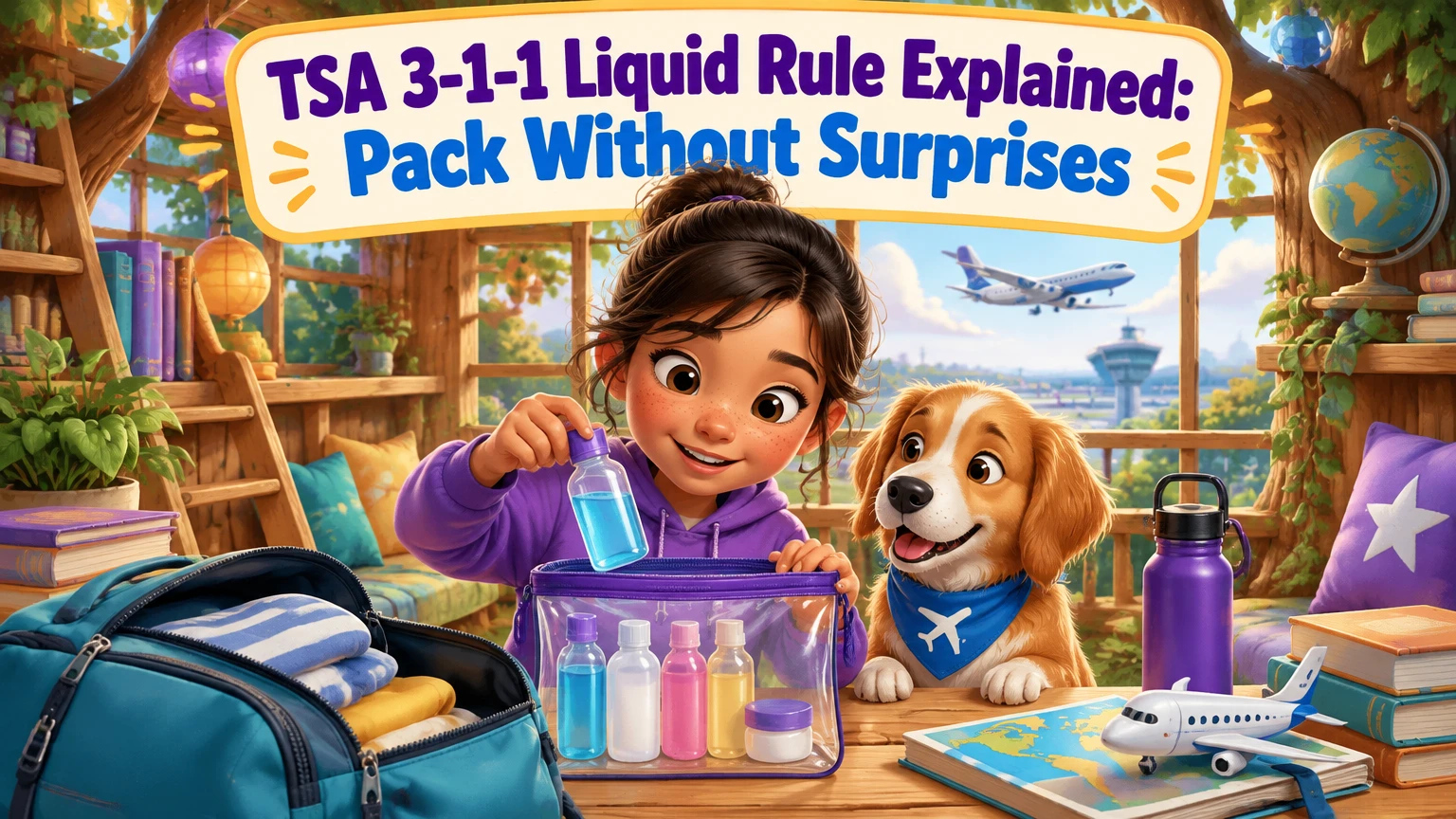
The TSA 3-1-1 Liquid Rule limits each carry-on liquid, aerosol, gel, cream, or paste container to 3.4 ounces (100 milliliters), requires containers to fit in one quart-sized resealable bag, and allows one such bag per passenger. Medical liquids, infant nutrition, and certain other items follow separate screening procedures.
Key Facts at a Glance
- A 3.4-ounce limit applies to the container’s maximum capacity, not the amount remaining inside.
- One passenger may bring one quart-sized, clear, resealable bag for ordinary carry-on liquids.
- A 6-ounce bottle containing 1 ounce of shampoo does not comply with the carry-on rule.
- Prescription medication, medically necessary liquids, breast milk, and infant formula can exceed 3.4 ounces when declared for separate screening.
- Food that can be poured, spread, pumped, squeezed, or smeared is generally treated as a liquid or gel.
- TSA officers and the airport checkpoint determine the final screening decision when an item is unusual or difficult to classify.
What Does the TSA 3-1-1 Liquid Rule Mean?
The TSA 3-1-1 Liquid Rule is a carry-on screening standard administered by the Transportation Security Administration at U.S. airport security checkpoints. The three numbers mean 3.4 ounces per container, 1 quart-sized bag, and 1 bag per passenger.
The rule applies to liquids, aerosols, gels, creams, and pastes because these materials can conceal prohibited substances and require different screening treatment from solid objects. The rule does not limit every liquid in every travel situation. It primarily governs ordinary liquids placed in cabin baggage before security screening.
The rule originated after the August 2006 disruption of a plot involving liquid explosives on transatlantic aircraft. TSA later introduced the familiar 3-1-1 framework as part of a broader aviation security system. The exact screening process can change as airports introduce updated equipment, but the 3.4-ounce carry-on standard remains the practical baseline for travelers.
What does each number represent?
| Number | Requirement | Practical meaning | Common failure |
|---|---|---|---|
| 3 | 3.4 fl oz maximum | Each container must hold no more than 3.4 U.S. fluid ounces, or 100 mL | A half-full 6-ounce bottle |
| 1 | 1 quart-sized bag | Ordinary liquid containers must fit in one clear, resealable bag | A second toiletry bag |
| 1 | 1 bag per passenger | Each traveler receives one ordinary liquids bag | One shared bag for several adults |
The 3.4-ounce figure is a rounded household expression of 100 milliliters. A product labeled 100 mL generally qualifies, while a product labeled 110 mL generally does not, even if its U.S. fluid-ounce conversion appears close.
Does the Container Size or Remaining Liquid Matter?
The container’s labeled capacity matters, not the volume of liquid left inside it. A 200 mL bottle with 30 mL remaining still exceeds the 100 mL carry-on limit because the screening concern is the container’s maximum capacity.
This rule creates the most common packing mistake. Travelers often carry a nearly empty full-size shampoo bottle, sunscreen tube, perfume bottle, or cosmetic jar because the remaining product would fit inside a travel container. TSA officers generally cannot approve it solely because the bottle is partly empty.
Look for the capacity printed, embossed, or molded on the container. A transparent bottle is not automatically compliant, and an unlabeled bottle can require additional inspection. The safest approach is to transfer the product into a container clearly marked 100 mL or less, then place it in the liquids bag.
| Container example | Amount remaining | Carry-on result | Reason |
|---|---|---|---|
| 3.4-ounce shampoo bottle | 2 ounces | Usually permitted | Capacity is within the limit |
| 6-ounce lotion bottle | 1 ounce | Not permitted under ordinary rules | Capacity exceeds 3.4 ounces |
| 100 mL perfume bottle | 75 mL | Usually permitted | Maximum capacity is 100 mL |
| 120 mL contact solution bottle | 20 mL | Not permitted under ordinary rules | Capacity exceeds 100 mL |
| 2-ounce toothpaste tube | 1.5 ounces | Usually permitted | Tube capacity is within the limit |
What Counts as a Liquid for TSA Screening?
TSA treats a substance as a liquid when it can be poured, pumped, squeezed, spread, sprayed, smeared, or brushed. The classification therefore includes many foods and personal-care products that travelers do not mentally label as liquids.
The physical state at the checkpoint matters. A frozen item may receive different treatment from the same item after it thaws, and a solid stick deodorant is handled differently from gel deodorant. When a product falls between categories, packaging and the officer’s inspection decision can affect the outcome.
Toiletries and personal-care products
| Product | Carry-on condition | Typical packing location | Key detail |
|---|---|---|---|
| Shampoo | 3.4 oz or 100 mL maximum | Quart bag | Solid shampoo avoids the liquid limit |
| Toothpaste | Tube capacity within 3.4 oz | Quart bag | A full-size tube may be refused |
| Mascara | Small container in quart bag | Quart bag | Liquid and gel mascara qualify |
| Perfume | Bottle within 3.4 oz | Quart bag | Fragile glass should be cushioned |
| Aerosol hairspray | Container within 3.4 oz | Quart bag | Airline hazardous-material limits may also apply |
| Gel deodorant | Container within 3.4 oz | Quart bag | Stick deodorant is not treated the same way |
| Liquid foundation | Container within 3.4 oz | Quart bag | Cream foundation may also require bag space |
| Nail polish | Small bottle in quart bag | Quart bag | Flammability rules may apply to checked quantities |
Common liquid or gel products include facial cleanser, moisturizer, sunscreen, shaving cream, hair gel, lip gloss, liquid soap, mouthwash, contact solution, liquid makeup, and aerosol dry shampoo.
Solid alternatives usually do not use quart-bag space. Shampoo bars, conditioner bars, stick deodorant, solid perfume, bar soap, toothpaste tablets, and powder makeup can simplify packing, although toothpaste tablets may require an explanation if their packaging is unfamiliar.
Foods and drinks
| Food or drink | Carry-on treatment | Example limit | Packing advice |
|---|---|---|---|
| Bottled water | Not allowed through ordinary screening | 0 oz before screening | Empty it and refill after security |
| Peanut butter | Treated as a spreadable liquid or gel | 3.4 oz | Use a small labeled jar |
| Yogurt | Treated as a liquid or gel | 3.4 oz | Freeze only if it remains solid at screening |
| Hummus | Treated as a spreadable liquid | 3.4 oz | Place it in the quart bag |
| Hard cheese | Usually treated as a solid | No 3.4 oz limit from this rule | Agricultural rules may apply internationally |
| Salsa | Treated as a liquid or gel | 3.4 oz | Pack a sealed travel container |
| Soup | Treated as a liquid | 3.4 oz | A large can belongs in checked baggage if permitted |
| Sandwich | Solid food | No 3.4 oz liquid limit | Sauces and spreads can change the analysis |
A sealed drink purchased before security cannot bypass the rule. Travelers may bring an empty bottle through the checkpoint and fill it after screening, subject to airport facilities and destination rules.
How Should You Pack Carry-On Liquids?
Pack carry-on liquids in five stages: classify the products, replace oversized containers, test the bag closure, separate exceptions, and present items according to checkpoint instructions. A careful traveler can usually complete the process in 10-20 minutes before leaving for the airport.
Step 1: Identify every liquid, aerosol, gel, cream, and paste
Inspect toiletries, cosmetics, snacks, medicines, cleaning products, and child-care supplies. Use the spill, spray, spread, squeeze, or pump test, but remember that some solid-looking foods, such as peanut butter, still qualify.
Step 2: Check each container’s maximum capacity
Read the printed capacity on the bottle, tube, jar, or aerosol can. Do not rely on the amount remaining, the container’s transparency, or an estimate based on its physical size.
Step 3: Reduce ordinary containers to 100 mL or less
Decant bulk products into travel containers with a capacity of 100 mL or less. Keep prescription medication and medically necessary products in their original packaging when practical, because labels can make screening more efficient.
Step 4: Load one clear, resealable quart-sized bag
Place ordinary liquids in one bag without forcing the zipper. The bag should close fully and remain intact. If the zipper requires stretching, remove items rather than hoping an officer will permit an overfilled bag.
Step 5: Separate declared exceptions
Keep medication, breast milk, formula, ice packs, and related supplies accessible. Tell the TSA officer about these items before screening begins, rather than hiding them inside the ordinary toiletries bag.
Step 6: Follow local checkpoint instructions
Some checkpoints ask travelers to remove the liquids bag. Some airports with computed tomography screening may allow liquids to remain inside the carry-on. TSA PreCheck procedures can also differ from standard lanes.
The presence of a CT scanner does not create a personal exemption from the 3.4-ounce rule. It changes the handling procedure, not the basic authorization of oversized ordinary liquids.
Which Items Are Exempt From the Ordinary 3-1-1 Limits?
Medical liquids, medically necessary gels, breast milk, infant formula, toddler drinks, and baby food may exceed 3.4 ounces when they are declared for separate screening. These exceptions are based on need and screening requirements, not on permission to bring unlimited ordinary toiletries.
Medical liquids and equipment
Prescription liquids, liquid medicine, insulin, inhalers, eye drops, injectable medication, and medically necessary cooling supplies can receive separate screening. TSA advises travelers to notify officers about medically necessary liquids and equipment before screening.
A prescription label is useful but is not the only basis for requesting an exception. Bring medication in original packaging when possible, carry supporting documentation when practical, and allow additional time for inspection. TSA may test, inspect, or open containers using procedures intended to preserve the item’s usability.
| Medical item | Ordinary bag requirement | Recommended action | Practical note |
|---|---|---|---|
| Insulin | May exceed 3.4 oz when medically necessary | Declare before screening | Carry supplies together |
| Liquid prescription | May be outside quart bag | Keep label available | Bring only a reasonable travel quantity |
| Eye drops | Small bottles usually fit the bag | Declare if medically necessary | Keep backup bottles accessible |
| Liquid cough medicine | May qualify as medication | Tell the officer | Do not conceal it in toiletries |
| Syringes | Permitted when associated with medication | Carry with medication | Do not place loose needles in a pocket |
| Ice pack for medication | May receive an exception | Declare its medical purpose | Frozen condition can simplify inspection |
Breast milk, formula, and infant food
Breast milk, formula, toddler drinks, baby food, and cooling accessories can exceed the normal 3.4-ounce limit when transported for a child. TSA states that a child does not have to be present for a passenger to transport breast milk, although the traveler should expect additional screening.
Keep bottles, storage bags, formula powder, water, and cooling packs together. Tell the officer what each item is before placing it on the conveyor. Officers may inspect containers and may use alternative screening methods when a traveler declines to open a container.
Cooling packs do not always need to be completely frozen when they support medically necessary items or infant supplies, but a frozen pack is generally easier to explain than a slushy or partially thawed one. Check the current TSA guidance before departure because checkpoint procedures and permitted quantities can change.
What Is Not Allowed in Carry-On Liquids?
The 3-1-1 rule does not make every small container legal. Flammable fuels, many chemical products, explosives, and prohibited self-defense sprays remain restricted or forbidden, while some items have separate Federal Aviation Administration or airline rules.
| Item | Carry-on result | Checked-bag result | Governing concern |
|---|---|---|---|
| Gasoline or lighter fluid | Prohibited | Prohibited | Flammable fuel |
| Bleach | Usually prohibited | Often prohibited | Corrosive chemical |
| Mace or pepper spray | Restricted or prohibited | Airline and federal limits apply | Self-defense chemical |
| Alcohol above 70% ABV | Generally prohibited | Dangerous-goods rules apply | High flammability |
| Alcohol between 24% and 70% ABV | Usually limited by quantity | Airline limits apply | Flammable beverage |
| Rubbing alcohol below 70% ABV | Small carry-on container may fit rule | Packaging rules still apply | Flammable liquid |
| E-cigarette liquid | 3.4 oz limit in carry-on | Battery devices generally cannot go in checked baggage | Liquid and lithium-battery rules |
| Paint thinner | Prohibited | Prohibited or restricted | Flammable chemical |
Alcohol is a frequent source of confusion. The 3.4-ounce rule addresses screening of carry-on containers, while aviation dangerous-goods rules can impose separate limits based on alcohol concentration, packaging, quantity, and whether the product is intended for personal consumption.
When an item is hazardous, checking it does not automatically solve the problem. Verify both TSA guidance and the airline’s dangerous-goods policy.
Can Larger Liquids Go in Checked Baggage?
Larger ordinary toiletries can often go in checked baggage, but checked baggage is not a universal workaround. A full-size shampoo bottle may be acceptable in checked luggage, while gasoline, bleach, lighter fluid, and other hazardous substances may remain prohibited.
| Item | Carry-on | Checked baggage | Packing method |
|---|---|---|---|
| 12-ounce shampoo | No under ordinary 3-1-1 rules | Usually allowed | Seal in a leak-resistant bag |
| Full-size sunscreen | No under ordinary rules | Usually allowed | Protect against pressure and leakage |
| Large mouthwash | No under ordinary rules | Usually allowed | Use original cap and secondary containment |
| Gasoline | No | No | Do not transport |
| Nail polish remover | Small quantity may fit | Airline limits may apply | Check flammable-liquid rules |
| Prescription supply | May exceed 3.4 oz | Usually allowed, but carry-on is safer | Keep essential doses with you |
| Infant formula | May exceed 3.4 oz with screening | Usually allowed | Carry enough for delays in cabin |
Pack essential medication, medically necessary supplies, and enough infant nutrition for delays in carry-on baggage rather than relying entirely on checked luggage. Checked bags can be delayed, lost, or inaccessible during a connection.
Do You Have to Remove the Liquids Bag at Security?
Travelers should follow the instructions of the specific security lane. Standard lanes commonly require the ordinary liquids bag to be removed and placed in a bin, while some CT-equipped lanes and TSA PreCheck lanes may allow it to remain inside the carry-on.
Airport equipment is not uniform. A terminal can have CT scanners in one lane and conventional X-ray equipment in another, and officers can change instructions during operational transitions. Prepare the bag so it can be removed quickly even when removal is not expected.
| Checkpoint situation | Likely handling | Traveler response |
|---|---|---|
| Standard X-ray lane | Liquids bag often removed | Place it in a bin when instructed |
| CT screening lane | Bag may remain inside | Follow the officer’s direction |
| TSA PreCheck lane | Liquids may often remain packed | Keep exceptions accessible |
| Medical exception | Separate inspection likely | Declare before screening |
| Crowded or changing lane | Procedure can vary | Ask the officer before unloading |
A compliant bag can still receive additional inspection. Compliance reduces avoidable problems, but it does not guarantee that TSA will not examine an item.
Which Travel Containers and Bags Work Best?
A simple clear resealable bag is the lowest-risk option because its size and closure are easy for officers to understand. Structured toiletry cases can be convenient, but a product marketed as “TSA approved” is not automatically accepted if it cannot fit the airport’s interpretation of a quart-sized bag.
| Packing option | Typical price | Main advantage | Main limitation |
|---|---|---|---|
| Disposable resealable bag | $0.05-$0.25 | Cheap and visibly clear | Tears and holds fewer bulky items |
| Clear structured toiletry case | $8-$25 | Reusable and organized | May exceed practical quart volume |
| Silicone travel bottles | $5-$15 per set | Flexible and reusable | Can leak if the cap is poorly seated |
| Rigid plastic bottles | $3-$12 per set | Lightweight and inexpensive | Can crack or retain product |
| Solid toiletry kit | $5-$30 | Reduces liquid volume | Not suitable for every formulation |
Use a flat bag when flying internationally, especially through airports that provide or require a specific transparent bag. A structured case that passes at a U.S. airport may be rejected elsewhere because foreign security agencies can enforce different dimensions or packing procedures.
The bag itself is not the only constraint. A quart-sized bag has limited usable volume, and large bottle shoulders, pumps, and thick caps waste space. Travel bottles with narrow profiles often hold more usable product than wide cosmetic jars.
How Do U.S. and International Liquid Rules Differ?
U.S. airports use the TSA 3-1-1 framework, while airports in the United Kingdom, European Union, Canada, and other regions may apply different bag dimensions, scanner procedures, and temporary restrictions. The safest international strategy is to use containers of 100 mL or less and a simple transparent bag.
The broad 100 mL container limit is common internationally, but the bag requirement is not identical everywhere. Some airports limit the number of containers, specify bag dimensions, require the bag to be presented separately, or use local airport-issued bags.
| Travel location | Common container limit | Bag or procedure variation | Best preparation |
|---|---|---|---|
| United States | 100 mL per ordinary container | One quart-sized bag is the practical standard | Use a clear resealable quart bag |
| United Kingdom | Commonly 100 mL | Airport-specific bag and scanner rules can apply | Check the departure airport |
| European Union | Commonly 100 mL | Local implementation and scanner rollout vary | Use a flat transparent bag |
| Canada | Commonly 100 mL | CATSA procedures apply at Canadian checkpoints | Check CATSA before departure |
| Connecting airport abroad | Often 100 mL | Transit security can rescreen purchases | Keep duty-free receipts and seals |
Duty-free liquids can receive special treatment when sealed in a security bag with proof of purchase, but a sealed bag is not guaranteed to pass every connection. A traveler who changes terminals or countries may face another security inspection.
What Common Mistakes Cause Confiscation?
Most liquid-rule problems arise from container capacity, bag overflow, forgotten food, undeclared exceptions, or confusion between TSA screening and airline hazardous-material rules. Fixing these errors at home is faster and cheaper than resolving them at the checkpoint.
- Packing a nearly empty full-size bottle. Replace it with a 100 mL container.
- Using two small liquid bags. Consolidate ordinary liquids into one bag or move nonessential items to checked luggage.
- Forcing the zipper closed. Remove bulky products until the bag closes without strain.
- Forgetting spreadable foods. Treat peanut butter, hummus, yogurt, jam, and salsa as liquids or gels.
- Hiding medication in the toiletry bag. Separate and declare medically necessary items.
- Assuming a TSA-approved label guarantees compliance. Check the actual container capacity and bag dimensions.
- Packing hazardous liquids in checked baggage without checking rules. Verify the FAA and airline requirements.
- Relying on a CT scanner exemption. Scanner technology may change removal instructions, but it does not authorize every oversized liquid.
An officer who questions a medically necessary item should be told clearly what the item is and why it is needed. Request a TSA supervisor if necessary, but remain calm and avoid delaying the lane while making the request.
How Can You Save Space in the Liquids Bag?
Replace products that do not need to be liquid, prioritize formulations used daily, and buy destination toiletries after security when the cost and availability make sense. Solid shampoo, bar soap, stick deodorant, toothpaste tablets, powder foundation, and solid fragrance can release most of the bag’s capacity.
A practical packing order is:
- Medication and medically necessary products, handled separately.
- Products unavailable at the destination.
- Small amounts of sunscreen, moisturizer, toothpaste, and cleanser.
- Optional cosmetics and duplicate products.
- Items that have solid or powder alternatives.
Do not decant products that degrade quickly, react with plastic, or require sterile packaging. Contact-lens solution, prescription medicine, and some skin treatments are better carried in their original containers.
TSA Liquid Rule FAQ
Can I bring a 4-ounce container if it only holds 3 ounces?
No. A 4-ounce container exceeds the ordinary 3.4-ounce maximum even when only 3 ounces remain. Transfer the product to a container labeled 100 mL or less, or place the original container in checked baggage if the product is permitted there.
Does toothpaste count as a liquid?
Yes. TSA generally treats toothpaste as a gel or paste, so the tube must have a capacity of 3.4 ounces or less and fit inside the quart-sized liquids bag. Toothpaste tablets and some dry tooth powders are handled differently, but unusual products can receive additional inspection.
Can I bring baby formula without a child?
TSA allows breast milk, formula, toddler drinks, and baby food in reasonable quantities for travel, and a child does not necessarily have to be present when transporting breast milk. Declare these items before screening and keep them accessible for separate inspection.
Can I bring frozen water through security?
Frozen water may be treated differently from liquid water, but it must remain solid when presented for screening. Once it melts, the ordinary liquid restriction applies. Airport officers control the final decision, so an empty bottle is the most reliable way to carry water through security.
Can I bring a disposable lighter?
A standard disposable lighter is generally treated under separate lighter and fire-safety rules rather than the 3-1-1 liquid rule. Travelers should check current TSA and airline guidance because torch lighters, fuel, and lighter fluid have different restrictions.
Is the TSA 3-1-1 rule changing because of new scanners?
New CT scanners can change whether travelers must remove liquids and electronics from their bags, but they do not automatically eliminate the ordinary 3.4-ounce container limit. Follow the instructions at the specific checkpoint, since equipment and procedures vary by airport and lane.
The Bottom Line
The TSA 3-1-1 Liquid Rule Explained in one sentence is this: carry-on liquid, aerosol, gel, cream, and paste containers must normally be 3.4 ounces or 100 mL or smaller, fit in one quart-sized resealable bag, and be limited to one bag per passenger. Check the container capacity, separate medical and infant exceptions, and follow local checkpoint instructions. Expect the TSA 3-1-1 Liquid Rule to govern ordinary toiletries even when an airport uses CT scanners.
Rimon · Travel With Rimon
More articles by this author →