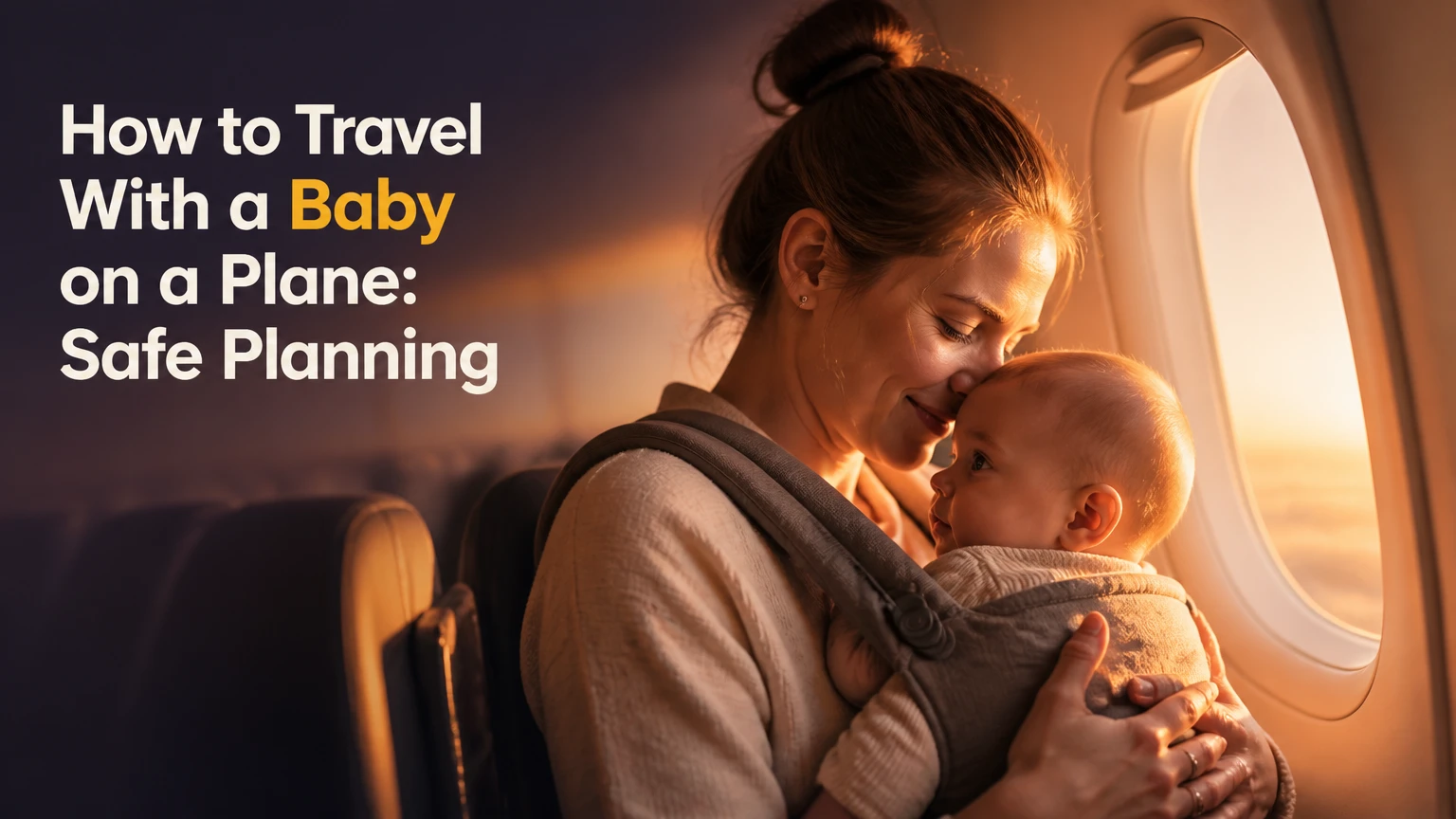
How to Travel With a Baby on a Plane: Safe Planning
How to travel with a baby on a plane means coordinating the infant’s ticket, documents, safety restraint, feeding, luggage, and airport routine before departure. The safest arrangement is a ticketed seat with an aircraft-approved rear-facing child restraint, while a lap infant costs less but remains unsecured during turbulence. Airline and national rules control the details.
Key Facts / Quick Answer
Children under 2 can usually travel as lap infants or in their own paid seats, but policies and fares vary by airline.
The Federal Aviation Administration recommends an approved child restraint system for every young child, rather than holding a baby during flight.
A baby’s passport is generally required for international travel, including infants; domestic identification rules vary by country and airline.
Breast milk, formula, baby food, and cooling packs receive special screening treatment in the United States, but travelers must declare them to TSA officers.
Gate-checking a stroller usually preserves access through the terminal, but a protective bag reduces damage and does not guarantee delivery at the aircraft door.
A diaper bag should contain supplies for the planned journey plus at least 4-6 additional hours for delays, diversions, and missed connections.
What Does Flying With a Baby Involve?
Flying with a baby involves four separate systems: airline transportation rules, airport security, child-restraint safety, and infant care. A successful plan treats each system separately because an airline may accept a stroller that airport security must inspect, while a car seat that is legal in a vehicle may not be approved for aircraft use.
A baby is normally classified as an infant until the second birthday, although the exact definition differs by carrier. Many airlines set a minimum flying age of 7-14 days, and some request a physician’s letter for very young newborns. Medical advice matters more when the baby was premature, recently ill, has heart or lung disease, or has had ear surgery.
The FAA states that “the safest place for your child under age 2 is in a child safety restraint system (CRS) or device, not on your lap.” That recommendation addresses unexpected turbulence, not only crashes. An adult cannot reliably brace a baby against rapid vertical movement.
The three decisions to make first
- Whether the baby will be a lap infant or occupy a purchased seat
- Which documents the destination, transit country, and carrier require
- Whether the selected stroller, car seat, bassinet, and feeding equipment fit the itinerary
Which Seating Option Should You Choose?
A ticketed seat with an aircraft-approved child restraint provides the strongest protection and gives the caregiver a defined place for feeding, sleeping, and handling personal belongings. A lap infant is usually cheaper, but the baby must be held whenever the seat-belt sign requires it and cannot use the adult seat belt.
| Arrangement | Typical USD cost | Safety position | Best practical use |
|---|---|---|---|
| Lap infant, domestic | $0-$75 plus taxes | Held by adult, no CRS | Short domestic flight with a tight budget |
| Lap infant, international | About 10% of adult fare plus taxes | Held by adult, no CRS | International trip where a second fare is unaffordable |
| Ticketed seat with CRS | 75%-100% of adult fare | Rear-facing approved restraint | Flights longer than 3 hours or safety-first travel |
| Bulkhead seat with bassinet | Seat fare plus $0-$150 selection fee | Baby held during turbulence | Long-haul flight with an eligible sleeping infant |
| Purchased seat without CRS | Full or child fare | Adult seat belt is not suitable for infants | Usually poor value for babies unable to sit safely |
A lap infant does not receive a separate seat, so a family must not assume that an empty neighboring seat is available. Seat-sharing tactics, such as booking aisle and window seats, can sometimes leave the middle seat open, but airlines may assign it to another passenger and cannot promise a free space.
A ticketed seat is particularly valuable for flights with turbulence, overnight segments, or two adults who need predictable rest. The car seat also creates consistency between the airport transfer, aircraft cabin, and destination vehicle.
When is a lap infant reasonable?
A lap arrangement may be reasonable when the flight is short, the airline permits it, the adult can hold the baby comfortably, and the family accepts that the child will remain unsecured during taxi, takeoff, landing, and turbulence. It is less practical for solo caregivers, red-eye flights, or babies who sleep only in a contained space.
How do bassinets work?
An airline bassinet is a small cot attached to a bulkhead, usually on selected long-haul aircraft. It must be requested before departure, is often allocated after the reservation rather than guaranteed by it, and cannot be used during taxi, takeoff, landing, or turbulence.
| Bassinet variable | Typical range or rule | What to verify |
|---|---|---|
| Maximum baby weight | 10-11 kg, or 22-25 lb | Carrier and aircraft-specific limit |
| Maximum baby length | About 70-80 cm | Cot dimensions, not only weight |
| Request timing | At booking to 4 weeks before departure | Written confirmation and airport check-in |
| Available positions | 1-4 per aircraft | Aircraft type and cabin configuration |
| Use during flight | Restricted during turbulence | Crew instruction overrides previous approval |
Bulkhead seats can have fixed armrests, limited under-seat storage, and bassinet fees. A bassinet reservation also does not eliminate the need to bring a safe holding plan for descent, turbulence, and landing.
How Do You Book and Check In?
Book the infant as a passenger from the beginning, then confirm the carrier’s infant policy directly before payment. The reservation must show the baby’s name, date of birth, and travel status, because an undeclared infant can create seating, weight-and-balance, or document problems at the airport.
Check whether the airline permits one lap infant per accompanying adult and whether the aircraft has an oxygen-mask limitation for infants in a row. International itineraries may require infant taxes, a passport, visas, transit permissions, or proof of onward travel even when the child is not occupying a seat.
| Booking task | Recommended timing | Document or confirmation |
|---|---|---|
| Add infant to reservation | At initial booking | Infant name and date of birth |
| Request bassinet | 4-8 weeks before departure | Carrier confirmation number |
| Verify minimum flying age | Before payment | Airline child-travel policy |
| Check passport validity | 2-6 months before travel | Destination and transit rules |
| Confirm seats and CRS location | 24-72 hours before departure | Seat map and aircraft approval |
| Reconfirm after aircraft change | Immediately after notification | New seat and bassinet status |
Which documents does a baby need?
For international travel, a baby generally needs an individual passport and any visa or electronic travel authorization required for that nationality. A birth certificate can establish age or parentage, but it normally does not replace a passport for crossing an international border.
For domestic travel, requirements depend on the country. In the United States, TSA does not require children under 18 to show identification when traveling with an adult on domestic flights, but an airline may request proof of age for an infant fare. Carry a birth certificate or equivalent record in an accessible folder.
A solo parent or adult traveling with a child may need a consent letter, custody order, death certificate, or other parental documentation. Check the destination embassy, transit country, and airline rather than relying on the departure country’s policy.
How Does Airport Security Work With Baby Supplies?
Airport security usually permits breast milk, formula, toddler drinks, baby food, and cooling packs in quantities greater than the standard liquid limit when those items are needed for the journey. In the United States, TSA asks travelers to remove these supplies for separate screening and may test containers or inspect them without opening them.
TSA allows breast milk and formula in carry-on bags, including quantities exceeding 3.4 ounces or 100 milliliters. A traveler should tell the officer at the start of screening, separate the supplies from ordinary liquids, and allow extra time for inspection.
| Item | Carry-on treatment in the United States | Practical packing method |
|---|---|---|
| Breast milk | Reasonable quantity, separate screening | Bottles in a clear pouch |
| Powdered formula | Permitted, separate screening may apply | Premeasured portions and empty bottles |
| Ready-to-feed formula | Greater than 3.4 oz allowed for baby travel | Original containers when possible |
| Baby food pouches | Permitted for the child’s journey | Group with feeding supplies |
| Ice or gel packs | Permitted when used with milk or food | Keep frozen or partially frozen |
| Breast pump | Carry-on equipment | Place batteries and cables together |
Security procedures outside the United States vary. The United Kingdom, European Union airports, Canada, Australia, and other jurisdictions may apply different limits, testing methods, or container requirements. The departure and transit airports matter, not only the airline.
A stroller may pass through an accessible screening lane, x-ray equipment, or manual inspection. The baby may need to come out of the stroller or carrier, although a screening officer can provide instructions based on the equipment and checkpoint.
What Gear Should You Bring?
The most useful travel gear is compact, replaceable, and usable during delays. A large stroller, multiple specialized gadgets, and a full-size diaper backpack can slow security screening and make transfers harder, while a small number of high-value items prevents avoidable disruption.
A practical carry-on kit includes:
- Diapers for the planned travel time plus 4-6 extra hours
- Wipes, changing mat, diaper cream, and sealable waste bags
- Breast milk, formula, bottles, burp cloths, and feeding utensils
- Two complete baby outfits and one clean adult shirt
- Pacifiers, a lightweight blanket, and a familiar sleep item
- Prescribed medicine in original packaging, with dosing instructions
- Baby carrier, stroller, and protective car-seat bag
- Passports, birth certificate, consent letter, and medical information
How should you handle a stroller and car seat?
Gate-check a stroller when the airport and carrier permit it, because the stroller remains available for terminal transfers and usually goes to the aircraft door. Confirm the delivery point at the gate, since some airports return gate-checked items at the jet bridge while others send them to baggage claim.
Use a protective bag for gate-checked strollers and car seats. Remove detachable accessories, label every component with a phone number, and photograph the equipment before handing it over. Gate checking reduces carrying effort but exposes gear to handling damage and delayed delivery at connections.
A car seat used in the aircraft must display the required aviation approval. In the United States, look for wording such as “This restraint is certified for use in motor vehicles and aircraft” or the applicable FAA-approved label. European and other national systems may use different approval markings.
| Equipment | Cabin or check-in choice | Typical dimensions or capacity | Main risk |
|---|---|---|---|
| Infant car seat | Cabin with paid seat | 40-45 cm wide typical | Too wide for aircraft seat |
| Compact stroller | Gate check or cabin if approved | Folded length under 55 cm typical | Overhead-bin rejection |
| Full-size stroller | Gate check | 8-15 kg typical | Damage or delayed return |
| Baby carrier | Cabin personal item | 0.5-1.5 kg typical | Baby removal at screening |
| Bassinet sheet | Carry-on | Cot-specific fit | Airline may prohibit loose bedding |
Do not use an inflatable cushion, travel hammock, or unapproved seat extender as a substitute for an aircraft-approved restraint. Cabin crew can require removal, and such products may obstruct evacuation or violate the carrier’s conditions of carriage.
What Is the Best Flight-Day Routine?
The best flight-day routine reduces transitions rather than trying to control every minute. Arrive about 2 hours before a domestic departure and 3 hours before an international departure as a typical starting point, then add time for parking, documentation, security, medication, and a connection.
- Feed and change the baby before leaving for the airport.
- Keep passports, infant records, and the reservation number together.
- Ask the check-in agent about stroller delivery and seat availability.
- Clear security with milk, formula, food, and medicines separated.
- Refill water after security, then prepare bottles according to safe-feeding instructions.
- Use the stroller until the gate when permitted.
- Board early only if installing a CRS or organizing the row requires it.
- Keep the baby in the approved restraint whenever the crew directs it.
- Offer breast milk, formula, or a pacifier during descent if the baby accepts it.
- Check the aircraft door area before leaving for gate-checked equipment.
The family does not need to board first if the baby will sit on a lap. Early boarding extends the time in a confined cabin, so one adult can board early with equipment while another remains at the gate with the baby when the airline allows that arrangement.
How Can You Manage Feeding, Sleep, and Diapers?
Feeding, swallowing, and familiar sleep cues help manage cabin changes, but they do not guarantee a quiet flight. A baby may refuse a bottle, sleep through pressure changes, or cry because of hunger, fatigue, heat, illness, restraint discomfort, or unfamiliar noise.
Offer a feed or pacifier during the initial climb and especially during descent, when pressure changes can become uncomfortable. Start before the baby becomes distressed, because a crying infant may have difficulty coordinating sucking and swallowing. Breastfeeding during flight is generally permitted, subject to local law and airline cabin procedures.
A baby with a cold, severe nasal congestion, ear infection, fever, vomiting, or breathing difficulty may need medical advice before flying. The American Academy of Pediatrics notes that air travel is usually safe for healthy infants, but individual conditions change that assessment. Decongestants should not be given to infants unless a clinician specifically prescribes them.
| In-flight need | Pack in reach | Typical response |
|---|---|---|
| Feeding | Two bottles, milk or formula, bib | Offer during descent |
| Diapering | 6-10 diapers on a short trip | Change before boarding |
| Clothing accident | Two baby outfits, one adult top | Replace wet or soiled layers |
| Sleep disruption | Pacifier, sleep sack, familiar cloth | Recreate one home cue |
| Pain or illness | Prescribed medicine and instructions | Contact clinician before dosing |
| Entertainment | Teether, soft book, two quiet toys | Rotate every 20-30 minutes |
Airplane lavatories usually contain a fold-down changing table, but space is limited. Change the diaper shortly before boarding, use a compact changing pouch, and avoid relying on overnight diapers as the only protection because leaks depend on fit and the baby’s output.
What Does Flying With a Baby Cost?
Flying with a baby costs anywhere from $0 for some domestic lap-infant fares to the full adult fare for a ticketed seat, with international lap infants commonly priced near 10% of the adult fare plus taxes and carrier charges. The advertised ticket price excludes possible seat selection, baggage, parking, and equipment costs.
| Cost item | Typical USD range | When charged |
|---|---|---|
| Domestic lap infant | $0-$75 plus taxes | Reservation or check-in |
| International lap infant | 10% of adult fare plus taxes | Ticket purchase |
| Infant’s own seat | 75%-100% of adult fare | Ticket purchase |
| Bassinet or bulkhead selection | $0-$150 | Seat assignment |
| Extra checked baggage | $0-$100 per bag | Fare or airport |
| Protective car-seat bag | $20-$80 | Before departure |
| Airport parking or transfer | $20-$150 | Travel day |
Airline rules determine whether a stroller and car seat are free, whether they count toward baggage limits, and whether a fare includes an infant’s checked bag. A low base fare can become expensive after seat selection and equipment charges.
The most reliable budget is built from the airline’s infant policy, the fare conditions, and the airport’s connection costs. Price the safer ticketed-seat option before deciding that a lap infant is automatically cheaper, especially when a child fare or reward-seat availability reduces the difference.
Which Travel Method Fits Your Trip?
The best travel method depends on flight duration, budget, adult support, infant age, and ground transportation at the destination. Safety and convenience generally improve when the baby has a ticketed seat and approved CRS, while cost and flexibility often favor a lap arrangement.
| Trip condition | Preferred arrangement | Reason | Avoid when |
|---|---|---|---|
| 1-hour domestic flight | Lap infant or CRS | Short cabin time | Adult cannot hold baby safely |
| 4-hour daytime flight | Paid seat with CRS | More space and restraint | Approved seat unavailable |
| 8-hour overnight flight | Paid seat with CRS or bassinet | Sleep and caregiver recovery | Bassinet limits do not fit |
| Solo adult traveler | Paid seat with CRS | Hands-free transitions | Seat cost exceeds budget |
| Two adults, tight budget | Lap infant | Lowest fare | Frequent turbulence expected |
| Rental car at destination | Paid seat with CRS | Same restraint continues | Seat lacks aircraft approval |
A bassinet is a comfort tool, not a safety restraint. The baby must be removed when the crew instructs, and the adult must hold the child during restricted phases of flight.
What Should You Do in Special Situations?
Newborn travel, long-haul flights, connections, and solo-parent trips require different safeguards. The correct plan changes with the baby’s health, citizenship, feeding method, sleep schedule, and the number of adults available to carry equipment.
Newborn travel
Confirm the airline’s minimum age before buying a nonrefundable fare. A baby younger than 7-14 days may need a physician’s letter, and a premature infant may need individualized clearance even after reaching the carrier’s stated minimum.
Long-haul travel
Choose a nonstop route when the price difference is manageable. One connection adds another security process, boarding sequence, diaper change, and probability of a missed bag or gate-checked item.
Solo adult travel
Use a wearable carrier for terminal movement, but expect to remove the baby at security. A paid seat with an approved CRS is easier for feeding, toileting, and turbulence than holding an infant for 8-12 hours.
Connections
Allow at least 90 minutes for a domestic connection and 2-3 hours for an international connection when traveling with a stroller, infant supplies, or a terminal change. Verify whether gate-checked equipment is returned at the connection or transferred automatically.
Breastfeeding and pumping
Carry pump parts in a clean pouch, bring charging adapters, and plan for storage if milk must remain cold. A pump may be screened separately, while local airport facilities and airline privacy policies vary.
What Mistakes Cause the Most Problems?
The most damaging mistakes are usually administrative rather than behavioral. Families often bring adequate diapers but lack an infant reservation, an acceptable document, a compatible CRS, or enough time to resolve an aircraft or seat change.
Expert insight: A gate-checked stroller is useful only if the family confirms the retrieval point. At some airports, “gate delivery” means the jet bridge; at others, the item appears at oversized baggage, which can require a long walk without the stroller.
Expert insight: Boarding early is valuable for installing a car seat, but it is counterproductive for a lap infant when both adults must remain seated with the baby for an additional 30 minutes. Divide the task instead of automatically preboarding everyone.
Expert insight: The most important spare item is often an adult shirt. A single spit-up or milk leak can make the caregiver cold, uncomfortable, and less able to manage the remaining journey.
Avoid these errors:
- Assuming every airline accepts the same infant belt or bassinet
- Packing milk without declaring it at security
- Checking the only car seat when the destination requires a vehicle
- Choosing a connection shorter than the airport’s normal minimum
- Giving new food, medicine, or sleep products on travel day
- Waiting until descent begins before offering a pacifier or feed
- Placing passports and infant documents inside checked luggage
Frequently Asked Questions About How to travel with a baby on a plane
What is the youngest age a baby can fly?
The youngest permitted age depends on the airline, with common minimums between 7 and 14 days. A carrier may request a medical certificate for a newborn, while a pediatrician may advise delaying travel after premature birth, respiratory illness, fever, or a recent procedure. Confirm both airline policy and medical suitability.
Can a baby sleep in a car seat on a plane?
A baby can sleep in an aircraft-approved car seat when the seat is installed in the child’s purchased aircraft seat and the crew permits its use. The restraint must remain within the manufacturer’s instructions, and an adult should not place a rear-facing seat in a location where it blocks another passenger’s exit.
Can I bring frozen breast milk through airport security?
In the United States, frozen breast milk is generally allowed in carry-on baggage in reasonable quantities for the journey, with ice or gel packs used to keep it cold. Declare it before screening and separate it from ordinary liquids. Other countries may apply different inspection or quantity rules.
Should I choose a window or aisle seat with an infant?
An aisle seat provides easier access to the lavatory and overhead items, while a window seat offers a wall for privacy and fewer passing passengers. For a ticketed CRS, confirm that the restraint is allowed in the chosen position because some carriers require a window seat.
How many diapers should I pack for a flight?
Pack the expected number for the complete door-to-door journey, then add enough for 4-6 extra hours. A two-hour flight can become a six-hour travel day after security, boarding, delays, and baggage collection. Put the full reserve in carry-on baggage, not checked luggage.
Can I use a baby carrier during takeoff and landing?
Airlines differ on whether a soft carrier may remain in use during taxi, takeoff, and landing. Many require the baby to be held or placed in an approved aircraft seat, and some prohibit carriers during critical flight phases. Follow the cabin crew’s instruction rather than assuming a carrier is accepted.
Conclusion
How to travel with a baby on a plane becomes manageable when the family separates safety, documentation, security, equipment, and comfort decisions. Declare the infant during booking, carry destination-appropriate documents, use an approved CRS when possible, pack 4-6 hours of reserve supplies, and verify every rule with the operating airline before departure.