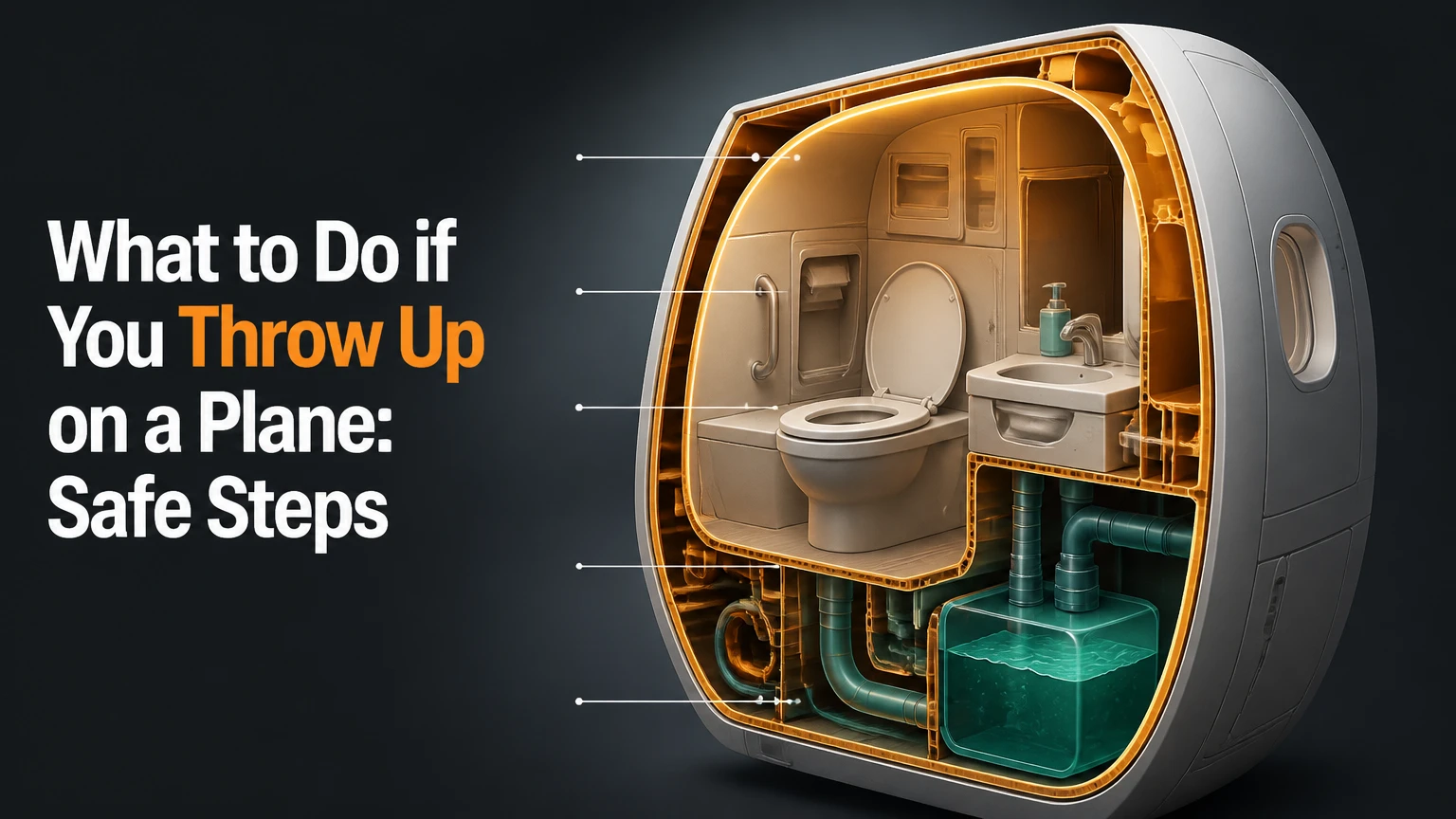
What to Do if You Throw Up on a Plane: Safe Steps
What to do if you throw up on a plane depends on whether vomiting is caused by motion sickness, illness, anxiety, or another medical problem. Use the seatback bag or lavatory when safe, alert a flight attendant, seal contaminated materials, and take small sips of fluid. Seek urgent help for blood, severe pain, confusion, or repeated vomiting.
Quick answer
Keep the air-sickness bag, a second bag, tissues, and wipes within reach before nausea peaks.
During turbulence or an illuminated seat-belt sign, stay seated and use the bag rather than walking to the lavatory.
Tell the cabin crew after vomiting. They can provide replacement bags, gloves, wipes, water, and medical assessment.
Sip 5-10 milliliters of water every few minutes instead of drinking a full cup.
Motion sickness often improves after turbulence ends, while fever, diarrhea, severe pain, or repeated vomiting suggests another cause.
Airlines do not generally apply a fixed vomit-cleaning fee, and passengers are not automatically liable for the full cost of a diversion.
What to Do if You Throw Up on a Plane
The safest response is containment first, communication second, and recovery third. Stop reading, gaming, or looking down; place the bag against your mouth, keep your torso slightly forward, and use the call button when the immediate episode ends.
If the seat-belt sign is off and the lavatory is close, a passenger with several minutes of warning can ask permission from a flight attendant before standing. If turbulence begins, the lavatory is occupied, or the sign is lit, remain buckled and use the bag. A fall in the aisle or lavatory can cause more serious injury than the vomiting itself.
The immediate five-step sequence
- Secure a container. Use the seatback air-sickness bag. If it is missing, ask a nearby passenger or press the call button for another bag.
- Protect your airway and clothing. Lean slightly forward rather than lying back. Keep glasses, phones, passports, and loose clothing away from the opening.
- Call the crew. State, “I have vomited and need another bag, wipes, and water.” Clear information gets a faster response than repeated apologies.
- Seal the waste. Fold or press the bag closure, place it inside a second bag, and hand it to the crew. Do not return a used bag to the seatback pocket.
- Recover gradually. Rinse your mouth, wait several minutes, then take small sips. Avoid a large meal until nausea settles.
Why Do Passengers Vomit During Flights?
Air travel vomiting is most often a motion-sickness response, but the same symptom can come from infection, food poisoning, migraine, pregnancy, medication, alcohol, anxiety, or a strong cabin odor. The cause affects whether the episode should end after turbulence or needs medical attention.
Motion sickness occurs when the brain receives conflicting movement signals. The inner ear detects acceleration, turning, and turbulence, while the eyes may see a stable cabin. The vestibular system then sends signals to brain regions that influence nausea, sweating, salivation, and vomiting.
Cabin pressure changes can increase gas expansion and ear discomfort, but pressure alone is not the usual explanation for vomiting in a healthy passenger. Descent can worsen symptoms because turbulence, visual movement, fatigue, and anxiety may arrive together. The “last 30 minutes” is not a universal peak window.
| Likely trigger | Clues during the flight | Typical course | Useful response |
|---|---|---|---|
| Motion sickness | Nausea, sweating, yawning, pallor, symptoms during turns or turbulence | Improves when movement stops, often within 15-60 minutes | Look at a distant stable point, cool the face, keep the head still |
| Food poisoning or gastroenteritis | Vomiting with cramps, diarrhea, fever, or sick contacts | May continue for hours or days | Tell crew, use hygiene precautions, arrange medical advice after landing |
| Anxiety or panic | Fast breathing, shaking, chest tightness, fear, nausea before takeoff | Often fluctuates with perceived threat | Slow breathing, name symptoms, request crew support |
| Migraine or vestibular migraine | Head pain, light sensitivity, vertigo, sound sensitivity | Can last several hours | Reduce visual stimulation and request medical assessment if severe |
| Pregnancy or medication effect | Recurrent nausea unrelated to turbulence | Variable, often predictable by trigger | Use only clinician-approved medicines and maintain hydration |
| Odor or contaminated cabin item | Sudden nausea near smoke, fuel, food, or strong fragrance | Often improves after moving away | Ask to change seats if possible and ventilate the face |
Which Vomiting Option Is Safest?
The seatback bag is safest for sudden vomiting because it avoids standing and remains available during turbulence. The lavatory is more private but is appropriate only when the sign is off, the aisle is safe, and the passenger can reach it without delaying an urgent episode.
| Option | Best use case | Capacity and access | Main risk |
|---|---|---|---|
| Seatback air-sickness bag | Sudden nausea, takeoff, landing, turbulence | Immediate access, limited capacity | Leakage if held sideways or left unsealed |
| Lavatory toilet | Early warning during stable cruise | Private, larger capacity, may have a queue | Falls, lockout, turbulence, or occupied lavatory |
| Crew-supplied waste bag | Missing, damaged, or full seatback bag | Usually larger and stronger | Response may take several minutes |
| Personal sealable bag | Prepared passenger with a small spill or child | Available in carry-on luggage | Household bags may leak or lack a secure closure |
In practice, use two bags when possible. The first contains the material; the second adds protection against a weak seam, especially if the aircraft is climbing, descending, or moving through turbulence.
Do not use the magazine pocket, seatback literature slot, paper cup, or floor. Those spaces are not liquid-tight, and vomit can spread into upholstery, electrical components, or another passenger’s belongings.
What if the lavatory is the only practical option?
Press the call button before standing if the seat-belt sign is off. A flight attendant may direct you to wait, accompany you, or provide a bag immediately. Never assume the lavatory is safe because the aircraft appears level, since unexpected turbulence can begin without much warning.
A passenger who cannot stand safely, feels faint, or has uncontrolled vomiting should remain seated and tell the crew. Cabin crew can coordinate assistance and may ask nearby passengers to move temporarily.
What Should You Do After Vomiting?
After vomiting, the immediate goals are to prevent a second episode, replace lost fluid slowly, and identify symptoms that exceed ordinary motion sickness. Mouth rinsing is useful, but brushing teeth immediately can spread stomach acid across softened enamel.
Wait about 5-10 minutes after the episode, then take one or two small sips every 2-3 minutes. If that stays down for 15-20 minutes, gradually increase the amount. Oral rehydration solution is more useful than alcohol, coffee, or a carbonated drink when repeated vomiting has caused fluid loss.
| Time after vomiting | Recommended action | Avoid | Practical amount |
|---|---|---|---|
| 0-5 minutes | Sit upright, breathe slowly, cool the face | Food, large drinks, rapid standing | No more than a mouth rinse |
| 5-20 minutes | Try tiny water or oral rehydration sips | Alcohol, coffee, dairy, greasy food | 5-10 mL every 2-3 minutes |
| 20-60 minutes | Continue fluids if tolerated | A full meal or repeated medication doses | 30-60 mL every 10 minutes |
| After 60 minutes | Try crackers, plain bread, rice, or banana | Spicy, fatty, or strongly scented foods | A few bites, then pause |
Ask for a sick bag even after feeling better. Nausea often returns during descent, when a passenger is less able to reach the crew or lavatory.
How should you handle clothing and belongings?
Tell the crew if vomit reached a seat, tray table, floor, wall, clothing, phone, laptop, or another passenger. Use the provided wipes on hard surfaces only, unless the crew gives different instructions; rubbing fabric can drive contamination deeper into upholstery.
Place contaminated clothing in a sealed bag. Do not rinse heavily soiled clothing in the lavatory sink, because solids can contaminate the basin and create an odor problem for later users. Photograph damaged personal property after landing and keep receipts if an insurance claim may be relevant.
Expert insight: The most useful passenger action is a precise location report. “The left side of seat 18A and my tray table are contaminated” lets the crew isolate the affected area, replace materials, and protect the next passenger more efficiently than a general apology.
When Is Vomiting on a Plane a Medical Emergency?
Vomiting during a flight needs urgent crew attention when it is repeated, severe, bloody, associated with intense pain, or accompanied by breathing difficulty, fainting, confusion, or signs of shock. Flight attendants cannot diagnose every cause, but they can contact ground-based medical support and prepare emergency equipment.
Tell the crew about relevant facts: pregnancy, diabetes, heart disease, recent surgery, new medication, suspected food poisoning, head injury, or known motion-sickness history. Do not hide symptoms to avoid a possible delay. A pilot and medical support team decide whether a diversion is appropriate.
Seek urgent assessment after landing for any of these signs:
- Blood, coffee-ground material, or green vomit
- Severe or worsening abdominal, chest, or head pain
- Fainting, confusion, blue lips, or difficulty breathing
- Repeated vomiting with inability to keep down even small sips
- High fever, stiff neck, severe headache, or a new neurological symptom
- Very little urine, extreme thirst, dry mouth, or marked weakness
- Possible poisoning, overdose, allergic reaction, or head injury
The Centers for Disease Control and Prevention identifies dehydration as a major concern when vomiting or diarrhea persists. A single motion-sickness episode usually does not cause dangerous dehydration, but repeated episodes over a long flight can.
Can vomiting cause an aircraft diversion?
Vomiting alone rarely determines a diversion. A diversion becomes more plausible when vomiting is part of a suspected stroke, cardiac event, severe allergic reaction, uncontrolled bleeding, acute abdominal condition, or rapidly worsening dehydration.
Airlines do not publish one universal passenger charge for a diversion. Operating expenses can be substantial, but the passenger is not automatically billed for fuel, landing, crew, or schedule disruption. Liability depends on the airline contract, applicable law, documented negligence, and the facts of the event. Travel insurance may cover eligible medical expenses, but exclusions vary.
What Prevents Air Sickness on the Next Flight?
The strongest prevention plan combines a stable seat, a distant visual reference, light food, adequate sleep, and medication chosen before boarding. Prevention works better when started before nausea becomes intense, because oral medicine may be harder to absorb after vomiting begins.
Choose a seat over or near the wings, where vertical movement is generally less noticeable than at the rear of the aircraft. A window seat can help some passengers view the horizon, while others do better looking straight ahead or closing their eyes. Reading and prolonged phone use commonly worsen the visual mismatch.
| Prevention measure | When to use it | Expected benefit | Limitation |
|---|---|---|---|
| Seat over the wing | At booking or check-in | Reduces perceived pitch and yaw | Does not remove turbulence |
| Cool air vent | Before nausea begins | Reduces heat and stale-air discomfort | Airflow may feel too cold or dry |
| Light meal | 1-3 hours before departure | Avoids an empty or overfull stomach | Individual food triggers differ |
| Dimenhydrinate | Commonly 30-60 minutes before travel | Reduces motion-sickness symptoms | Sedation, dry mouth, blurred vision |
| Meclizine | Commonly about 1 hour before travel | Longer-lasting symptom control | Drowsiness and drug interactions |
| Scopolamine patch | Prescription, often applied hours before travel | Useful for planned recurrent motion sickness | Dry mouth, blurred vision, contraindications |
| Ginger | Before or during travel | May help mild nausea for some people | Evidence and effect vary |
Medication labels differ by country and formulation. Ask a pharmacist or clinician before using dimenhydrinate, meclizine, or scopolamine if you are pregnant, have glaucoma, urinary retention, heart rhythm problems, sleep apnea, or take sedatives.
Do not combine sedating medicines with alcohol. Test a medicine before a critical trip only if a clinician or pharmacist considers that appropriate, because individual drowsiness can be substantial.
Expert insight: A common prevention mistake is taking a sedating antihistamine after nausea starts and then drinking alcohol to “sleep through” the flight. That combination can impair judgment and breathing more than either choice alone.
What should you eat and drink before flying?
Eat a modest, familiar meal rather than boarding after heavy, greasy, spicy, or unusually large food. Water is preferable to alcohol, and excessive caffeine can intensify tremor or anxiety in sensitive passengers.
Carry plain crackers, pretzels, oral rehydration sachets, tissues, and two sealable bags. Ginger ale is not a medical treatment, and carbonation may increase bloating for some passengers, so still water or oral rehydration fluid is the more predictable option.
How Should You Manage Anxiety-Related Nausea?
Anxiety-related nausea improves when breathing, attention, and communication are managed before symptoms peak. Tell the crew at boarding that you have a history of flight-related nausea, then choose an aisle or window seat according to whether access or visual stability helps you more.
Try a paced breathing pattern such as inhaling for four seconds and exhaling for six seconds for several minutes. Keep both feet supported, relax the jaw and shoulders, and avoid repeatedly checking the aircraft’s sounds or movement. These measures do not treat a medical emergency, but they can reduce the escalation between fear and nausea.
Ask a healthcare professional about treatment before travel if panic repeatedly causes vomiting. Do not use someone else’s prescription sedative, and do not mix anti-anxiety medication with alcohol.
What If You Think You Have Food Poisoning?
Suspected food poisoning or gastroenteritis requires extra hygiene and consideration for other passengers. Vomiting with diarrhea, fever, abdominal cramps, or a known outbreak is less consistent with simple motion sickness, especially if symptoms began before boarding.
Tell the crew discreetly and limit contact with shared surfaces. Use the lavatory only when safe, wash hands thoroughly, and avoid preparing food for other people during the illness. If you are still actively vomiting before departure, contact the airline about its illness and rebooking policies rather than assuming you can safely travel.
A passenger with infectious symptoms may need medical advice about travel, particularly after recent hospitalization, in a medically vulnerable state, or during a known norovirus outbreak. Airline rules differ, and crew members may deny boarding when a condition presents a clear safety or public-health concern.
What Are the Rules About Cleanup and Airline Charges?
Routine accidental vomiting is normally handled by the cabin crew with spare bags, gloves, wipes, and established cleaning procedures. There is no standard worldwide $100-$500 vomit fee, and online claims about automatic charges are unreliable.
A passenger may face a claim if documented damage resulted from intentional conduct, serious misconduct, or contamination of another person’s property, but the airline’s contract and local law control. Ask for a written explanation before paying any invoice, and keep photographs, receipts, and travel-insurance records.
| Situation | Likely immediate handling | Possible passenger expense | Best documentation |
|---|---|---|---|
| Vomit contained in the sick bag | Crew removes sealed bag | Usually $0 during the flight | No claim normally needed |
| Seat or tray contamination | Crew isolates and cleans area | Policy-dependent, not automatically charged | Seat number and photos after landing |
| Clothing or electronics contaminated | Crew provides bags and wipes | Repair or replacement may be claimed through insurance | Photos, receipts, airline report |
| Medical evaluation after landing | Airport or local medical service | Country, provider, and insurance dependent | Medical record and itemized bill |
| Aircraft diversion for a serious illness | Pilot and medical support assess safety | No universal automatic diversion bill | Incident details and insurance notification |
Expert insight: Never place a used air-sickness bag in the seatback pocket. The pocket is emptied during turnaround, but a sealed handoff alerts the crew to contamination and reduces exposure for cleaners and the next passenger.
Frequently Asked Questions About What to do if you throw up on a plane
Should you tell the flight attendant if you vomit once?
Yes. Tell the flight attendant even after one contained episode so the crew can replace the bag, clean the area, and monitor symptoms. One episode without pain, fever, faintness, or ongoing nausea often fits motion sickness, but the crew still needs to know about contamination or a possible medical problem.
Can you take Dramamine after vomiting on a flight?
You may be able to take dimenhydrinate after vomiting, but the dose and timing depend on the product label, your age, health conditions, and other medicines. If vomiting continues, another dose may not stay down and excessive dosing can cause dangerous sedation. Ask the crew for medical support or contact a pharmacist.
Is it better to sit by the window or aisle?
A window seat helps passengers who benefit from seeing the horizon and limiting head movement, while an aisle seat gives faster lavatory access and easier crew communication. The most stable location is generally over the wings. Choose the arrangement that addresses your main trigger, rather than assuming one seat suits everyone.
How long does motion sickness last after landing?
Flight-related motion sickness often improves within minutes to several hours after movement stops. Residual nausea can last longer when dehydration, anxiety, migraine, alcohol, or illness is involved. Persistent vomiting, severe dizziness, inability to drink, or new neurological symptoms requires medical assessment rather than routine post-flight recovery.
Can you fly after vomiting before your trip?
A single episode with a clear noninfectious explanation does not always prevent travel, but active vomiting, fever, diarrhea, severe pain, or suspected contagious illness makes flying unsafe for you and other passengers. Contact the airline before departure and seek medical advice when the cause is unclear or symptoms are escalating.
Conclusion: What to Do if You Throw Up on a Plane
If you need to know what to do if you throw up on a plane, contain the episode in the air-sickness bag, stay seated during turbulence, press the call button, and hand the sealed bag to the crew. Rinse your mouth, rehydrate with tiny sips, and report blood, severe pain, faintness, fever, or repeated vomiting immediately.