How to Prepare a Cat for a Long Car Ride: Road Trip Plan
How to prepare a cat for a long car ride means building carrier comfort, rehearsing vehicle movement, preventing escape, and arranging veterinary support before departure. A successful trip keeps the cat secured in a well-ventilated carrier, limits motion-sickness triggers, maintains a stable temperature, and uses planned checks rather than opening the carrier beside traffic.
Key Facts and Quick Answer
Begin carrier training 4-6 weeks before departure, then introduce the parked vehicle and short drives in stages.
Keep the cat inside a secured carrier for the entire moving journey. Never allow roaming in the cabin.
A typical long-drive schedule includes a quiet check every 2-4 hours, with food, water, and litter access adjusted to the cat’s needs.
Ask a veterinarian about anxiety or nausea medication at least 1-2 weeks ahead, and test any prescription at home before travel day.
Use updated microchip registration, two forms of identification, absorbent bedding, spare liners, and a closed-car escape procedure.
A typical basic setup costs about $80-$250 in USD, excluding fuel, lodging, veterinary testing, and prescription fees.
Why Long Car Rides Stress Cats
A long car ride combines territory loss, unfamiliar handling, vibration, noise, visual motion, confinement, and unpredictable stops. Cats often interpret the carrier and vehicle as a connected threat because both appear during veterinary visits or relocation, so preparation must change those associations before the journey.
Cats do not need to enjoy driving to travel safely. The practical goal is lower arousal, predictable routines, and a carrier that remains a secure refuge. A cat hiding quietly with normal breathing is in a better state than a cat panting, drooling, or repeatedly striking the carrier door.
The American Veterinary Medical Association gives a simple safety rule for vehicle travel: “Never leave your pet unattended in a parked vehicle.” Cracked windows do not reliably control cabin temperature, and shade can disappear as the sun moves or the vehicle shifts.
Stress Versus Motion Sickness
Stress and motion sickness can occur together, but their signs are not identical. Anxiety commonly causes persistent vocalization, crouching, rapid breathing, dilated pupils, escape attempts, urination, or defecation; nausea more often produces drooling, lip licking, repeated swallowing, vomiting, or loss of appetite.
| Sign | More consistent with anxiety | More consistent with nausea | Immediate response |
|---|---|---|---|
| Loud repeated meowing | Often | Sometimes | Reduce noise and inspect breathing |
| Drooling or lip licking | Sometimes | Often | Ask the veterinarian about anti-nausea treatment |
| Vomiting | Possible after severe distress | Common | Stop safely, clean carrier, monitor hydration |
| Panting or open-mouth breathing | Concerning | Less typical | Contact a veterinarian if it persists |
| Urination or defecation | Common fear response | Possible | Replace bedding without opening the carrier outdoors |
| Collapse, blue or pale gums | Not normal travel stress | Not normal travel stress | Seek emergency veterinary care |
Open-mouth breathing deserves special caution. Cats may pant briefly after intense handling, but persistent panting, weakness, collapse, abnormal gum color, or labored breathing can indicate heat stress, respiratory disease, or another emergency rather than ordinary travel anxiety.
The Preparation Timeline
The preparation timeline should match the cat’s starting point, not an ideal calendar. A confident adult may progress in 2-3 weeks, while a fearful rescue cat, senior cat, or cat with previous traumatic transport may need 6-8 weeks and smaller exposure steps.
| Time before departure | Preparation task | Readiness standard |
|---|---|---|
| 6-8 weeks | Choose carrier, verify microchip, book veterinary appointment | Cat can investigate carrier without immediate retreat |
| 4-6 weeks | Leave carrier open, feed treats nearby and inside | Cat enters voluntarily at least once daily |
| 3-4 weeks | Carry carrier indoors, then sit in parked vehicle | Cat settles within about 10 minutes |
| 2-3 weeks | Start engine, take 5-10 minute drives | No escalating panic or repeated vomiting |
| 1-2 weeks | Extend drives to 20-30 minutes, confirm documents | Cat recovers within 15-30 minutes after practice |
| 2-7 days | Pack duplicates, wash bedding, confirm route and stops | Medication trial and emergency plan are complete |
| Travel day | Feed appropriately, secure carrier, perform final ID check | Cat enters without chasing or forced wrestling |
How to Prepare a Cat for a Long Car Ride
Start by placing the carrier in a room the cat uses daily, with the door fixed open and a familiar blanket inside. Put treats at the entrance first, then farther inside; feeding a complete meal in the carrier is useful only when the cat already enters calmly.
After several calm days, close the door for 5-10 seconds while the cat eats, then reopen it before distress begins. Increase the closed-door period gradually to 1, 5, and 10 minutes. If the cat scratches frantically, pants, or refuses food, shorten the next session rather than forcing progress.
Carry the occupied carrier around the home for 1-2 minutes. Then place it in the parked car without starting the engine. Sit nearby for 10 minutes, return indoors, and repeat on different days. Start the engine only after the cat can remain settled in the stationary vehicle.
The most useful readiness test is recovery, not silence. A cat that meows during a 10-minute drive but returns to normal within several minutes may need more repetition; a cat whose distress escalates after each session needs a veterinary behavior plan or a slower program.
Build the Travel Setup
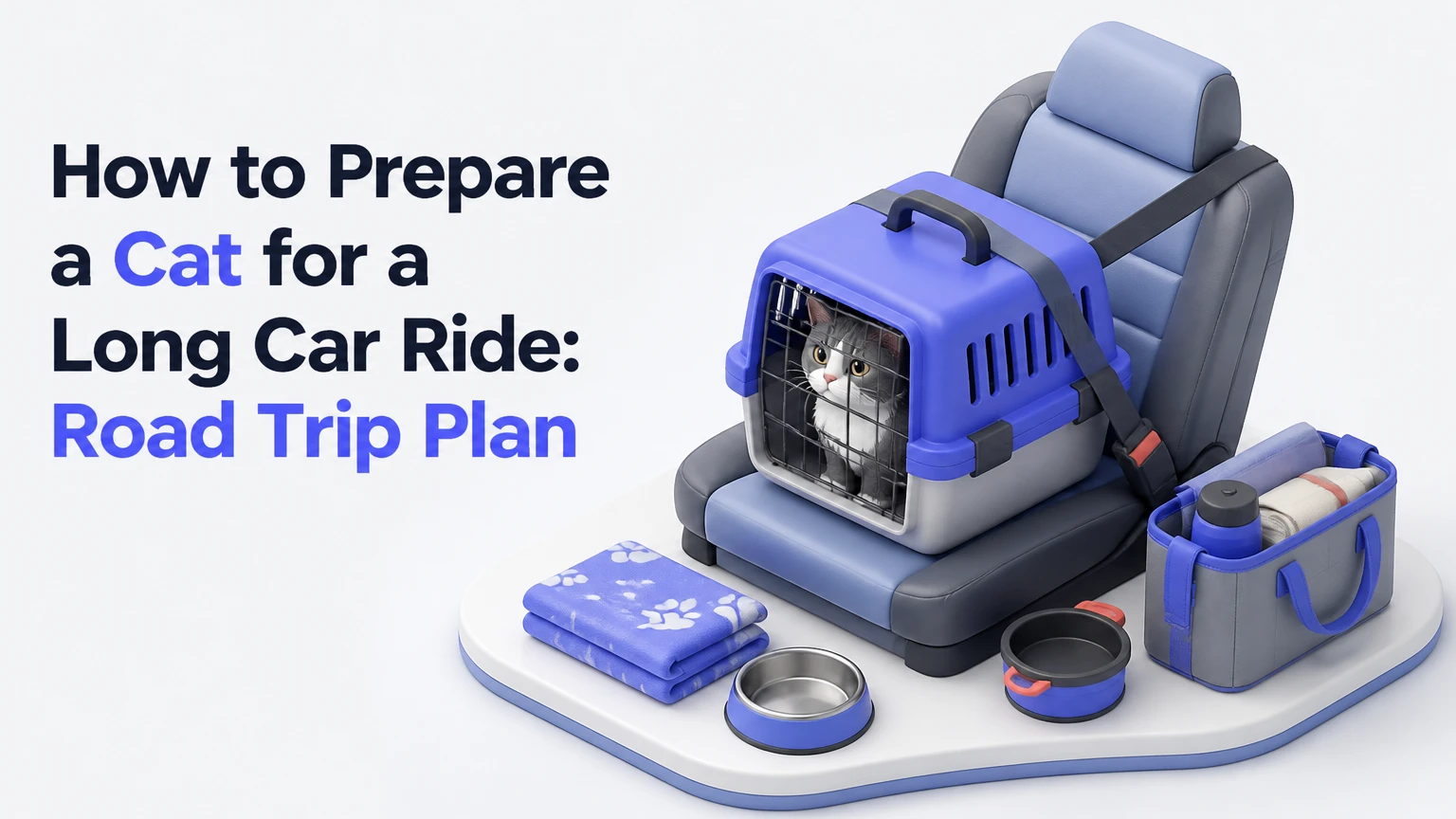
The travel setup should prevent escape, absorb accidents, preserve familiar smells, and keep the carrier stable during braking. A hard-sided carrier with a secure door is usually easier to clean and protect than a soft bag, although an airline-compliant soft carrier may be required for approved cabin air travel.
Choose a carrier large enough for the cat to stand, turn around, and lie in a natural position, but avoid an oversized crate that allows the cat to slide during cornering. For long journeys, a larger secured kennel can work if it is crash-tested or firmly anchored and does not become a projectile.
- Hard-sided carrier with metal or reinforced plastic door
- Absorbent pad below a washable blanket
- Two spare pads and at least one spare blanket
- Familiar shirt or bedding carrying the owner’s scent
- Disposable gloves, waste bags, paper towels, and enzyme cleaner
- Collapsible litter tray, unscented litter, and sealable waste bags
- Water bowl that clips to the carrier or a spill-resistant travel bowl
- Current medications, prescription instructions, and veterinary records
- Printed destination address and two telephone numbers
- Backup collar, harness, leash, and recent full-body photograph
Pheromone sprays containing synthetic feline facial pheromone may help some cats, but they are not sedatives and do not replace conditioning. If used, spray the bedding or carrier interior according to the product label and allow the carrier to air before placing the cat inside. Never spray a frightened cat directly.
Where Should the Carrier Go?
Place the carrier on the floor behind a front seat when its dimensions allow secure, level positioning. This location limits sliding and reduces the risk of injury from airbag deployment. If the carrier must sit on a rear seat, secure it exactly as the manufacturer permits, commonly with a seat belt around the carrier or through designated restraint points.
Do not place a carrier on the front passenger seat. A deploying airbag can cause severe injury. Do not wedge the carrier under luggage, cover ventilation openings, or place heavy objects on top.
| Setup choice | Main advantage | Main limitation | Best use |
|---|---|---|---|
| Floor behind front seat | Low center of gravity and reduced sliding | May not fit large carriers | Most small and medium cats |
| Rear seat with approved restraint | Convenient access and visibility | Incorrect belt routing can tip carrier | Vehicles with compatible restraints |
| Large secured kennel | Space for litter and movement | Requires strong anchoring | Multi-day trips and larger cats |
| Soft-sided carrier | Lightweight and compact | Easier to deform or escape from | Short trips or airline-approved cabins |
Food, Water, Toileting, and Breaks
Feeding should reduce nausea without creating dehydration or low blood glucose. A common veterinary starting point is to avoid a full meal for about 4-6 hours before departure, but fasting for 6-8 hours is not appropriate for every cat, especially kittens, diabetic cats, underweight cats, and cats with illnesses requiring regular food.
Ask the veterinarian for an individualized feeding interval. Keep fresh water available until departure unless the veterinary team gives different instructions. Offer a small amount during a secure stop if the cat normally drinks, but do not force water into the mouth.
For a drive longer than 4-6 hours, pack a litter tray and introduce it at a safe destination or inside a fully closed vehicle. Many cats will not toilet during the drive, while others may urinate from fear within the first hour. Layering absorbent pads lets you change the surface without exposing the cat.
Breaks every 2-4 hours are useful for the driver’s safety and the cat’s welfare, but a break does not mean opening the carrier at a roadside shoulder. Stop in a quiet, secure location, lock every vehicle door and window, check the cat through the carrier, and offer food, water, or litter only inside the closed cabin.
| Journey length | Food plan, typical | Water and litter plan | Monitoring interval |
|---|---|---|---|
| 1-3 hours | Normal meal 3-4 hours before | Water before loading; no tray usually needed | Check at destination |
| 4-8 hours | Small pre-trip meal after veterinary advice | Water at a secure stop; tray available | Every 2-3 hours |
| 8-16 hours | Small meals at planned stops | Tray inside closed cabin or lodging | Every 2 hours |
| Multiple days | Normal daily calories divided into small meals | Fresh water and tray at lodging | Each stop and overnight |
Veterinary Planning and Medication
A veterinary appointment 2-4 weeks before departure allows time for a physical examination, vaccine review, microchip scan, health certificate requirements, and medication testing. Interstate, international, or airline travel may require destination-specific documents, parasite treatments, rabies records, or an official certificate issued within a narrow time window.
Gabapentin is commonly prescribed by veterinarians for situational feline anxiety, while maropitant may be prescribed for motion sickness and vomiting. The correct choice depends on age, kidney and liver function, other medicines, prior reactions, and whether anxiety, nausea, or both drive the problem.
Never use human sleeping pills, antihistamines, cannabis products, or leftover medication without veterinary direction. Sedation can impair balance and thermoregulation, and a heavily sedated cat may be harder to assess if illness develops. Medication should reduce distress while preserving safe breathing and appropriate monitoring.
Ask these questions during the appointment:
- Does the cat need a physical examination or blood testing before medication?
- What dose, timing, duration, and repeat-dose limits apply?
- Should food be given with the medicine?
- What side effects require a call or emergency visit?
- What should happen if the cat vomits after dosing?
- Is the medicine safe during hot weather or for a brachycephalic cat?
- What documents or vaccines does the destination require?
Test the prescribed medicine on a quiet day at home, using the exact dose and timing planned for travel. A trial reveals whether the cat becomes excessively sedated, remains distressed, vomits, or experiences an unexpected reaction. Do not wait until departure morning to discover that the medicine does not solve the actual problem.
Vehicle Safety for Cats
Vehicle safety depends on restraint, temperature, ventilation, and escape control. Keep the carrier closed and secured while the car is moving, maintain a comfortable cabin temperature, and plan stops where the cat cannot slip through an open door or window.
Run climate control before loading the cat in extreme weather. Direct vents away from the carrier, keep the carrier out of direct sun, and monitor for overheating rather than relying only on the dashboard temperature. A parked car is unsafe even for a short errand because interior temperature can rise rapidly.
Use low-volume audio and avoid sudden loud music, heavy bass, or barking sounds. Classical music is not a guaranteed calming treatment, but consistent low-level sound can mask abrupt highway noise for some cats. The strongest environmental intervention remains stable restraint and predictable handling.
Expert insight: covering part of a carrier can reduce visual stimulation, but covering the entire carrier can restrict airflow and trap heat. Use a light, breathable cover over one or two sides, then check that ventilation remains open and the cat is not panting.
What to Do During a Multi-Day Journey
A multi-day trip needs overnight accommodation that accepts cats and a controlled room where the cat can decompress. Reserve the lodging in advance, inspect the room for open windows and hiding gaps, and move the carrier inside before opening its door.
At the overnight stop, prepare food, water, litter, medication, and a hiding option before releasing the cat. Close the bathroom and exterior doors. Allow the cat to leave the carrier voluntarily unless a veterinarian has given a different handling instruction.
For a long relocation, keep one small travel kit accessible in the passenger area and a second replacement kit in the luggage. Pack more food and medication than the itinerary requires because traffic, weather, mechanical failure, or a delayed hotel check-in can extend the journey.
The First Hours After Arrival
The arrival room should be quiet, closed, and furnished with familiar bedding, water, food, litter, and a hiding place. Open the carrier and let the cat choose when to emerge; dragging the cat out can create a new negative association with the carrier.
Keep the cat in that room for several hours or overnight, depending on behavior. Expand access gradually after eating, drinking, toileting, grooming, and normal exploration resume. A cat that hides after arrival may be recovering from stress, but refusal to eat, repeated vomiting, breathing difficulty, or profound lethargy warrants veterinary advice.
Driving, Air Travel, Ground Transport, or Staying Home
Driving offers door-to-door control and avoids airport handling, but it exposes the cat to many hours of vibration and requires careful temperature management. Air travel may shorten elapsed time for very long distances, yet airline rules, cargo restrictions, noise, and documentation create additional risks.
If the cat is staying at the current home, a reliable in-home sitter is often less stressful than transporting the cat to an unfamiliar temporary location. Professional ground transport can help when the owner cannot drive, provided the company explains restraint, temperature monitoring, stop procedures, insurance, and emergency veterinary arrangements.
| Option | Typical duration | Typical direct cost in USD | Suitable when |
|---|---|---|---|
| Private car | 4-30 hours over 1-3 days | $100-$800 plus lodging and fuel | Cat is relocating with the owner |
| Professional ground transport | 1-5 days | $500-$2,500 | Owner cannot drive or needs door-to-door support |
| Airline cabin travel | 3-12 hours total | $125-$600 plus carrier and fees | Route and airline accept the cat in cabin |
| Airline cargo transport | Variable, often 6-24 hours | $300-$1,500 | Destination rules prevent cabin travel |
| In-home cat sitter | No transport time | $25-$75 per visit | Cat can safely remain in familiar territory |
These prices are typical planning ranges, not quotes. Veterinary visits, health certificates, medication, fuel, tolls, pet-friendly lodging, airline fees, and destination permits can materially increase the total.
Common Mistakes and Edge Cases
The most dangerous mistake is opening the carrier outside a fully closed room or vehicle. A frightened cat can escape through a small gap, cross traffic, climb into the undercarriage, or disappear before identification details help.
Other preventable failures include:
- Leaving the carrier unsecured so it tips during hard braking
- Using a new food, litter, blanket, or medication on departure day
- Fasting a kitten or diabetic cat without veterinary instructions
- Placing the carrier in direct sun or blocking its ventilation
- Assuming a quiet cat is comfortable when it is actually shut down
- Stopping at a noisy rest area and opening the carrier near traffic
- Forgetting a second set of identification details and a recent photograph
- Giving a sedative without testing its effect beforehand
If the Cat Refuses the Carrier
Move the carrier back into a familiar room and stop chasing the cat. Use food trails, a towel-lined carrier, and short door-closing sessions; for a top-opening carrier, lower the cat gently while supporting the chest and hindquarters only when necessary.
If departure is imminent, ask the veterinary practice about a safe handling plan or prescribed medication. Do not force the cat into a soft carrier that can collapse, and never transport an unrestrained cat because it appears calmer outside the carrier.
If the Cat Vomits or Has Diarrhea
Pull over safely and assess breathing, alertness, gum color, and the amount of fluid lost. Replace soiled bedding inside the closed car, offer water according to veterinary advice, and contact the veterinary team if vomiting repeats, diarrhea is severe, blood appears, or the cat becomes weak.
A single vomit does not prove that the trip must end, but repeated vomiting despite prescribed treatment requires reassessment. Motion-sickness medication may help nausea while leaving the underlying fear untreated.
Typical Budget and Packing Quantities
A basic preparation budget is usually $80-$250 in USD for equipment, while veterinary services and transport costs vary by location and medical need. Buy supplies early enough to use them during practice drives rather than treating them as emergency purchases.
| Item | Typical quantity | Typical USD cost | Selection detail |
|---|---|---|---|
| Hard-sided carrier | 1, or 2 for backup | $35-$120 | Secure door, washable base, adequate ventilation |
| Absorbent pads | 6-12 | $8-$25 | Enough for accidents and a multi-day delay |
| Familiar blankets | 2-4 | $0-$40 | Use existing scent-rich bedding when possible |
| Litter and tray | 1 tray, 2-5 lb litter | $10-$35 | Unscented, low-dust litter |
| Pheromone spray | 1 bottle | $15-$35 | Optional, use according to label |
| Water and food bowls | 1-2 each | $10-$35 | Spill-resistant or clip-on |
| Identification supplies | 2 tags, microchip update | $0-$30 | Verify registration before travel |
| Veterinary consultation and medication | 1 appointment | $50-$250 typical | Higher for tests, certificates, or specialist care |
Departure-Day Checklist
Follow the same order on every practice drive and on the actual departure. Repetition reduces handling errors when the cat is vocal or the schedule changes.
- Confirm the cat’s medication, food, water, records, and identification.
- Place a clean absorbent pad beneath familiar bedding.
- Load luggage first so the carrier remains accessible and ventilated.
- Close all vehicle doors and windows before opening the home carrier.
- Put the cat into the carrier in a quiet room, then lock the carrier door.
- Confirm the latch, attach the identification card, and inspect ventilation.
- Secure the carrier on the floor or with an approved restraint.
- Start climate control before driving in hot or cold weather.
- Record the departure time, medication time, food intake, and last toileting.
- Check the cat at planned intervals without opening the carrier roadside.
Frequently Asked Questions About How to prepare a cat for a long car ride
How long can a cat safely ride in a car?
A healthy cat may travel for many hours when the carrier is secure, the cabin is temperature-controlled, and the driver checks regularly. For journeys beyond 6-8 hours, plan food, water, litter, and rest arrangements. A multi-day drive should include overnight lodging rather than continuous confinement.
Should I let my cat roam in the car?
No. A cat should remain in a secured carrier while the vehicle moves because roaming can obstruct the driver, enter the pedal area, escape through a door, or become injured during sudden braking. Open the carrier only inside a closed room or a fully closed vehicle.
What should I do if my cat cries the entire trip?
Check whether the cat is breathing normally and whether drooling, vomiting, or panting suggests nausea or medical distress. Keep the carrier stable, reduce noise, and avoid opening it during roadside stops. If distress escalates during practice drives, ask a veterinarian about slower conditioning and medication.
Can kittens go on long road trips?
Kittens can travel, but their feeding, temperature, vaccination, and hydration needs differ from adult cats. Do not apply a 6-8 hour fasting plan to a kitten without veterinary guidance. Use shorter practice drives, frequent monitoring, and a destination plan that prevents contact with unvaccinated animals.
Is a harness safer than a carrier?
A harness can provide a secondary handling option, but it is not a substitute for a closed carrier during driving. Fit and practice the harness at home, attach the leash only in a closed environment, and never rely on it to prevent injury during a collision.
What if my cat has a medical condition?
Ask the veterinarian whether travel is appropriate and whether the condition requires medication timing, blood testing, temperature limits, or more frequent monitoring. Cats with diabetes, heart disease, respiratory disease, kidney disease, recent surgery, or severe obesity need individualized travel instructions rather than a generic fasting or medication schedule.
Conclusion
How to prepare a cat for a long car ride is a staged safety and welfare process, not a single travel-day trick. Condition the carrier for 4-6 weeks, rehearse parked-car exposure and short drives, secure the carrier, plan food and litter access, verify identification, and obtain veterinary guidance when anxiety or nausea appears. The safest journey is predictable, restrained, temperature-controlled, and designed around the cat’s observed recovery after each practice session.