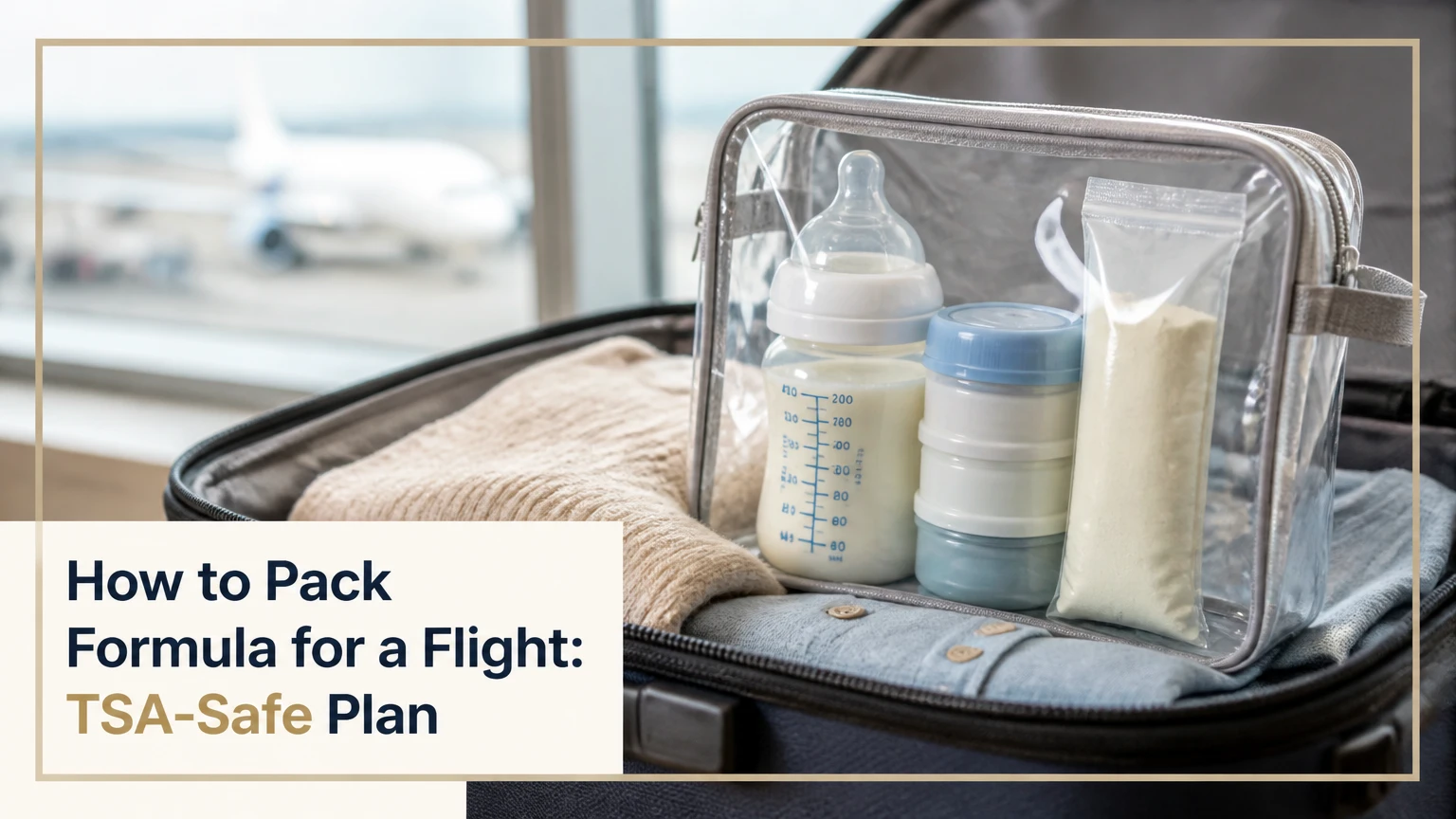
How to Pack Formula for a Flight: TSA-Safe Plan
How to pack formula for a flight depends on the formula type, your baby’s feeding schedule, and the security rules at your departure airport. Pack dry powder or sealed ready-to-feed formula in your carry-on, declare medically necessary liquids, use safe water, and carry enough for the journey plus at least 24 extra hours.
Key Facts
TSA allows baby formula and toddler drinks in reasonable quantities above 3.4 ounces when they are medically necessary for the child.
Tell the TSA officer about formula before screening and remove formula, bottles, water, and cooling accessories from your bag.
CDC guidance gives prepared formula a 2-hour room-temperature limit, a 24-hour refrigerated limit, and a 1-hour limit after feeding starts.
Powder is light and economical, while ready-to-feed formula reduces preparation but adds weight, cost, and liquid screening.
Keep the entire formula supply in your carry-on, including enough for delays, cancellations, lost luggage, and one unexpected extra feeding.
A sealed bottle of water purchased after security is convenient, but it is not the only safe option. Empty bottles and a measured powder dispenser also work.
TSA Rules for How to Pack Formula for a Flight
TSA treats infant formula, breast milk, and juice as medically necessary liquids, so they can exceed the usual 3.4-ounce liquid limit when carried in reasonable quantities. The exemption applies to the child’s travel needs, not to unlimited household stock, and the final screening decision belongs to the TSA officer.
TSA recommends informing the officer at the beginning of screening. Formula may receive additional inspection, including visual examination, testing for explosives, opening a container, or asking the traveler to transfer a small amount. Formula does not have to fit inside the standard quart-size liquids bag.
What to Remove at the Checkpoint
Place these items where they can be removed quickly:
| Item | Carry-on location | Typical screening action |
|---|---|---|
| Ready-to-feed cartons | Clear outer pouch | Visual inspection and liquid testing |
| Powder dispenser | Separate diaper-bag pocket | X-ray or hand inspection |
| Bottled water | Separate from electronics | Additional liquid screening |
| Empty bottles and nipples | Clean zippered pouch | Visual inspection |
| Ice packs or gel packs | Insulated cooler | Inspection while frozen or partially frozen |
The TSA advises travelers to notify officers about formula and cooling packs before the bag enters the screening lane. A cooler may contain frozen gel packs even when the child does not currently have a bottle prepared.
If you prefer not to have formula X-rayed or opened, say so before inspection begins. TSA can use alternative procedures, but those procedures may take longer and can include additional handling or screening.
Domestic and International Differences
| Travel stage | Governing authority | Practical rule |
|---|---|---|
| U.S. departure checkpoint | TSA | Formula may exceed 3.4 ounces in reasonable quantities |
| U.S. connecting checkpoint | TSA | Re-screening can occur after a sterile-area exit |
| Arrival in another country | Destination customs agency | Declare formula if the entry form requires food or dairy declaration |
| Return departure checkpoint | Local airport security authority | Check that country’s liquid and baby-food rules |
| U.S. re-entry | U.S. Customs and Border Protection | Keep commercial labels and disclose food products when asked |
A TSA exemption does not guarantee admission into another country. Customs authorities may restrict homemade prepared formula, animal-derived ingredients, or opened food containers. Before an international trip, check the destination’s customs agency and the airport security authority for every country where you will re-clear security.
Which Formula Format Works Best?
Powdered formula is usually the best choice for weight and cost, ready-to-feed formula is the simplest choice during boarding and turbulence, and liquid concentrate is a middle option that still requires measured water. The best travel plan often combines formats rather than using one format for every stage.
- Powdered formula: Lightweight, inexpensive, and easy to portion before leaving home.
- Ready-to-feed formula: Factory-sealed and usable without mixing, but heavy and subject to liquid inspection.
- Liquid concentrate: Shelf-stable before opening, but requires a precise water ratio and creates another liquid container to manage.
- Specialty formula: Necessary for some allergies or medical conditions, so brand substitution should be cleared with the child’s clinician.
| Format | Typical retail cost per prepared ounce | Preparation time | Main travel limitation |
|---|---|---|---|
| Powder | $0.15-$0.30 | 2-5 minutes | Requires safe water and clean mixing |
| Ready-to-feed | $0.35-$0.65 | Under 1 minute | Adds liquid weight and inspection |
| Concentrate | $0.25-$0.45 | 3-6 minutes | Requires a 1:1 water measurement |
| Specialty powder | $0.40-$1.00 | 2-5 minutes | Replacement may be difficult abroad |
Costs are typical U.S. retail ranges, not regulated prices. Specialty products can cost substantially more, and imported brands may have different preparation instructions.
Powder Versus Ready-to-Feed
Powder works well when the caregiver can control water quality, preparation space, and cleaning. Ready-to-feed works better during takeoff, landing, a short connection, or a delay when washing and measuring would be difficult.
The practical mistake is choosing only by price. A family may save $20 on powder and then spend that advantage in stress, spilled bottles, or an unavailable water source. Many experienced travelers use measured powder for most feeds and one or two sealed ready-to-feed servings for airport queues and descent.
How Much Formula Should You Pack?
Calculate the planned supply from the baby’s normal intake, then add one full day of reserve. For example, a baby taking six 6-ounce bottles each day needs 36 prepared ounces daily; a two-day trip with a 24-hour reserve requires 108 prepared ounces before accounting for spills or feeding changes.
| Travel duration | Example daily intake | Planned formula | With 24-hour reserve |
|---|---|---|---|
| 6-hour flight day | 30 ounces | 30 ounces | 60 ounces |
| 10-hour itinerary | 36 ounces | 36 ounces | 72 ounces |
| 2-day trip | 36 ounces daily | 72 ounces | 108 ounces |
| 5-day trip | 30 ounces daily | 150 ounces | 180 ounces |
Use your baby’s actual feeding pattern rather than a generic age chart. Babies may feed more during a long travel day, and a delay can create several additional bottles.
For powder, convert prepared ounces into the manufacturer’s scoop ratio. If the label uses one scoop for 2 fluid ounces, 108 prepared ounces require 54 level scoops. Never weaken or concentrate formula to stretch supplies.
How to Pack Powdered Formula
Powdered formula should travel in measured, sealed portions with the original label, lot information, and preparation instructions available. Do not rely on a loose scoop in a diaper bag, because moisture, dirt, and accidental over-measuring can affect both hygiene and concentration.
- Check the manufacturer’s expiration date and discard damaged or wet powder.
- Photograph the original label, including the scoop ratio and allergen information.
- Wash and completely dry a formula dispenser or small food-safe containers.
- Measure level scoops according to the label, without compressing the powder.
- Seal each portion and mark the number of prepared ounces it makes.
- Pack one clean bottle for each planned feed when washing access is uncertain.
- Put the powder, bottles, and a backup supply in the personal item or diaper bag.
- Carry empty bottles through security and obtain safe water afterward.
- Mix only when the bottle will be used soon.
- Discard leftovers according to the formula’s storage instructions and CDC time limits.
A factory-sealed tub is acceptable, but a large open container is inconvenient at checkpoints and vulnerable to spills. Keep a small working supply in dispensers and retain the original container or a clear photograph for inspection and identification.
Water, Mixing, and Heating on the Plane
Use commercially sealed drinking water or another water source that your pediatric clinician considers safe. Do not use water from an aircraft lavatory tap, and do not assume a flight attendant can provide water at a specific temperature for powdered formula.
For babies younger than 2 months, babies born prematurely, or babies with weakened immune systems, powdered formula carries additional preparation concerns because powder is not sterile. The World Health Organization has recommended preparing powdered formula with water at least 70°C, then cooling it before feeding, while CDC and manufacturer instructions should guide the final method for the baby’s situation.
| Water option | Availability | Temperature control | Recommended use |
|---|---|---|---|
| Sealed bottled water after security | Usually available | Room temperature | Convenient for routine feeds |
| Home-prepared safe water in a declared container | Depends on screening | Controlled before departure | Useful when airport supply is uncertain |
| Aircraft service water | Inconsistent | Usually uncontrolled | Do not use for formula mixing |
| Hot water in a cup | Crew-dependent | May be too hot or too cool | Use only as an external warming bath |
| Airport family-room sink | Location-dependent | Variable | Wash bottles only if water is confirmed safe |
Do not microwave a bottle. Microwaves create hot spots that can burn a baby even when the bottle feels cool on the outside. To warm ready-to-feed formula, place the closed bottle in warm water, then rotate and test a few drops on the inside of your wrist.
A Formula Machine Is Usually Poor Cabin Equipment
Portable formula machines can reduce measuring at home, but most are poor substitutes for a clean water and bottle system on an aircraft. Their reservoirs, funnels, batteries, and cleaning parts add failure points, while a machine may not fit the manufacturer’s exact powder-to-water instructions.
Use a machine only when the model’s instructions match the formula label and you can clean every food-contact part. A measured dispenser and a clean bottle are usually lighter and easier to explain at security.
Storage and Feeding Safety During Travel
Prepared infant formula should generally be used within 2 hours at room temperature, within 24 hours when refrigerated at 40°F or below, and within 1 hour from the beginning of a feed. The CDC states, “Use prepared infant formula within 2 hours of preparation and within one hour from when feeding begins.”
The commonly repeated 48-hour rule is not a universal formula safety limit. Some manufacturers specify different times for particular products, but a caregiver should follow the product label and the stricter applicable guidance rather than assume every opened liquid or mixed bottle lasts two days.
| Formula state | Typical maximum time | Action |
|---|---|---|
| Unused prepared formula at room temperature | 2 hours | Use or discard |
| Unused prepared formula refrigerated at 40°F or below | 24 hours | Use within the refrigerated window |
| Bottle after baby begins feeding | 1 hour | Discard remaining formula |
| Opened ready-to-feed container | Label-specific | Refrigerate and follow the package |
| Opened powdered formula | Commonly 30 days | Follow the tub label and keep dry |
Prepared formula stored in an insulated cooler is not automatically safe for 24 hours. A cooler with ice packs can keep bottles cold, but the caregiver must maintain cold conditions and avoid repeatedly warming and cooling the same bottle.
In practice, the safest flight routine is to carry dry powder and mix one bottle at a time. If you use ready-to-feed formula, keep unopened servings sealed until needed and mark the time a container or bottle is opened.
Carry-On Packing System for Delays and Connections
Formula belongs in the carry-on because checked baggage can be delayed, lost, or exposed to temperature swings. Divide the supply so that one small accessible kit covers the checkpoint, boarding, and the first several hours, while the remaining reserve stays protected in the main personal item.
| Packing module | Contents | Quantity for a typical travel day | Reason |
|---|---|---|---|
| Feeding kit | Bottles, nipples, caps | 4-6 bottles | Covers feeds and one dirty-bottle contingency |
| Powder kit | Measured portions | Daily amount plus 24 hours | Avoids opening a large tub |
| Liquid kit | Ready-to-feed servings | 1-2 servings | Covers security, turbulence, or descent |
| Cleaning kit | Bottle brush, soap, clean bags | 1 set | Enables washing at a safe sink |
| Temperature kit | Insulated bag and ice packs | 1 bag, 2 packs | Protects prepared formula |
| Documentation kit | Label photo and prescription | 1 digital and paper copy | Helps identify specialty products |
Keep formula away from toiletries and leaking diaper creams. Use a waterproof pouch for bottles, and put each measured portion inside a secondary sealable bag. Cabin pressure can force air through imperfect seals, but pressure itself does not spoil dry formula; poor closure and moisture cause the practical problem.
What to Do During a Delay
A delay changes the feeding clock, not the safety rules. Track preparation and first-sip times in a phone note, and keep at least one unused serving separate from bottles already prepared.
If a prepared bottle approaches its room-temperature limit, discard it even when the formula looks and smells normal. During a long delay, mix a fresh serving after obtaining safe water instead of trying to preserve an old bottle.
Feeding During Takeoff and Landing
Sucking can help some babies swallow during pressure changes, but feeding is not mandatory and does not guarantee relief from ear discomfort. Offer a bottle, breastfeed, or pacifier when the baby is awake and interested, especially during descent when pressure changes often become more noticeable.
Ready-to-feed servings are convenient for this phase because they eliminate powder, water, and mixing in a moving cabin. Do not force a feed to match the aircraft schedule, and do not prop a bottle in the baby’s mouth.
| Flight phase | Useful preparation | Avoid |
|---|---|---|
| Before security | Empty bottles and measured powder | Premixing every bottle |
| Boarding | One accessible sealed serving | Packing supplies overhead |
| Takeoff | Bottle or pacifier if baby wants it | Feeding while holding hot water |
| Cruise | Freshly mixed bottle as needed | Aircraft lavatory water |
| Descent | Ready-to-feed or fresh bottle | Waiting until the baby is distressed |
| After landing | Remaining unopened reserve | Assuming baggage arrives first |
Common Problems and Edge Cases
Specialty and Prescription Formula
Bring the exact prescribed product when a baby uses hypoallergenic, amino-acid, metabolic, or other medical formula. Carry the original packaging and, when practical, a clinician’s note listing the product and feeding requirement, although the note does not replace airport or customs rules.
Do not switch brands during travel solely to reduce luggage. A sudden formula change can cause feeding intolerance, and a foreign equivalent may use different preparation ratios or ingredients.
Formula During a Sterile Connection
Some airports require passengers to leave the sterile area during an international connection. In that situation, liquids purchased after the first checkpoint may need to be screened again, and a previously sealed bottle may no longer be treated as untouched.
Ask the airport or airline whether a sterile transit route exists. Keep enough powder for the connection so the plan does not depend entirely on buying liquid formula at one terminal.
Bottle Cleaning Without a Kitchen
A bottle brush, unscented dish soap, and a clean drying bag are more useful than a bulky sterilizer. The CDC recommends cleaning feeding items regularly, and babies under 2 months, premature babies, or immunocompromised babies may need extra sanitizing precautions.
Do not rinse a bottle with aircraft tap water when the water source is uncertain. Use safe bottled water for rinsing only when necessary, then allow components to air-dry on a clean surface.
Expert insight: The most reliable backup is not double the number of bottles. It is one complete independent feeding system, including powder, water access, a clean bottle, and a way to wash it, stored separately from the primary kit.
Frequently Asked Questions About How to pack formula for a flight
Can I bring a full tub of powdered formula through airport security?
Yes, powdered formula can generally travel in a carry-on, and TSA may inspect larger quantities. A full tub is less convenient than measured portions because it occupies more space and can spill. Keep the original label, seal the lid with a secondary bag, and place the tub where officers can reach it quickly.
Can I bring water for formula through TSA?
Yes, TSA allows water for a baby in reasonable quantities under the medically necessary liquid exception, but the container may receive additional screening. Empty bottles are simpler. After security, sealed drinking water is often the fastest option, especially when a flight connection makes inspection time unpredictable.
Should I premix bottles before leaving home?
Premix only the bottles you can keep cold and use within the applicable safety window. Powder packed dry is usually safer for a full travel day because room-temperature prepared formula has a 2-hour limit. If you premix, record the preparation time and transport bottles in a properly chilled cooler.
Does powdered formula need to be sterile on an airplane?
Powdered formula is not sterile, whether used at home or on an airplane. Babies under 2 months, premature babies, and babies with weakened immune systems face higher risk from contaminated preparation. Ask a pediatric clinician whether ready-to-feed sterile liquid is more appropriate for your baby’s trip.
Can flight attendants warm my baby’s formula?
Flight attendants may provide warm water, but airline equipment, timing, and temperature vary. Ask for warm water in a cup and warm a closed bottle externally. Never microwave formula, and test the liquid before feeding because cup water can be much hotter than expected.
How do I pack formula for a long international trip?
Pack the core supply in your carry-on, preserve original labels, verify destination customs rules, and avoid depending on local substitutes for specialty products. Divide powder into sealed daily portions, carry a 24-hour reserve, and confirm whether any connection requires another security screening.
Conclusion
How to pack formula for a flight is mainly a logistics and food-safety problem, not a liquid-limit problem. Use dry portions or sealed ready-to-feed servings in your carry-on, declare medically necessary liquids to TSA, use safe water, track preparation times, and carry a complete 24-hour reserve. The most dependable plan combines lightweight powder for routine feeds with ready-to-feed formula for checkpoints, delays, and descent.