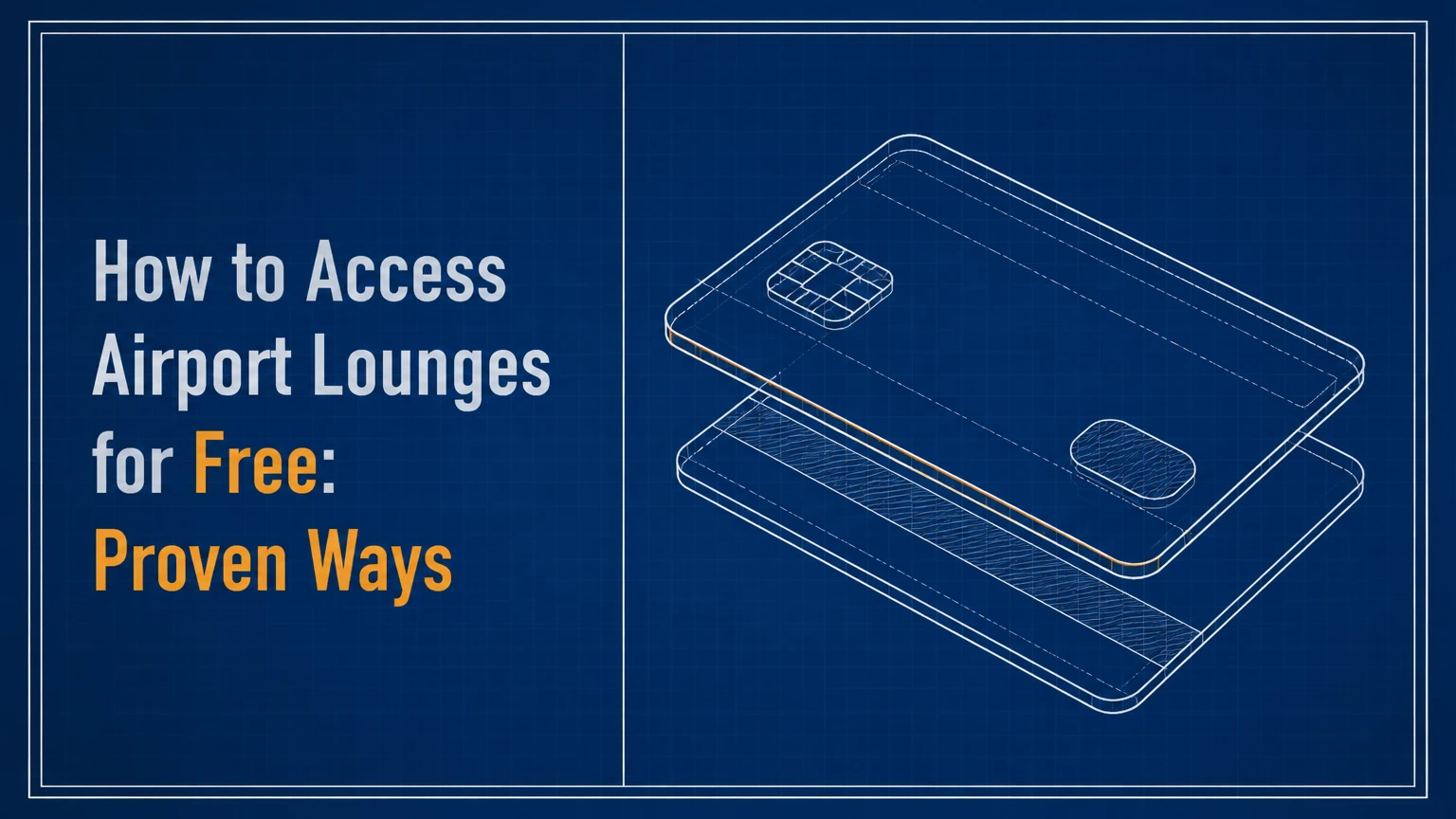
How to Access Airport Lounges for Free: Proven Ways
Airport lounge access is entry to a restricted terminal space with seating, Wi-Fi, refreshments, and sometimes showers or work areas. How to access airport lounges for free usually means presenting an eligible credit card benefit, membership, voucher, airline status, or premium-cabin boarding pass instead of paying the lounge’s walk-in fee. Your credential and same-day departing boarding pass must match the lounge’s rules.
Key Facts About Complimentary Lounge Entry
- A lounge visit is genuinely free only when the entry fee is waived and no guest, membership, or card cost is allocated to that visit.
- Most access methods require a same-day boarding pass for a departing flight, although connecting passengers often receive different treatment.
- A premium credit card may provide access through Priority Pass, LoungeKey, a proprietary network, or a limited number of annual passes.
- Airline lounges commonly restrict entry by airline, alliance, cabin, route, elite tier, or lounge membership.
- Typical independent-lounge walk-in prices range from $40-$100 per person, but prices and capacity vary by airport.
- Entry can fail even with a valid benefit because of guest fees, an inactive membership, terminal restrictions, a full lounge, or an excluded location.
What Free Airport Lounge Access Actually Means
Free airport lounge access is a benefit that removes the lounge’s per-visit charge after a provider verifies eligibility. The benefit may come from a payment card, airline status, premium ticket, lounge membership, promotional code, or travel package. The traveler still needs to satisfy operational conditions such as opening hours, terminal access, dress rules, and capacity.
The word “free” requires careful interpretation. A card with a $695 annual fee does not create costless access; it creates access with a potentially useful marginal visit price. A promotional voucher may have no annual cost, while a Priority Pass membership supplied by a card can still charge for guests or exceed a visit allowance.
At the reception desk, staff normally check four items:
- A digital or physical membership credential, eligible payment card, voucher, or airline document.
- A same-day boarding pass, usually for a departing flight.
- The passenger’s name, where the benefit is non-transferable.
- Guest quantity and any applicable charge.
Priority Pass, LoungeKey, and DragonPass do not make every lounge interchangeable. Each network has its own participating locations, operating hours, guest terms, and restaurant exclusions. The lounge directory inside the relevant app is more authoritative than an old blog post or a card advertisement.
Which Lounge Networks Can You Use?
Airport lounges fall into four practical categories: airline-operated lounges, independent networks, alliance lounges, and credit-card lounges. The category determines whether your flight, airline, terminal, cabin, status, card, or network membership controls admission.
| Lounge category | Typical examples | Main eligibility test | Typical guest result |
|---|---|---|---|
| Airline-operated | Delta Sky Club, United Club, Emirates Lounge | Airline, cabin, route, status, or membership | Guest rules vary by lounge and status |
| Independent network | Priority Pass, DragonPass, Plaza Premium | Active membership plus same-day boarding pass | Guest may be free or charged per visit |
| Alliance-operated | Star Alliance, oneworld, SkyTeam lounges | Eligible alliance airline, cabin, or elite tier | Usually follows alliance access policy |
| Card-branded | Centurion Lounge, Capital One Lounge, Chase Sapphire Lounge | Specific card, authorized user, and flight rules | Usually one or more guests, subject to terms |
Airline and Alliance Lounges
Business- or first-class travel can include lounge access when the itinerary meets the airline or alliance policy. Elite members may also enter while flying economy, but route restrictions often apply. For example, international premium-cabin rules can differ from domestic rules within the same airline group.
Star Alliance, oneworld, and SkyTeam publish alliance-level access policies, but the operating airline and airport can add practical restrictions. A lounge may be in a different terminal from your gate, and security checkpoints may prevent a passenger from reaching it after clearing the wrong terminal.
Independent Lounge Networks
Priority Pass, DragonPass, and Plaza Premium are useful when you fly different airlines or travel through airports without a suitable airline lounge. Their weakness is uneven coverage. One airport may offer several participating lounges, while another may have only a small contract lounge with limited food and no showers.
Some independent networks include airport restaurants, spas, or sleep facilities as alternatives to lounges. A card issuer can exclude those non-lounge benefits even when the general membership is advertised as complimentary.
Credit-Card Lounges
American Express Centurion Lounges, Capital One Lounges, and Chase Sapphire Lounges normally require a specific card and a same-day eligible flight. The card may provide access to the branded lounge, a partner network, or both, but these are separate benefits and should not be assumed to overlap.
A card can have access geographically but still fail operationally. A lounge may admit only passengers departing from that airport, impose a three-hour window, or stop accepting guests during overcrowded periods.
How to Get In Without Paying a Visit Fee
The most reliable route depends on how often you travel, which airports you use, and whether your airline offers useful status benefits. The following methods cover legitimate access; asking a stranger to scan a card or misrepresenting eligibility can result in denied entry and account problems.
- Use a premium travel card. Confirm whether the card supplies unlimited visits, a fixed number of passes, or only access at branded lounges.
- Activate the linked membership. Register for Priority Pass, LoungeKey, or another program before traveling, then create the digital membership card.
- Use airline elite status. Check whether your status covers domestic, international, or transborder itineraries and whether the operating carrier matters.
- Book an eligible premium cabin. Verify access before purchasing because some discounted business fares, partner-operated flights, and domestic first-class routes have different rules.
- Redeem a travel or lounge voucher. Corporate travel programs, bank promotions, hotel packages, and airline offers sometimes issue single-use credentials.
- Use an authorized-user benefit. Some issuers provide lounge access to authorized users, while others charge a separate fee or give the user only cardholder access.
- Use a free trial or promotional offer. Confirm the expiration date, participating locations, and whether automatic renewal applies.
- Use an employer or membership benefit. Certain corporate cards, professional associations, and travel clubs include a limited number of passes.
The card or ticket is not enough by itself. The benefit must be active, the passenger must be eligible, and the lounge must be accepting that access type.
What Do Lounge Cards Really Cost?
Lounge access costs range from $0 for a targeted voucher to hundreds of dollars in annual card or membership fees. The correct comparison is marginal cost per visit, calculated after annual fees, credits, included visits, guest charges, and the value of benefits you would use anyway.
| Access route | Typical annual cost | Visit charge | Break-even consideration |
|---|---|---|---|
| Promotional voucher | $0 | $0 for 1 visit | Best for a single eligible trip |
| Priority Pass Standard | $99 | About $35 per visit | Rarely economical for one or two visits |
| Priority Pass Prestige | About $469 | $0 for member visits | Break-even near 10-14 visits versus $35 fees |
| Premium travel card | $395-$695 | Often $0 for included access | Depends on credits, travel frequency, and guest use |
| Paid independent lounge visit | $0 annual fee | Typically $40-$100 | Useful when access is occasional and capacity permits |
Priority Pass has offered membership tiers with different visit charges, but the exact price depends on country and issuer. Card-supplied memberships can use different terms from retail memberships. Read the issuer’s benefit guide rather than relying on the network’s consumer price page.
A simple calculation prevents misleading savings claims:
Effective visit cost = annual fee allocated to lounge use + visit charges + guest charges – usable travel credits.
For example, a $550 card used for ten solo visits, with $300 in credits that you would otherwise purchase, produces a remaining benefit cost of $250, or $25 per visit before considering points and other insurance. That is not free, but it may beat ten $50 walk-in visits.
| Traveler profile | Visits per year | Likely best route | Main reason |
|---|---|---|---|
| Occasional solo traveler | 1-2 | Voucher or paid day pass | Avoids a large fixed fee |
| Domestic frequent flyer | 6-10 | Airline or card benefit | Repeated airport use can justify access |
| International traveler | 10-20 | Network membership or premium card | Broader participating-airport coverage |
| Family traveler | 4-8 people-visits | Card with free guests | Guest terms can outweigh annual fee |
| Mixed-airline business traveler | 8-15 | Independent network | Airline status may not transfer across trips |
The Break-Even Mistake
The most common calculation mistake is treating a premium card’s lounge benefit as its entire value. If you would not otherwise buy the card, allocate only the portion of the annual fee that the lounge benefit actually justifies. Also subtract credits that expire, require enrollment, or are limited to specific merchants.
A second mistake is ignoring guest visits. A card that is free for the primary holder but charges $35 per guest can become expensive for a couple traveling six times. The cheapest individual benefit is not always the cheapest household arrangement.
When Can You Enter and How Long Can You Stay?
Most airport lounges permit entry within approximately three hours before a scheduled departure, but the exact rule belongs to the lounge, airline, or card issuer. Connecting passengers are often treated differently, and arrival-only access is uncommon because lounges usually require a valid departing boarding pass.
| Travel situation | Typical entry rule | Typical stay result | Main restriction |
|---|---|---|---|
| Origin airport departure | About 3 hours before flight | Until boarding or lounge limit | Earlier entry may be refused |
| Same-day connection | Often exempt from 3-hour limit | During the connection | Must show onward boarding pass |
| Final arrival | Usually unavailable | No standard stay | Arrival boarding pass may not qualify |
| Overnight flight | Depends on opening hours | Until closing or departure | Lounge may close before boarding |
| Delayed flight | Often remains valid | Subject to capacity | Original departure time may control |
| Terminal change | Access only if landside or connected | Time limited by transfer | Security may block movement |
Lounge staff may enforce a maximum stay, especially at crowded independent facilities. A three-hour entry rule also does not guarantee three hours inside. Capacity controls can produce a waitlist, early closure, or temporary pause in admissions.
Why Terminal Location Matters
A lounge in Terminal 1 may be unusable for a passenger departing Terminal 3 when the airport lacks an airside transfer route. At large airports, a 20-minute train ride, another security check, and a gate deadline can eliminate the practical value of a lounge visit.
Check the terminal, concourse, security access, walking time, and boarding time together. Lounge apps show location, but airport maps and the operating carrier determine whether the route is feasible.
How to Activate and Use the Benefit
Activation should happen before the travel day because some providers take hours or several days to issue a digital membership credential. The most dependable process combines issuer verification, lounge-directory research, and a backup plan.
- Sign in to the card issuer or airline account.
- Find the lounge benefit and complete enrollment.
- Download the applicable app, such as Priority Pass or the issuer’s travel app.
- Confirm your name, membership number, expiration date, and guest terms.
- Search the departure and connection airports.
- Read the individual lounge listing for hours, terminal, capacity notes, and exclusions.
- Save the digital card and boarding pass offline.
- Carry the physical payment card and government identification when required.
- Arrive with enough time for a possible waitlist or terminal transfer.
- Ask the attendant to confirm any guest fee before the credential is scanned.
A screenshot may not work if the lounge requires a live QR code or app-generated membership card. Some programs also reject a payment card after the card product changes, even if the account remains open.
What Can Prevent Free Entry?
Valid lounge access is conditional, not guaranteed. The most frequent denial occurs when a traveler has a qualifying card but has not enrolled in the associated program or has arrived at a lounge excluded from that card’s network.
| Failure point | What the traveler expects | What can happen | Preventive check |
|---|---|---|---|
| Inactive membership | Card automatically grants entry | Staff cannot find a valid account | Enroll and display the digital card |
| Wrong terminal | Nearby lounge is reachable | Airside transfer is impossible | Check terminal and security route |
| Guest limitation | Companions enter free | $35-$50 charge per guest may apply | Read issuer guest terms |
| Capacity control | Valid credential guarantees access | Waitlist or refusal at peak time | Arrive early and identify a backup |
| Restaurant exclusion | Network benefit covers every venue | Visit is denied or charged | Check the specific listing |
| Expired voucher | Old pass remains usable | Barcode is rejected | Verify expiration before departure |
| Name mismatch | Family member can use the card | Non-transferable credential is refused | Use the named member or permitted guest |
Expert insight: Lounge access is a capacity product as much as a payment benefit. During hub banks, the lounge may value occupancy control over additional revenue, so a valid credential can still produce no entry.
Expert insight: A physical card can be less useful than a digital membership number. Many network lounges identify the benefit in their own system, while the payment card only proves that the issuer relationship exists.
Expert insight: The best backup is often a second lounge in the same terminal, not a second network. A different network may be irrelevant if the airport’s concourse layout prevents access.
How Do Guest Rules Work?
Guest access depends on the exact card, lounge, and membership program, so travelers should treat every companion as a separate eligibility question. A guest may enter free, incur a fixed fee, need to be accompanied by the primary member, or be excluded when the lounge reaches capacity.
| Benefit type | Primary holder | Typical guest policy | Common charge |
|---|---|---|---|
| Premium card lounge | Included | 1-2 guests, terms vary | $0-$50 per guest |
| Retail Priority Pass | Included | Guest permitted under membership terms | About $35 per guest |
| Airline status | Depends on route | Eligible guest or immediate family in some cases | $0 or lounge-specific fee |
| Single-use voucher | One named user | Guest usually needs another pass | $40-$100 if available |
| Authorized user | Separate enrolled member | May receive own guest allowance | $0-$175 annual user fee |
Do not hand your card to a companion and leave the lounge. Most credentials are non-transferable, and the named member normally must be present. Some cards allow an authorized user to enroll independently, but the account holder remains responsible for charges and compliance.
Children can count as guests even when a lounge’s marketing language says “family friendly.” Age thresholds differ by provider, and an infant policy does not necessarily waive charges for older children.
Which Free Method Is Best for Your Situation?
The best strategy is the one that matches your airport pattern rather than the card with the most impressive lounge list. Airline loyalists should first price the value of status, while occasional travelers should avoid a recurring annual fee for a benefit used once.
| Situation | Preferred first option | Secondary option | Avoid when |
|---|---|---|---|
| One annual trip | Promotional pass | Day pass if under $50 | The pass expires before travel |
| Economy flight | Card or independent network | Airline status | The card’s lounges are outside your terminal |
| Frequent one-airline travel | Airline status or club membership | Premium card | Your routes do not meet status thresholds |
| Family of four | Card with free guest access | Two memberships | Each guest is charged per visit |
| International connections | Priority Pass or DragonPass | Alliance status | The network has weak coverage at transit airports |
| No credit-card application | Airline status, voucher, employer benefit | Paid lounge visit | You need guaranteed access during peak time |
Travelers Without Premium Credit Cards
Travelers who do not want a premium card can still use airline status, employer-issued benefits, bank promotions, or occasional vouchers. A no-fee starter card may offer a small number of passes, but the number, lounge network, and annual fee must be confirmed for the current product version.
Do not open a card solely for a lounge visit if approval is uncertain or the annual fee exceeds the realistic benefit. A declined application, hard inquiry, foreign transaction fee, or unpaid balance can cost more than several lounge entries.
International and Regional Differences
Lounge programs are not globally uniform. A benefit issued in the United States may have different guest rules from a similarly named product in Canada, the United Kingdom, India, Australia, or Singapore. Currency conversion, local card eligibility, airport taxes, and regional network contracts also change the calculation.
Search the issuer’s country-specific benefits page and the airport’s official lounge directory. The network brand alone does not establish that a particular lounge accepts your membership.
Free Access Versus Business Class and Day Passes
Complimentary credential-based access is flexible because it can work with an economy ticket, but premium-cabin access may be more predictable on a qualifying itinerary. A day pass avoids annual commitments, although the lounge can restrict sales when crowded.
| Feature | Card or status access | Business or first class | Paid day pass |
|---|---|---|---|
| Ticket requirement | Often economy permitted | Eligible premium cabin | Usually any eligible departure |
| Visit price | $0 after qualification | Included in ticket economics | Typically $40-$100 |
| Annual commitment | $0-$695 typical card fee | None beyond fare | None |
| Guest flexibility | Card-specific | Airline-specific | Usually one pass per person |
| Capacity certainty | Can be restricted | Often more predictable | Sales may stop when full |
| Network breadth | One or more networks | Airline or alliance lounges | Specific lounge only |
The comparison changes when the premium fare is purchased for work, a long-haul overnight flight, or a flexible ticket. Buying business class solely for lounge access rarely produces a sensible financial return because the fare difference is usually several times the lounge’s retail value.
When Is Lounge Access Not Worth Pursuing?
Airport lounges are poor value when the visit is short, the facility is overcrowded, or the traveler must cross terminals and repeat security screening. They also may not provide a quiet premium experience: some contract lounges have limited food, shared seating, and no showers.
Skip the lounge when:
- Your gate is more than 15-20 minutes away and boarding begins soon.
- The lounge requires a terminal transfer that adds security risk.
- Your visit would trigger a $35 guest fee for a brief stay.
- You are already paying a high annual fee for benefits you do not use.
- The lounge listing reports a waitlist during your travel period.
- You need a guaranteed workspace, private call room, or substantial meal.
Lounge food should be treated as a convenience, not an automatic meal replacement. Menu quality varies by airport, time of day, contract operator, and local catering budget.
A Practical Decision Rule
Use a voucher or day pass for one or two annual visits, an independent network for varied international travel, and airline status for repeated trips on one carrier. Choose a premium card only when its credits, points, insurance, and lounge access collectively justify the annual fee.
Before applying for any product, record your last 12 months of airports, terminals, airlines, companions, and annual visits. Then match those facts against the current benefit guide. This method prevents a common error: buying theoretical access at airports you rarely use while lacking a usable lounge at your home airport.
Frequently Asked Questions About How to access airport lounges for free
Can I enter a lounge with an economy ticket?
Yes, many card-linked networks and independent lounges accept economy passengers with an active membership and same-day boarding pass. Airline lounges are different: access may require premium cabin travel, elite status, a club membership, or a qualifying international itinerary. Check the individual lounge and operating carrier before departure.
Can I use another person’s lounge membership?
Usually no. Lounge memberships and card-linked credentials are generally assigned to a named member and require that person’s presence. A companion may enter as a permitted guest, but the guest fee and capacity rules still apply. Using another person’s credential without authorization can lead to refusal or account consequences.
Can I bring my children into an airport lounge?
Usually yes, if the lounge and access program permit guests, but children may count toward the guest limit or incur the standard guest fee. Some providers waive charges for infants or children below a stated age. Confirm the exact age rule and whether the primary member must accompany the family.
Can I enter an airport lounge after landing?
Most lounges do not provide standard arrival access because they require a departing boarding pass. Arrival access may exist at a landside lounge, a connected airport hotel facility, or under a specific local policy. If you have a connection, present the onward boarding pass because connecting passengers often receive broader access than final-arrival passengers.
Can a lounge refuse me if I have a valid card?
Yes. A lounge can restrict entry because of capacity, operating hours, terminal access, an excluded benefit, an inactive membership, a guest limit, or an invalid boarding pass. A valid card establishes potential eligibility, not guaranteed admission. Check the lounge directory shortly before travel and keep an alternative waiting area in mind.
Do airport lounges provide free alcohol and meals?
Many lounges provide complimentary snacks, soft drinks, Wi-Fi, and some alcoholic beverages, but the selection varies by operator and location. Premium branded lounges may offer hot meals and showers, while contract lounges may offer only packaged food. Paid premium drinks, spa treatments, and sleeping rooms are common exclusions.
Conclusion
To determine how to access airport lounges for free, start with the credential you already have, verify the exact lounge and terminal, activate the benefit, and calculate guest and annual-fee costs honestly. A same-day departing boarding pass, active membership, compliant guest arrangement, and capacity-aware backup plan matter more than the card’s marketing label.