How to Tip Hotel Housekeeping: A Practical Guide
How to tip hotel housekeeping means leaving a voluntary cash gratuity for the employees who clean, sanitize, restock, and reset your room. In the United States, a practical baseline is $2-$5 per occupied night, left daily in a marked envelope or note; raise the amount for luxury suites, extra occupants, pets, heavy mess, or special requests.
Key Facts
Leave $2-$5 per night at most standard U.S. hotels.
Use $5-$10 or more for luxury rooms, suites, heavy cleaning, or several occupants.
Leave the money each day, because housekeeping assignments can rotate.
Write “For Housekeeping” or “Thank you, housekeeping” on an envelope or note.
Place the tip on the desk or another obvious, clean surface, not loose on the floor.
A resort fee, destination fee, or service charge does not automatically equal a housekeeping tip.
What Does a Housekeeping Tip Pay For?
A hotel housekeeping tip compensates room attendants for cleaning and resetting a guest room, including tasks that visitors rarely observe. Typical work includes changing linens, disinfecting bathrooms, vacuuming or mopping, removing waste, replenishing amenities, checking supplies, and preparing the room for the next guest.
Housekeeping is usually a blind service. The attendant often works after the guest leaves, so the employee may never know which person occupied the room or whether that person appreciated the work. Daily gratuity connects the payment to the person who performed that day’s service rather than to a general hotel account.
The payment remains optional. Hotels may have union rules, shared-tip systems, or policies that prohibit particular employees from accepting gratuities, so a guest should follow an in-room notice or ask the front desk when uncertain. A tip is separate from a room rate, a destination fee, and an automatic service charge.
The American Hotel & Lodging Association has historically recommended $1-$5 per day for housekeeping in the United States. That guideline is a starting point, not a mandatory price. Inflation, hotel category, local wages, room size, and the amount of labor required all affect a reasonable amount.
How Much Should You Tip Hotel Housekeeping?
A typical U.S. housekeeping gratuity is $2-$5 per occupied night for a standard room, while $5-$10 or more fits luxury accommodations, large suites, or unusually demanding cleaning. Guests should calculate the amount by workload and service quality, then leave it daily rather than relying on a single checkout payment.
| Hotel situation | Typical tip per night | Practical adjustment |
|---|---|---|
| Budget or limited-service room | $2-$3 | Add $1-$2 for several occupants |
| Mid-scale full-service room | $3-$5 | Use the upper end for daily linen changes |
| Luxury hotel or resort room | $5-$10 | Add more for suites or multiple bathrooms |
| Large suite or connecting rooms | $10-$20 | Split the amount by room if staff are assigned separately |
| Heavy mess, pet hair, or spilled material | Base amount plus $5-$10 | Increase only when extra labor is apparent |
| Rollaway bed, crib, or repeated supply delivery | Base amount plus $2-$5 | Consider each substantial request separately |
These are typical practitioner ranges in USD, not published mandatory rates. A $3 tip for a compact room with one occupant is different from a $3 tip for a family suite with wet towels, food debris, a pet, and an added sofa bed.
A guest does not need to match the room price. A $400 room does not automatically require a $40 tip. Room rate measures the hotel’s product, whereas housekeeping gratuity reflects the attendant’s workload.
A Simple Workload Formula
Use the nightly base rate, then add for visible labor:
Nightly tip = $2-$5 base + $1-$3 per major workload factor
Major factors include a suite layout, more than two occupants, a pet, a rollaway bed, significant trash, or a special cleaning request. This is a budgeting tool, not a mathematical rule.
For example, a two-night mid-scale stay for two adults in one standard room might receive $4 per day, or $8 total. A three-night suite with four occupants, a dog, and a rollaway bed might receive $8-$12 per day.
Expert insight: The most reliable adjustment is room turnover complexity, not luxury branding. A small room with a pet and a crib can require more labor than a quiet suite occupied by one adult.
Why Should You Tip Daily?
Daily tipping is preferable because hotel attendants can change from one shift to another, and a checkout envelope may reach only the final worker or remain unclaimed. The American Hotel & Lodging Association’s daily guideline reflects this staffing reality, although some hotels operate with shared pools or fixed assignments.
Daily payment also matches the service being performed. If a guest stays five nights and three attendants clean the room, leaving money after each completed service distributes recognition more fairly than leaving one lump sum on the last morning.
| Stay pattern | Recommended timing | Example amount |
|---|---|---|
| One night | Before departure or after service | $3-$5 |
| Two to four nights | Every morning | $3-$7 daily |
| Five or more nights | Every morning, with a final fallback | $3-$10 daily |
| No cleaning one day | Leave nothing for that day unless a request was fulfilled | $0-$5 |
| Late checkout | Leave before departing if service occurred | $3-$10 |
| Checkout before morning service | Leave a marked envelope at departure | $3-$10 |
Most stayover attendants work morning or early afternoon shifts, but schedules differ by property. Leaving money before 9:00 a.m. can help when the room is serviced early, yet the better rule is to leave it before leaving the room for the day.
If a guest places a “Do Not Disturb” sign on the door, the attendant may not enter. The guest can tip for any supplies or service actually delivered, but a missed cleaning day does not create an automatic obligation.
How Should You Leave the Money?
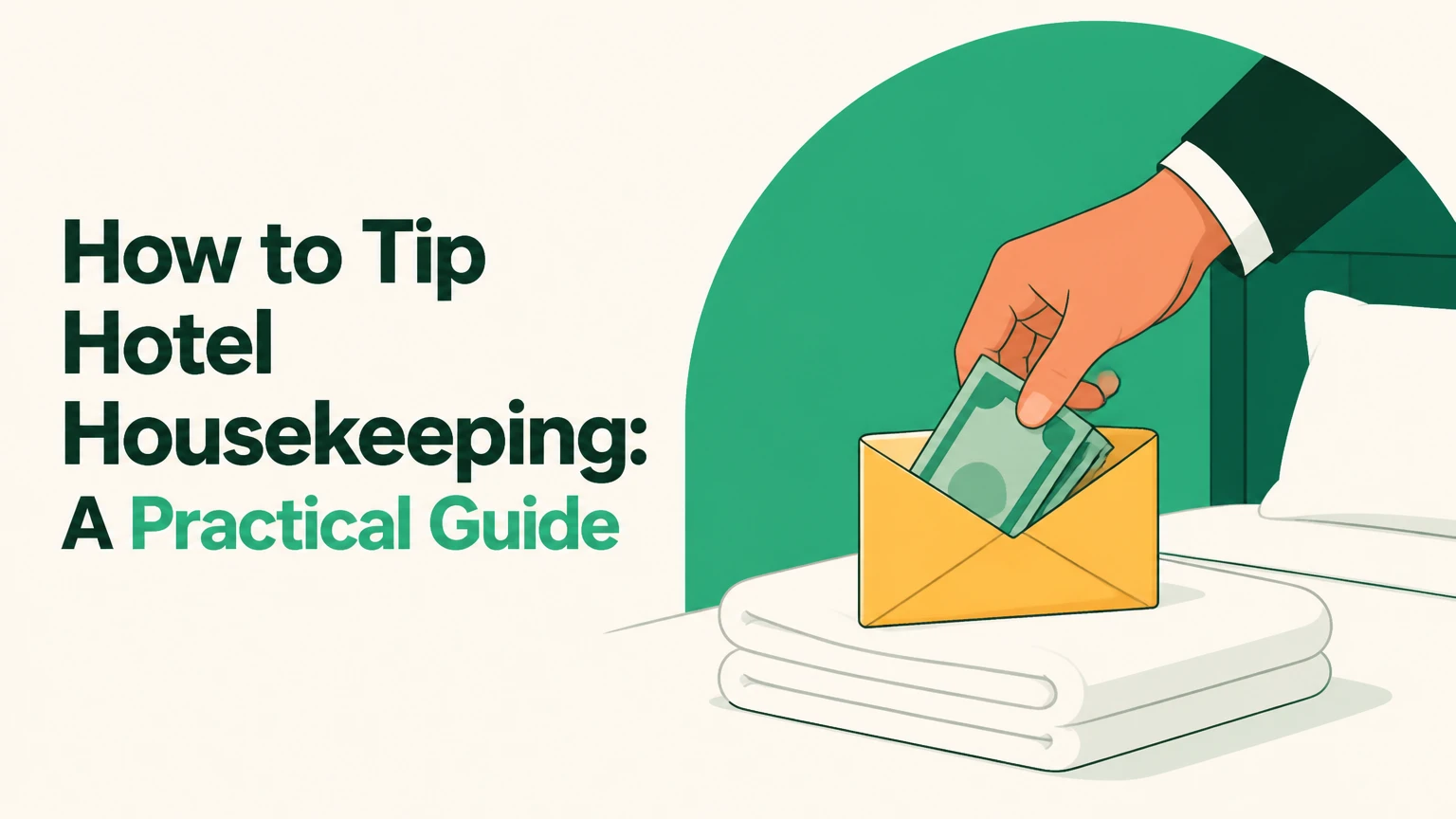
Place cash in a hotel envelope or a folded note clearly labeled “Housekeeping” and put it on the desk, nightstand, or another highly visible surface. A loose bill can be mistaken for abandoned property, especially when hotel employees must avoid accusations of taking money from a room.
Use clean, recognizable U.S. currency when tipping in the United States. Avoid a pile of coins, foreign notes, or money hidden under a pillow, because the employee may not see it or may be prohibited from handling uncertain property.
- Count the amount before housekeeping arrives.
- Put the cash in an envelope or alongside a written note.
- Write “For Housekeeping” or “Thank you, housekeeping.”
- Place it on the desk or nightstand, away from food, water, and personal items.
- Remove the envelope if service is declined and no work was completed.
- Replace it each morning for the next attendant.
A pillow is visible, but the desk is usually cleaner and less likely to confuse the tip with personal property. Never place cash on a bathroom counter, the floor, inside a drawer, or under towels.
What Should the Note Say?
A short note is sufficient: “Thank you for cleaning room 814. For housekeeping, $5.” Including the room number helps if the envelope is separated from the room during collection, although the employee can usually identify the room from the location.
Guests should not include card numbers, passport details, or other personal information. The envelope needs only the recipient, a polite message, and the amount.
Which Tipping Method Is Best?
Cash in a labeled envelope remains the clearest method because the guest controls the amount and can direct it to the room attendant. Digital tipping, front-desk charges, and gifts may work at some properties, but each has routing, eligibility, or timing limitations.
| Method | Guest control | Typical delivery time | Main limitation |
|---|---|---|---|
| Marked cash envelope | High | Same shift or collection round | Can be missed if unlabeled |
| Hotel-approved QR code | Medium | Same day to next payroll cycle | Fees, phone access, or staff eligibility |
| Front-desk folio charge | Low to medium | Next payroll cycle or later | Distribution may be pooled or unclear |
| Card left in room | None unless authorized | Not applicable | Security risk and payment confusion |
| Packaged snack or gift | Medium | Immediate | Allergies, policy, and cultural preferences |
A QR code displayed in the room may be an official hotel system, but it does not guarantee that the named attendant receives the full amount immediately. Ask whether the platform deducts transaction fees, pools tips, or excludes contract cleaners.
A front-desk gratuity can be useful when the hotel prohibits cash in rooms or offers a documented housekeeping fund. Ask one precise question: “Can this payment be directed to the housekeeping team, and how is it distributed?”
Noncash gifts are unpredictable. Food may conflict with allergies, religious requirements, workplace rules, or corporate anti-theft policies. Cash is generally easier for the recipient to use.
Expert insight: A guest-facing QR code is a payment channel, not proof of fair distribution. The important distinction is whether the system identifies the attendant, pools the payment, and discloses deductions.
What Changes the Amount?
Room workload, occupant count, special requests, and unusual cleanup should influence the gratuity more than the hotel’s marketing category. Guests can increase the amount when an attendant handles labor beyond ordinary daily servicing, but they do not need to pay for normal wear that the room rate already covers.
Consider an increase when the room includes:
- A rollaway bed, crib, or sofa bed that requires preparation
- More than two occupants and correspondingly higher linen or waste volume
- A dog, cat, or substantial pet hair
- Medical equipment, mobility aids, or accessibility-related setup
- A spill, broken glass, excessive food waste, or unusual bathroom cleanup
- Repeated towel, bedding, or amenity deliveries
- A multi-room suite with separate sleeping and living areas
Do not treat a room attendant as a personal concierge. Carrying luggage, repairing electronics, changing a reservation, or processing a complaint belongs to another hotel department, even if the attendant helps in practice.
A guest who creates a large mess should also notify the front desk or housekeeping supervisor. A higher tip recognizes labor, but it does not replace a safety disclosure when broken glass, bodily fluids, pests, or hazardous material is present.
How Do Long Stays and Missed Tips Work?
For a long stay, budget a daily amount and leave it each morning, because the room may pass between regular attendants, weekend staff, and supervisors. If the guest forgets, a marked envelope at checkout is still better than omitting the gratuity, although it may not reach every person who cleaned the room.
A simple long-stay budget looks like this:
| Length of stay | Standard-room budget at $3 per day | Higher-service budget at $7 per day |
|---|---|---|
| 3 nights | $9 | $21 |
| 5 nights | $15 | $35 |
| 7 nights | $21 | $49 |
| 14 nights | $42 | $98 |
If service is skipped because of a “Do Not Disturb” sign, no tip is required for that date. If the guest requests fresh towels, trash removal, or a partial clean, a $2-$5 tip is reasonable for that service.
When a guest forgets every day, the front desk may accept a labeled envelope, but staff cannot promise that it will be divided among previous attendants. Do not leave a large amount loose in the room after checkout. Ask for the property’s approved process.
Do Resort Fees Include Housekeeping Gratuity?
A resort fee or destination fee usually pays for listed amenities and operating services, not a personal housekeeping gratuity. The folio language controls, so guests should inspect the bill for terms such as “housekeeping service charge,” “automatic gratuity,” or “service charge.”
| Charge on the folio | Typical purpose | Separate tip needed? |
|---|---|---|
| Room rate | Accommodation and included services | Usually yes, if desired |
| Resort or destination fee | Amenities such as Wi-Fi, fitness, or activities | Usually yes |
| Housekeeping service charge | Property-defined cleaning charge | Check policy and distribution |
| Automatic gratuity | A mandatory or added service payment | Ask whether housekeeping receives it |
| Bell or room-service charge | Luggage or food-service labor | Usually separate from housekeeping |
A mandatory service charge is not legally identical to a voluntary tip in every jurisdiction. The hotel’s policy and local law determine how the money is classified and distributed.
Guests who see a housekeeping charge should ask whether it replaces voluntary tipping, supplements it, or goes into a general operating account. Paying twice is avoidable when the hotel explains the charge clearly.
How Do Customs Vary by Country?
Tipping expectations differ by country, hotel category, and whether a service charge is customary. The amounts below are orientation points, not universal rules; local currency, hotel instructions, and employee expectations should take priority.
| Destination | Common housekeeping practice | Currency guidance | Guest action |
|---|---|---|---|
| United States | $2-$10 per night is common | Use USD | Tip daily in a marked envelope |
| Canada | CAD $2-CAD $5 per night is typical | Use Canadian dollars | Confirm hotel policy |
| Mexico | MXN $20-MXN $100 per night is common | Use pesos | Increase for resorts or suites |
| Japan | Routine tipping is uncommon | Do not force a gratuity | Follow hotel customs |
| Australia | Tipping is optional | Use Australian dollars | Tip for exceptional service |
| Many European countries | Optional, often modest | Use euros or local currency | Check service-charge language |
In countries where tipping is uncommon, a sincere thank-you may be more appropriate than leaving money. In countries with established gratuity practices, small local-currency notes are easier for employees than foreign coins or large unfamiliar bills.
A hotel’s international brand does not create one global tipping standard. The same chain may have different policies in New York, Cancún, Tokyo, and Paris because labor customs and wage systems differ.
What Happens If You Do Not Tip?
Nothing punitive should happen when a guest does not tip, because housekeeping gratuity is voluntary. Room cleaning should remain part of the contracted hotel service, and an attendant should not reduce care because a prior guest left no money.
The practical consequence is only that the employee receives no discretionary recognition for that work. Guests may reasonably withhold a tip when the room was not cleaned, requested services were ignored, or the hotel added an undisclosed mandatory charge.
If service quality is poor, report the specific problem to the front desk. A tip should not be used to pressure staff into correcting unsafe conditions, and a complaint creates a record that a gratuity cannot provide.
If a guest cannot afford a tip, leaving a note of appreciation is acceptable. Employees generally prefer clear communication over an unmarked amount that may create uncertainty.
What Are the Most Common Mistakes?
The most common housekeeping tipping mistakes are leaving unmarked cash, tipping only at checkout, using foreign currency without checking local practice, and assuming a resort fee automatically reaches the attendant. Each mistake reduces the chance that the intended employee receives the payment.
Avoid these errors:
- Unmarked cash: Staff may leave it untouched to avoid an accusation of theft.
- Hidden cash: Money under a pillow or in a drawer can be missed.
- Checkout-only payment: The final attendant may not be the only person who cleaned.
- Loose coins: Small change is inconvenient and may look accidental.
- Foreign currency: Exchange and acceptance can be difficult.
- No-service tipping: A guest does not owe a gratuity for a day with no work.
- Overtipping for ordinary access: A standard room does not require a percentage of the room rate.
- Tipping another department by mistake: Bell, valet, room service, and housekeeping have different roles.
One counterintuitive point matters: a guest who declines daily service does not create “double work” automatically. Checkout cleaning is part of the hotel’s normal turnover process, although a particularly dirty room may require additional labor.
Frequently Asked Questions About How to tip hotel housekeeping
Should I tip housekeeping if I only stay one night?
Yes, if you want to recognize the service, leave $2-$5 for a standard U.S. room after cleaning or at checkout. Put the money in a marked envelope before departing. A one-night guest may not encounter the attendant, so the label matters more than a verbal thank-you alone.
Do I tip if the room is not cleaned every day?
No tip is required for a day when no housekeeping work occurred. If an attendant delivered towels, emptied trash, or completed a partial service, $2-$5 is a reasonable acknowledgment. Hotels increasingly use opt-in cleaning schedules, so gratuity should follow actual service rather than the number of nights booked.
Should I tip housekeeping when I use a hotel loyalty upgrade?
Yes, when an upgraded room receives housekeeping service. Base the amount on the room’s actual workload, not the discounted rate or loyalty status. A standard upgraded room might receive $3-$7 daily, while a suite with extra occupants or multiple bathrooms may justify $7-$15.
Can I tip housekeeping with a credit card?
Only use a credit-card or QR option when the hotel explicitly provides an approved system. Do not leave a personal card or payment details in the room. Ask whether the digital gratuity reaches the assigned attendant, enters a shared pool, and incurs a transaction deduction.
Should I tip more when traveling with a pet?
Usually, yes, if the pet creates additional cleaning work. Add about $5-$10 per stay or $2-$5 per affected night when hair, accidents, extra waste, or rearranged furniture requires attention. Follow the hotel’s pet policy and report accidents rather than concealing them.
What should I do if I forgot to leave a tip?
You can leave a marked envelope on the final morning, ask the front desk about an official housekeeping fund, or provide a tip when you next stay. The hotel may not be able to route a late payment to the specific attendant, so ask before assuming the money will be distributed.
Final Recommendation
How to tip hotel housekeeping is straightforward: leave $2-$5 per night for a standard U.S. room, $5-$10 or more for luxury rooms and demanding workloads, and place the cash daily in a clearly labeled envelope. Adjust for actual labor, check automatic charges, and follow local customs when traveling internationally.