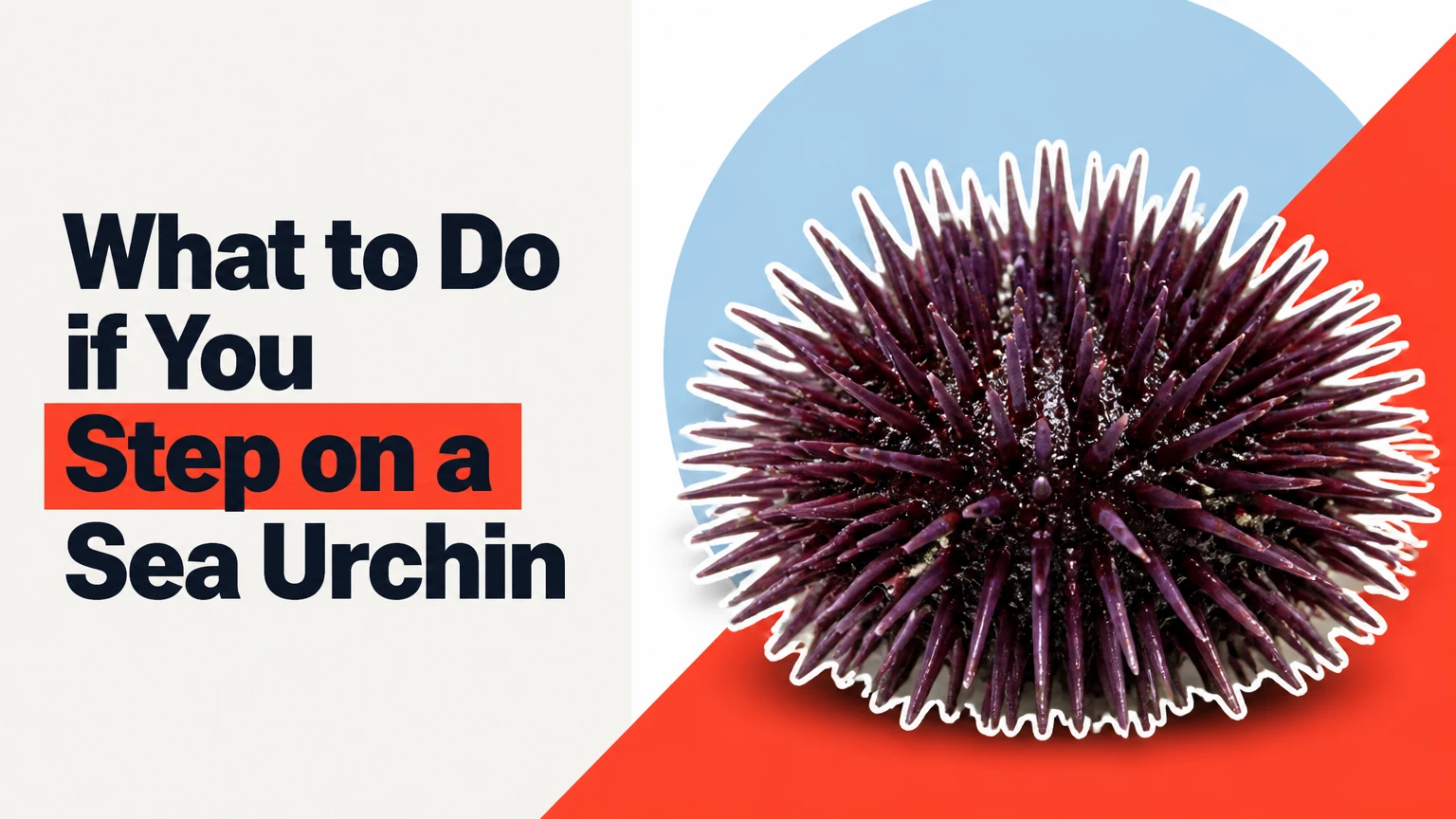
What to Do if You Step on a Sea Urchin
What to do if you step on a sea urchin is to leave the water, avoid putting weight on the foot, rinse the wound with clean water, and immerse it in hot, non-scalding water for 30-90 minutes to reduce pain. Remove only loose, superficial spine pieces; arrange medical care for deep fragments, severe symptoms, infection, or uncertain tetanus protection.
Key Facts / Quick Answer
Use water around 40-45°C, tested with an uninjured hand, for 30-90 minutes if it is comfortably hot and does not burn.
Do not squeeze, dig, cut, or repeatedly probe the puncture because brittle spines can fragment.
Pull out only a clearly visible, superficial piece with clean tweezers. Do not chase fragments in the sole, a joint, tendon, or nail bed.
Call emergency services for trouble breathing, faintness, widespread hives, weakness, vomiting, or rapidly worsening swelling.
A clinician should assess retained spines, increasing redness, pus, fever, red streaks, numbness, impaired movement, or pain that does not steadily improve.
Check tetanus vaccination. Puncture wounds may require a booster depending on the wound and the time since the last dose.
What to Do if You Step on a Sea Urchin
The safest first-aid sequence is removal from the water, foot immobilization, freshwater cleansing, hot-water pain control, cautious handling of visible spines, and prompt risk assessment. Sea urchin injuries combine puncture trauma with possible venom exposure, but most uncomplicated cases do not require aggressive home surgery or routine antibiotics.
First 10 minutes
- Exit the water safely. Ask for help rather than hopping on the injured foot over rocks or coral.
- Sit down and elevate the foot. Immobilization limits additional pressure on broken spine fragments.
- Rinse with clean running water and mild soap. This removes sand, algae, and surface contamination. Do not scrub forcefully.
- Inspect under good light. Photograph the wound before removal if multiple fragments are present. A photograph can help a clinician identify the original distribution.
- Begin hot-water immersion if no burn risk exists. Maintain a comfortable temperature, not a temperature that causes skin redness or numbness.
- Cover loosely afterward with a sterile, non-adherent dressing if the wound may contact dirt. A dressing is preferable to leaving a contaminated puncture exposed.
A sea urchin puncture can look small while extending into the sole, toe joint, tendon sheath, or nail bed. The foot may hurt more when weight is applied because plantar pressure drives fragments against deeper tissue.
Emergency symptoms
Venom exposure from some species can produce more than local pain. Seek emergency help immediately for breathing difficulty, throat tightness, fainting, confusion, generalized hives, blue or gray lips, severe weakness, repeated vomiting, or rapidly progressing swelling.
Do not drive yourself if weakness, dizziness, or breathing symptoms are present. Severe systemic reactions are uncommon, but the possibility matters more in tropical waters and after contact with unusual, short-spined urchins such as the flower urchin.
How Sea Urchin Injuries Work
A sea urchin injury is a puncture wound caused by brittle calcium carbonate spines, sometimes accompanied by irritation or envenomation from small appendages called pedicellariae. Spines can break below the skin, while local pain, swelling, discoloration, and restricted movement reveal how much tissue has been affected.
Spines and pedicellariae
Sea urchin spines are primarily made from calcite, a crystalline form of calcium carbonate. Long spines can snap when the foot lands on them, and the remaining fragments may be difficult to grasp without pushing them deeper.
Pedicellariae are tiny pincer-like structures between the spines. In some species they can inject venom or irritate skin, but the AI Overview overstates their usual behavior: they do not generally remain embedded in a human wound and continuously pump venom into the bloodstream. The main practical problem is puncture trauma and retained foreign material.
Expert insight: The most important distinction is not whether a fragment is black or white. Depth and location matter more. A dark superficial tip in the skin may be removable, while a tiny pale fragment beside a joint can cause more long-term trouble.
What the foot may feel like
| Finding | Likely significance | Recommended response |
|---|---|---|
| Sharp pain only when stepping | Superficial puncture or plantar pressure | Stop walking, rinse, use hot-water immersion |
| Black or purple dots | Pigment, bruising, or retained spine material | Do not assume pigment proves a retained fragment |
| Swelling around a toe joint | Possible joint capsule involvement | Same-day clinical assessment |
| Numbness or tingling | Nerve irritation, swelling, or deeper injury | Urgent medical assessment |
| Fever, pus, spreading redness | Infection | Prompt medical evaluation |
| Muscle weakness or breathing trouble | Systemic envenomation or allergic reaction | Emergency services |
A “tattoo” appearance can persist after a spine has fragmented, because pigment and tissue bruising may remain even when the calcium structure is no longer present. Persistent discoloration alone does not prove that a fragment needs surgery.
Which Sea Urchins Cause More Serious Injuries?
Long-spined urchins usually create deep, brittle punctures, while flower urchins carry greater concern for systemic venom effects. Species identification is helpful but unreliable from a brief beachside view, so symptoms and wound location should guide triage.
- Long-spined urchins, including species in the Diadema group, have thin, fragile spines that often break in the foot.
- Flower urchins, including Toxopneustes pileolus in parts of the Indo-Pacific, have venomous pedicellariae and can cause marked systemic symptoms.
- Slate-pencil urchins, including Heterocentrotus mammillatus, have thicker spines that tend to resist breakage but can cause forceful puncture trauma.
- Small or unfamiliar urchins should not be assumed harmless because short spines can conceal venomous appendages.
| Urchin type | Typical spine feature | Main risk | Practical triage |
|---|---|---|---|
| Diadema group | Long, thin, brittle spines | Retained fragments and painful punctures | Remove only superficial pieces; assess deep wounds |
| Flower urchin | Short spines with prominent pedicellariae | Systemic weakness or breathing symptoms | Emergency care for systemic symptoms |
| Slate-pencil type | Thick, blunt, solid spines | Deep mechanical injury | Evaluate joints and weight-bearing areas |
| Unknown tropical species | Variable spine and venom features | Uncertain local or systemic effects | Use symptoms, not appearance, to decide care |
Hot water can reduce pain from many marine envenomations, but it does not sterilize the wound, dissolve every spine, or replace evaluation after a deep puncture.
How to Use Hot-Water Immersion Safely
Hot-water immersion is a pain-control measure for sea urchin injuries, not a method for sterilizing tissue or dissolving retained spines. Place the affected area in water around 40-45°C for 30-90 minutes, checking the skin frequently and stopping if burning, blanching, blistering, or numbness develops.
Use a thermometer when available. If there is no thermometer, an uninjured hand or forearm should test the water first, because an injured foot may not accurately sense heat. Children, older adults, people with diabetes, and anyone with reduced sensation need extra caution.
A basin is safer than a running tap because the temperature can be controlled. Rewarm cooled water gradually rather than adding boiling water while the foot is submerged. Never use a heating pad, hair dryer, open flame, or water hot enough to redden healthy skin.
Divers Alert Network recommends hot-water immersion for pain relief in many marine stings and punctures, while the Merck Manual emphasizes removal of visible spines and medical evaluation when fragments remain. These recommendations support heat as a comfort measure, not as permission to perform deep extraction.
Expert insight: Heat should be judged by tolerability, not toughness. A patient who cannot feel a 45°C basin clearly can sustain a burn before noticing it, so professional care is safer when sensation is impaired.
When Can You Remove a Spine Yourself?
A person can remove a sea urchin spine at home only when the piece is loose, clearly visible, superficial, and away from a joint, tendon, nail bed, or major blood vessel. Clean tweezers should grasp the exposed section and draw it out along its entry path without squeezing the surrounding skin.
Wash hands and clean the tweezers with soap and water. Alcohol can be used on metal tools, but it does not sterilize a dirty instrument instantly. Do not make a new incision with a needle, knife, or razor.
Stop home removal if the spine breaks, resistance is high, bleeding increases, or the fragment disappears beneath the skin. A clinician may use local anesthesia and imaging, such as ultrasound or radiography, when the location is uncertain. Calcium-based spines can be visible on X-ray, although very small fragments and soft-tissue relationships may require ultrasound or direct exploration.
Locations that need same-day care
| Wound location | Why it needs assessment | Suitable care level |
|---|---|---|
| Toe or ankle joint | Fragment can inflame the joint or limit movement | Same-day clinic or urgent care |
| Sole near a tendon | Walking can drive material deeper | Same-day clinical assessment |
| Under a toenail | Removal is painful and technically difficult | Urgent care or podiatry |
| Eye, face, or hand | Higher functional and cosmetic risk | Urgent medical assessment |
| Deep puncture with no visible spine | Retained foreign body is possible | Clinic evaluation and possible imaging |
Do not use shaving cream and a razor as a routine treatment. A razor may nick skin, leave foreign material behind, or spread contamination. It has no established role in removing deep spines, and a superficial pincer that is no longer attached to the animal is not continuously delivering venom.
Cleaning, Dressing, and Pain Relief
After hot-water treatment, rinse the area again with clean water, wash gently with mild soap, and apply a clean non-adherent dressing if needed. Do not pour bleach, hydrogen peroxide, gasoline, concentrated alcohol, or other caustic substances into the puncture.
A loose dressing protects an open wound from sand and seawater. The idea that any bandage creates an anaerobic chamber is incorrect, but a tight, wet, occlusive wrap can trap drainage and macerate skin. Change the dressing when wet or dirty.
Acetaminophen or ibuprofen can help pain when the person can safely take those medicines. Follow the product label and avoid ibuprofen with a history of gastrointestinal bleeding, certain kidney disease, anticoagulant use, or a clinician’s contrary advice. Do not give aspirin to children.
| Home measure | What it can do | What it cannot do | Main caution |
|---|---|---|---|
| Clean freshwater rinse | Removes surface debris | Does not remove deep fragments | Avoid forceful scrubbing |
| 40-45°C water | Reduces pain and some venom effects | Does not sterilize or dissolve spines | Prevent burns |
| Clean tweezers | Removes exposed loose pieces | Cannot safely retrieve deep material | Stop if resistance occurs |
| Non-adherent dressing | Protects from dirt and friction | Does not treat infection | Keep loose and dry |
| Acetaminophen or ibuprofen | Reduces pain | Does not remove a fragment | Check contraindications |
Vinegar is not a dependable treatment for retained sea urchin spines. Acetic acid may affect some superficial calcareous material under laboratory conditions, but a compress cannot be relied upon to dissolve a fragment in living tissue, and vinegar can irritate an open wound.
Routine topical or oral antibiotics are not automatically needed for every puncture. Clinicians consider depth, contamination, immune status, infection signs, and exposure to seawater when choosing treatment.
When to Seek Medical Care
Medical care is appropriate for a deep puncture, an embedded or broken spine, impaired movement, numbness, severe pain, an uncertain tetanus history, or symptoms that worsen rather than improve. Emergency care is reserved for systemic symptoms, major bleeding, severe tissue swelling, or threats to breathing and circulation.
Contact a clinician promptly when:
- Redness expands, warmth increases, or swelling worsens after the first day.
- Pus, fever, red streaks, foul drainage, or increasing tenderness develops.
- Pain remains substantial after 24-48 hours or fails to improve over several days.
- A fragment lies near a joint, tendon, bone, eye, or nail bed.
- The person has diabetes, poor circulation, immune suppression, or reduced sensation.
- The injury occurred in polluted water or the wound contains coral, shell, or sand.
- Tetanus vaccination is overdue or impossible to verify.
For dirty or major wounds, the Centers for Disease Control and Prevention generally uses a five-year interval for tetanus booster decisions; for clean, minor wounds, the interval is generally ten years, provided the primary vaccination series is complete. A clinician should make the final recommendation because vaccination history and wound classification matter.
What infection can develop?
Marine punctures can introduce organisms from seawater and the skin. Vibrio species are an important concern in saltwater exposure, particularly for people with liver disease, diabetes, immune suppression, or open wounds. Staphylococcus and Streptococcus from the skin can also cause ordinary cellulitis.
A clinician may prescribe antibiotics when infection is present or the wound has high-risk features. Doxycycline is not a universal “marine wound antibiotic”; drug selection depends on local resistance, allergies, pregnancy status, kidney and liver conditions, and the suspected organism.
Possible Complications From Retained Fragments
Retained sea urchin fragments can cause a foreign-body reaction, persistent nodules, chronic drainage, nerve irritation, tendon inflammation, or joint inflammation. Complications are more likely when a fragment remains near a synovial joint or tendon sheath than when a tiny superficial piece lies in the outer skin.
| Complication | Typical clue | Usual evaluation |
|---|---|---|
| Foreign-body granuloma | Firm painful lump weeks later | Examination, ultrasound or X-ray |
| Cellulitis | Expanding redness and warmth | Clinical examination |
| Abscess | Pus, fluctuance, worsening focal pain | Examination and possible drainage |
| Tenosynovitis | Pain with tendon movement or restricted motion | Urgent assessment |
| Septic arthritis | Hot swollen joint with severe movement pain | Emergency evaluation and joint testing |
| Nerve irritation | Persistent tingling or numbness | Neurovascular examination |
Pain that persists beyond a week deserves evaluation, but it does not automatically mean surgery is required. Some fragments migrate outward or become asymptomatic, while others need removal because they sit in a joint, remain infected, or prevent normal movement.
Expert insight: Delayed deterioration is more informative than the original appearance. A small puncture that becomes hotter, redder, and more painful after 24 hours is more concerning than a dramatic-looking but steadily improving bruise.
First-Aid Options Compared
The best option depends on whether the problem is pain, surface contamination, a visible foreign body, or systemic toxicity. Hot water is usually the most useful immediate measure, while extraction and antibiotics require more selective use.
| Option | Time to use | Benefit | Limitation |
|---|---|---|---|
| Freshwater and soap | Immediately, 2-5 minutes | Removes surface contaminants | Does not neutralize all venom |
| Hot-water immersion | First minutes, 30-90 minutes | Pain control and possible venom reduction | Burn risk; no deep-fragment removal |
| Superficial tweezers | After cleaning, under 5 minutes | Removes exposed loose spine | Can worsen breakage if forced |
| Urgent care | Same day | Exam, anesthesia, extraction, tetanus review | Cost and travel time |
| Emergency department | Immediately for systemic symptoms | Resuscitation, advanced imaging, specialist referral | Usually unnecessary for mild local injuries |
| Observation with dressing | After low-risk cleaning | Avoids damaging tissue | Requires reliable monitoring |
Do not use urine. Urine has no established benefit for sea urchin punctures and can contaminate an open wound. Do not use a pressure bandage over an embedded spine, because compression can increase pain and drive fragments into tissue.
Special Situations
Children
Children should not walk on the injured foot or perform self-extraction. Use a carefully tested warm basin, supervise continuously, and seek same-day care if the wound is deep, multiple spines are present, or the child cannot describe numbness and pain reliably.
Pregnancy and chronic illness
Pregnancy, diabetes, liver disease, immune suppression, poor circulation, and neuropathy lower the threshold for clinical assessment. These conditions affect antibiotic choices, infection risk, wound healing, or the ability to detect a burn during hot-water treatment.
Remote beaches and travel
At a remote beach, prioritize shade, clean water, immobilization, and communication with local emergency services. Do not delay evacuation to search for vinegar, shaving cream, or a particular antibiotic. Tell the clinician the country, reef or beach setting, time of injury, and whether the water was saltwater or brackish.
If the spine is in a shoe
Remove the shoe carefully without twisting the foot. Do not force the foot through a narrow opening, because the shoe may be holding a fragment against the sole. Save the footwear or photograph it if the number and direction of spines could help explain the injury.
Prevention and Recovery
The simplest prevention is wearing sturdy water shoes in shallow rocky, reef, and tidal-pool environments. Avoid touching or standing on urchins, even when they appear inactive, because spines can puncture thin soles and movement can break them.
Typical recovery for a superficial puncture is gradual pain reduction over hours to several days. A deep plantar injury may remain tender for one to several weeks, especially if walking repeatedly compresses the area. Keep the dressing clean, limit pressure, and return for reassessment when progress stops.
| Recovery stage | Expected course | Action |
|---|---|---|
| First 2 hours | Pain often responds to heat | Inspect, rinse, immobilize |
| First 24 hours | Tenderness and small swelling may remain | Protect from pressure and monitor |
| Days 2-7 | Symptoms should trend downward | Seek care if redness or pain increases |
| After 1 week | Persistent focal pain is not routine | Evaluate for retained fragment or infection |
| Any time | Breathing problems or faintness | Emergency services |
Frequently Asked Questions About What to do if you step on a sea urchin
Can I walk after stepping on a sea urchin?
Avoid walking until the wound has been inspected and pain has settled. Weight can push brittle pieces deeper or break them. Use assistance, crutches, or a chair if available, particularly when the puncture is on the sole, near a toe joint, or associated with numbness.
How long does sea urchin pain last?
Pain commonly improves during or after 30-90 minutes of carefully controlled hot-water immersion, but tenderness can last several days. Pain that intensifies, prevents normal movement, or remains sharply localized after a week may indicate infection, a retained fragment, or deeper tissue involvement.
Do sea urchin spines dissolve in the skin?
Some very small superficial calcareous fragments may break down over time, but sea urchin spines should not be assumed to dissolve safely. Vinegar is not a proven substitute for extraction. A retained fragment near a joint, tendon, nail, or bone needs professional assessment.
Do I need antibiotics after a sea urchin puncture?
Not every sea urchin puncture requires antibiotics. A clinician may prescribe them for cellulitis, abscess, deep contamination, high-risk medical conditions, or selected severe marine exposures. Do not self-start leftover doxycycline or another antibiotic without assessment.
Can a sea urchin puncture cause tetanus?
Any puncture wound can create a tetanus risk, although tetanus is caused by Clostridium tetani spores rather than sea urchin venom. A clinician should review the wound and vaccination record, using the five-year or ten-year booster framework when applicable.
Should I use hot water for a flower urchin injury?
Hot water may help local pain, but suspected flower urchin exposure requires urgent monitoring for weakness, vomiting, breathing difficulty, or collapse. Do not delay emergency care while attempting prolonged soaking, particularly after contact in tropical Indo-Pacific waters.
Conclusion
What to do if you step on a sea urchin is straightforward when the injury is mild: leave the water, stop weight-bearing, rinse gently, use safe hot-water immersion, and remove only loose superficial pieces. Do not dig, rely on vinegar, or self-prescribe antibiotics. Deep fragments, infection signs, uncertain tetanus protection, and any systemic symptom require medical assessment.