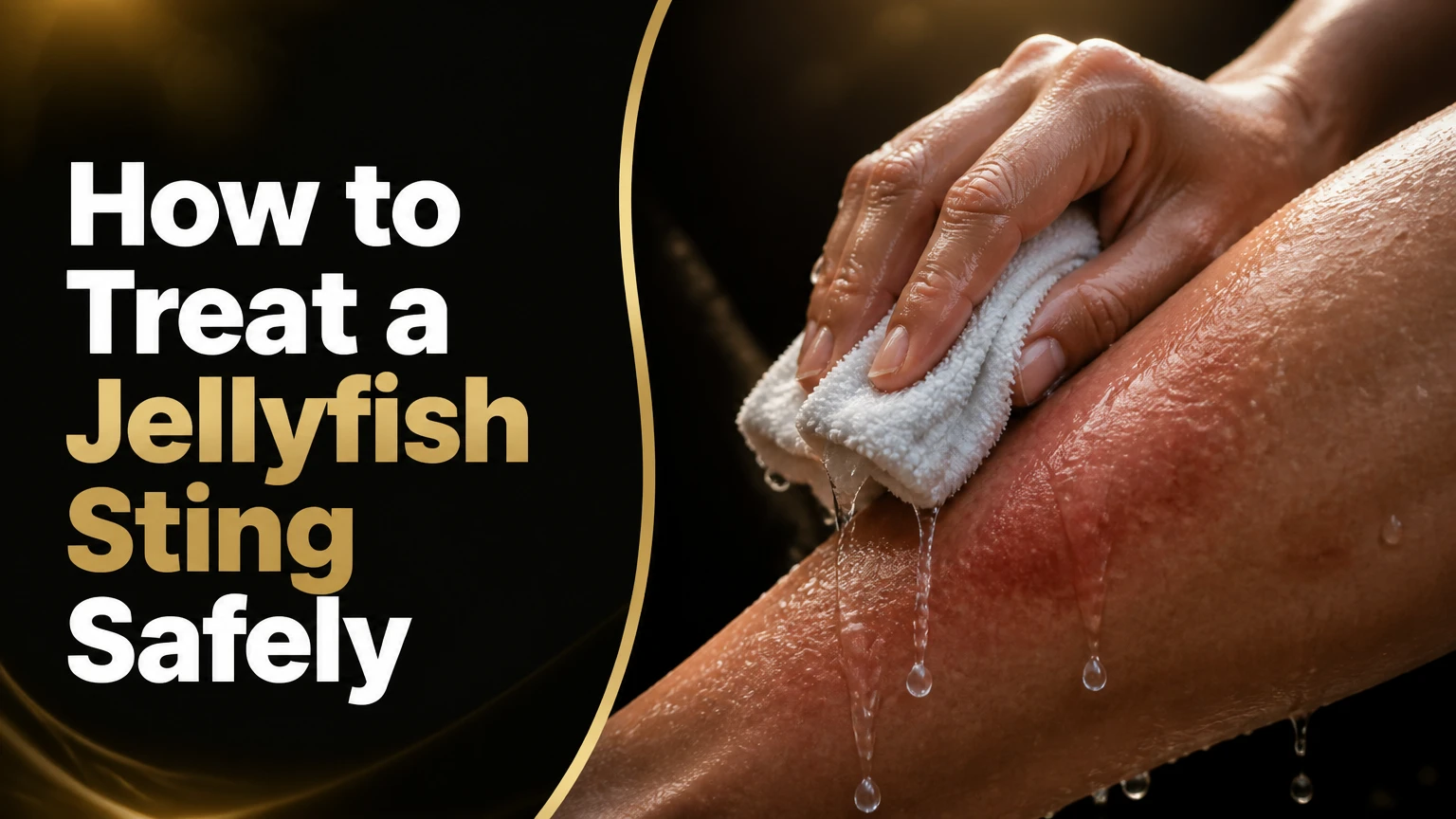
How to Treat a Jellyfish Sting Safely
A jellyfish sting is a venomous skin injury caused by microscopic nematocysts on tentacles. For a mild, localized sting, leave the water, call for help if needed, follow local species guidance, rinse with seawater, remove tentacles without rubbing, and use safely hot water for pain when appropriate. Vinegar is region-specific, not universal.
Key Facts / Quick Answer
Call emergency services immediately for breathing difficulty, collapse, chest pain, severe weakness, confusion, seizures, or rapidly spreading pain.
Do not rub the skin, apply freshwater, use urine, scrape with sand, or apply alcohol or ammonia.
Seawater can rinse away loose tentacles without the osmotic shock associated with freshwater.
Vinegar is recommended for some box-jellyfish exposures, but Australian and some regional protocols advise against it for bluebottles and certain other species.
Remove visible tentacles with tweezers, gloved fingers, or a rigid object, then use water heated to about 42-45°C, or 107-113°F, for 20-30 minutes if local guidance supports heat.
Eye, mouth, genital, or extensive stings need medical assessment even when breathing is normal.
What a Jellyfish Sting Does to Skin
A jellyfish sting injects venom when nematocysts, microscopic capsules inside cnidocytes, discharge barbed threads into the skin. Mechanical pressure, changes in water chemistry, and contact with remaining tentacles can activate unfired capsules, so first aid must reduce additional discharge before treating pain.
Cnidocytes are specialized stinging cells. Each nematocyst contains a tightly coiled thread under high internal pressure. When its trigger is activated, the thread everts rapidly and delivers venom. The visible result may be a linear welt, whip-like marks, red patches, swelling, burning pain, itching, or small blisters.
Venom composition varies by species and location. Reported components include pore-forming toxins, enzymes such as phospholipase and metalloproteinases, and inflammatory mediators. A local sting usually remains a skin problem, but some species can affect the heart, nervous system, blood pressure, or breathing within minutes.
The important first-aid distinction is between venom already injected and stinging cells still attached to the skin. Heat may reduce pain from many common species, but heat cannot reliably reverse severe cardiovascular or neurological envenomation. A person who looks well can deteriorate quickly after a dangerous tropical exposure.
How to Treat a Jellyfish Sting Immediately
For a mild local reaction, the first steps are to exit the water, assess breathing and consciousness, rinse with seawater, remove attached tentacles without rubbing, and apply safe hot water for pain. Use vinegar only when local marine-rescue or medical guidance recommends it for the suspected species.
1. Leave the water and assess the person
Support the person out of the surf without exposing yourself to tentacles. A rescuer should use gloves, a towel, or another barrier when possible.
Check responsiveness and breathing. Ask a bystander to call emergency services and retrieve an automated external defibrillator if the person has collapse, abnormal breathing, severe weakness, or loss of consciousness. Begin CPR if the person is unresponsive and not breathing normally.
Urgent warning signs include:
- Trouble breathing, wheezing, throat tightness, or facial swelling
- Faintness, collapse, confusion, seizure, or severe drowsiness
- Chest pain, palpitations, or an unusually fast heartbeat
- Severe generalized pain, back pain, vomiting, sweating, or agitation
- Rapidly spreading welts or pain extending beyond the contact area
- A sting involving the eye, mouth, throat, or a large area of skin
- A child, older adult, or person with serious heart or breathing disease who develops more than mild symptoms
Do not delay a call for vinegar, tweezers, or hot water.
2. Rinse with seawater when appropriate
Use clean seawater to gently rinse away loose tentacles and debris. Do not use a bucket of freshwater, bottled drinking water, tap water, or carbonated water on attached stinging cells because the change in salinity may trigger discharge in some species.
Seawater is a practical fallback when the species is unknown and vinegar guidance is unavailable. Rinsing should flush across the skin rather than forcefully spray a concentrated jet at it. Do not collect the animal with bare hands.
3. Decide whether vinegar is appropriate
Vinegar, usually 4-6% acetic acid, can prevent additional nematocyst discharge for some box-jellyfish exposures. Australian Resuscitation Council guidance and several Australian marine protocols caution against vinegar for bluebottle stings because regional evidence indicates it may increase discharge in that setting.
This conflict is geographic, not a simple disagreement about household products. Vinegar may be appropriate in one beach jurisdiction and discouraged at another. Follow the beach sign, lifeguard, emergency dispatcher, or local first-aid protocol.
If local guidance recommends vinegar, pour it over the affected area for about 30 seconds without rubbing. Do not use vinegar as a substitute for emergency care, and do not improvise with concentrated acetic acid, cleaning vinegar, alcohol, or mixed chemicals.
4. Remove tentacles without rubbing
After the applicable rinse or vinegar step, lift visible tentacles with tweezers, gloved fingers, a plastic card edge, or another rigid tool. Use slow, deliberate movements and avoid pressing the tentacle against clean skin.
If no tool is available, a gloved hand is safer than a bare hand. A bare-hand removal should be reserved for an emergency when no barrier exists, because the rescuer can also be stung. Do not scrape aggressively, brush the area, massage it, or rub it with a towel.
5. Apply safe heat for pain
Place the affected limb in hot water maintained at approximately 42-45°C, or 107-113°F, for 20-30 minutes. A warm shower can help when immersion is impractical. Test the water on an unaffected part of the rescuer’s skin first, and keep checking the person because numbness can conceal a burn.
Heat should feel distinctly hot but tolerable, never scalding. Stop if the skin blanches, blisters, becomes numb, or develops increasing pain from the water. If hot water cannot be safely maintained, use a comfortably warm alternative and seek medical advice.
The Wilderness Medical Society’s practice guidance identifies hot-water immersion as a useful treatment for pain from many jellyfish stings, but species and local protocols still control the decontamination step. Heat is supportive first aid, not an antidote for systemic venom.
Which Jellyfish Species Change First Aid?
Jellyfish species change first aid because their nematocysts and venoms respond differently to vinegar, heat, and mechanical handling. The animal’s location, beach warnings, season, and the appearance of the lesion can be more useful than trying to identify a damaged jellyfish on the sand.
| Exposure type | Typical region or setting | Common reaction | First-aid distinction |
|---|---|---|---|
| Chironex fleckeri box jellyfish | Northern Australia and Indo-Pacific waters | Severe pain, cardiovascular collapse, extensive ladder-like marks | Treat as a life-threatening emergency; follow local vinegar and antivenom protocols |
| Irukandji-type box jellyfish | Tropical northern Australia and nearby Indo-Pacific waters | Delayed severe back or muscle pain, sweating, vomiting, hypertension, tachycardia | Monitor for delayed systemic illness and obtain urgent medical care |
| Physalia bluebottle or Portuguese man-of-war | Warm and temperate ocean beaches worldwide | Intense local pain and long linear or whip-like welts | Follow local bluebottle guidance; some Australian protocols advise seawater and no vinegar |
| Sea nettle or lion’s mane | Atlantic and Pacific temperate coasts | Burning pain, red lines, itching, localized swelling | Remove tentacles carefully and use local guidance for rinse and heat |
| Small unidentified jellyfish | Any coast | Mild localized burning, itching, or hives | Use seawater, avoid rubbing, monitor closely, and ask lifeguards about local species |
Box jellyfish and Irukandji exposure
Box jellyfish are not one uniform clinical category. Large Chironex fleckeri can produce rapid cardiovascular toxicity, while tiny Carukia and related species can cause Irukandji syndrome after a seemingly minor contact.
Irukandji symptoms may begin 5-40 minutes after the sting rather than immediately. Severe lower-back pain, whole-body muscle pain, nausea, sweating, anxiety, high blood pressure, or rapid pulse requires emergency assessment. Do not use the initial size of the skin mark to judge risk.
Bluebottle and Portuguese man-of-war stings
Physalia is a siphonophore, not a single true jellyfish, but its tentacles can deliver painful venom. Bluebottle advice varies by country, and Australian protocols commonly recommend seawater rinsing, careful tentacle removal, and hot water while advising against vinegar.
A beach with bluebottle warnings may have a dedicated protocol posted by lifeguards. That local instruction has priority over a generic internet checklist.
Temperate jellyfish
Most temperate coastal stings cause localized pain, erythema, swelling, and itching rather than cardiovascular collapse. Severe or spreading symptoms remain possible, especially after extensive contact or in a child.
Species identification is often uncertain. Do not delay emergency treatment while photographing or handling the animal.
Vinegar, Seawater, Heat, and Ice Compared
The best treatment method depends on species, geography, and the stage of exposure. Seawater removes loose material, vinegar may inhibit discharge for selected species, and hot water primarily controls pain; none of these options replaces assessment for systemic toxicity.
| Method | Typical amount or duration | Main purpose | Important limitation |
|---|---|---|---|
| Seawater rinse | Gentle rinse for 10-30 seconds | Removes loose tentacles and preserves salinity around cells | Does not neutralize venom already injected |
| Household vinegar | About 30 seconds when locally recommended | Can inhibit unfired nematocysts in some species | May be discouraged for bluebottles and certain regional species |
| Hot-water immersion | 42-45°C for 20-30 minutes | Reduces pain and may limit activity of heat-sensitive venom components | Burn risk; not adequate for systemic envenomation |
| Cold pack wrapped in cloth | Short intervals, typically 10-15 minutes | May reduce pain when heat is unavailable | Evidence and species response are inconsistent; never apply ice directly |
| Commercial sting product | Follow the product label | May assist decontamination or pain control | Formulas differ; local clinical guidance takes priority |
Ice is not automatically dangerous for every jellyfish sting, but it is not the preferred universal treatment. A wrapped cold pack can provide temporary analgesia when safe hot water is unavailable, especially for a minor sting, but it should not replace the heat protocol recommended by local medical services.
Why freshwater and rubbing are poor choices
Freshwater can alter the osmotic environment around unfired nematocysts. Rubbing adds mechanical pressure. Together, those actions can cause additional cells to discharge, increasing venom exposure after the person has already left the water.
This is why wiping tentacles with a towel is a common practical error. The towel may remove visible material while simultaneously pressing microscopic cells into the skin.
Why urine, alcohol, ammonia, and sand should be avoided
Urine has no reliable venom-neutralizing action and can irritate broken skin. Alcohol, methylated spirits, ammonia, and household cleaners can irritate tissue and may stimulate nematocysts. Sand creates friction and can embed tentacle fragments.
Pressure-immobilization bandages are also unsuitable for most jellyfish stings because compression may press attached cells into the skin. Follow a specific emergency protocol only when directed by trained local responders.
When Should a Jellyfish Sting Receive Medical Care?
A jellyfish sting needs emergency care when symptoms involve breathing, consciousness, circulation, severe generalized pain, or a high-risk body site. A localized welt can often receive first aid and observation, but the threshold for assessment should be lower in children and after tropical-water exposure.
| Symptom or circumstance | Urgency | Action |
|---|---|---|
| Collapse, abnormal breathing, seizure, or unresponsiveness | Immediate | Call emergency services, begin CPR if needed, use an AED if available |
| Chest pain, faintness, palpitations, or breathing difficulty | Immediate | Call emergency services and keep the person still and monitored |
| Severe back pain, sweating, vomiting, or rapid pulse after tropical exposure | Immediate | Suspect systemic envenomation or Irukandji syndrome |
| Sting to eye, mouth, throat, or genitals | Same-day urgent assessment | Rinse the eye with saline or clean water and obtain medical care |
| Large area, many stings, or worsening pain | Urgent | Contact emergency or poison advice services and follow local protocol |
| Small welt with improving pain and no systemic symptoms | Home observation may be reasonable | Use appropriate first aid and monitor for several hours |
Mayo Clinic advises seeking emergency help for serious reactions and avoiding rubbing the affected area. That simple rule matters because the first minutes often determine whether attached nematocysts remain quiet or discharge.
Eye and mouth stings
Do not rub an eye after marine contact. Irrigate continuously with sterile saline or clean water and obtain urgent ophthalmic evaluation, because tentacle fragments can remain on the conjunctiva and corneal injury may be difficult to see.
A mouth or throat sting can swell the airway. Do not induce vomiting or give food to a person with swallowing difficulty. Call emergency services.
Children, pregnancy, and extensive contact
Children have less body mass, may struggle to describe symptoms, and can deteriorate quickly. Keep a child under direct observation after any significant sting, particularly when the species is unknown or tropical.
Pregnancy does not create a separate home treatment, but systemic symptoms warrant urgent care because maternal cardiovascular stress affects both patient and fetus. Extensive contact, stings across the torso, or numerous separate lesions should be medically assessed even if the pain initially improves.
Aftercare for a Mild Local Reaction
Aftercare for a mild jellyfish sting focuses on pain, itching, skin protection, and monitoring for delayed illness. Wash hands after handling tentacles, keep the area clean, and use an over-the-counter medicine only when the label and the person’s medical history permit it.
For persistent itch or inflammation, a pharmacist or clinician may recommend 0.5-1% hydrocortisone or calamine. Avoid hydrocortisone on broken, infected, or heavily blistered skin unless a clinician advises it. Oral antihistamines may help itching, while acetaminophen or ibuprofen may reduce pain when appropriate.
Avoid ibuprofen and other nonsteroidal anti-inflammatory drugs in people with a prior serious reaction, stomach ulcer, kidney disease, blood-thinner use, or a clinician’s restriction. Do not give aspirin to children or teenagers for a viral-like illness or unexplained fever.
| Aftercare option | Typical use | Avoid or reassess when |
|---|---|---|
| Hot-water treatment | 20-30 minutes initially, repeat only with safe temperature control | Skin is numb, blistered, or burned |
| Hydrocortisone 0.5-1% | Thin layer for itch, according to label | Broken skin, infection, eye area, or prolonged unsupervised use |
| Calamine lotion | Itch relief on intact skin | Skin becomes more irritated or develops drainage |
| Acetaminophen | Pain relief according to package directions | Liver disease, heavy alcohol use, or duplicate products |
| Ibuprofen | Pain and inflammation according to package directions | Ulcer, kidney disease, anticoagulants, allergy, pregnancy advice |
| Oral antihistamine | Itching or hives according to label | Sedation risk, drug interactions, or breathing symptoms |
Seek care if redness expands after 24-48 hours, warmth and pus develop, fever appears, pain worsens rather than improves, or blisters become extensive. Those findings can indicate infection, tissue injury, or an unusually severe reaction rather than ordinary healing.
Practical Timing, Costs, and First-Aid Equipment
First aid usually costs little when supplies are already available, but emergency treatment can become expensive and varies greatly by country, insurance, transport, and antivenom requirements. The figures below are typical planning ranges in USD, not guaranteed patient bills.
| Item | Typical price in USD | Useful specification | Planning note |
|---|---|---|---|
| Household vinegar | $2-$6 | 4-6% acetic acid | Carry only where local protocols recommend it |
| Nitrile gloves | $5-$15 per box | Disposable barrier | Protects the rescuer during tentacle removal |
| Fine-point tweezers | $5-$15 | Stainless steel | Useful for small attached fragments |
| Instant cold pack | $1-$5 each | Single-use | Backup analgesia when safe heat is unavailable |
| Waterproof thermometer | $8-$25 | Reads 42-45°C | Helps prevent hot-water burns |
| Commercial marine-sting product | $10-$40 | Product-specific formulation | Not a substitute for local species guidance |
| Ambulance and emergency evaluation | $500-$3,000 or more | Region and insurance dependent | Systemic symptoms justify calling regardless of cost |
| Antivenom and intensive care | Several thousand USD or more | Species-specific hospital treatment | Availability is regional and hospital-controlled |
A compact beach kit should contain nitrile gloves, fine-point tweezers, a thermometer, clean towels, saline, a first-aid card with local emergency numbers, and a sealed container for any regionally recommended decontamination product. Do not treat a kit as permission to delay a rescue call.
Special Situations and Common “What If” Problems
What if vinegar is unavailable?
Use seawater to rinse loose material, remove tentacles carefully, and apply safely hot water if the local protocol supports it. Do not replace vinegar with freshwater, urine, alcohol, ammonia, or concentrated household chemicals.
What if the tentacles cannot be removed?
Do not scrape aggressively or keep handling the area with bare fingers. Ask lifeguards for gloves and tweezers, and seek medical assistance if fragments remain, pain is severe, or the sting covers a large area.
What if hot water is unavailable?
Use a warm shower or another safely warm source. A cloth-wrapped cold pack can temporarily numb a minor sting, but never place ice directly on skin and do not use cold treatment to delay medical care.
What if the person feels better after five minutes?
Continue observation. Rapid improvement supports a mild local reaction but does not exclude delayed Irukandji syndrome or a developing allergic reaction after tropical exposure.
What if the jellyfish is dead?
A dead jellyfish or detached tentacle can still contain functioning nematocysts. Keep children and animals away, avoid bare-hand contact, and follow the same handling precautions as for a live animal.
Preventing Another Sting
Prevention is more reliable than post-sting treatment because no home method removes venom already delivered to the circulation. Check beach warning flags, ask lifeguards about recent species, avoid swimming after storms or jellyfish sightings, and wear a stinger suit in tropical waters during high-risk seasons.
| Prevention measure | Best setting | Specific benefit |
|---|---|---|
| Follow lifeguard closures | Any patrolled beach | Avoids known local blooms and dangerous species |
| Wear a full stinger suit | Tropical Australia and Indo-Pacific waters | Reduces exposed skin and tentacle contact |
| Use gloves and footwear | Rocky shore or cleanup work | Protects hands and feet from detached tentacles |
| Swim in designated enclosures | Northern Australian beaches | Adds physical separation from box jellyfish |
| Carry a local first-aid card | Remote or unfamiliar beaches | Prevents applying the wrong vinegar or rinse protocol |
| Avoid handling stranded animals | All coastlines | Prevents delayed discharge from detached nematocysts |
Frequently Asked Questions About How to treat a jellyfish sting
Can I use tap water to wash a jellyfish sting?
Tap water is not the preferred first rinse for an active jellyfish sting because freshwater can trigger unfired nematocysts in some species. Use seawater to remove loose tentacles, then follow the local vinegar or heat protocol. Clean water is appropriate for irrigating an eye when saline is unavailable.
How long does jellyfish sting pain usually last?
Pain from a mild local sting often improves during hot-water treatment and may settle within several hours. Redness, itching, or linear marks can persist for one to several days. Severe, worsening, recurrent, or whole-body pain is not typical aftercare and requires medical assessment.
Should I put aloe vera or antibiotic cream on the area?
Aloe vera may soothe intact irritated skin, but it does not deactivate nematocysts or treat systemic venom. Antibiotic cream is unnecessary unless a clinician identifies infection or a skin wound at risk. Neither product should replace seawater rinsing, careful tentacle removal, heat, or emergency evaluation.
Can a jellyfish sting cause an allergic reaction later?
A delayed allergic response can produce generalized hives, facial swelling, wheezing, dizziness, or vomiting. Those symptoms require emergency care, especially if breathing or circulation changes. A localized itchy rash several hours later can also represent delayed inflammation and should be discussed with a pharmacist or clinician if persistent.
Is a jellyfish sting dangerous after the mark disappears?
A fading skin mark usually indicates improving local injury, but it does not guarantee that delayed systemic symptoms will not occur after a tropical exposure. Continue observation for severe pain, vomiting, sweating, weakness, breathing difficulty, palpitations, or confusion, and seek care if any appear.
Should I identify the jellyfish before treating the injury?
Do not delay first aid or emergency care to identify the animal. Photograph it from a safe distance only if this does not expose anyone to tentacles. The beach location, warning signs, season, and lifeguard advice generally provide more actionable information than an uncertain visual identification.
Conclusion
To treat a jellyfish sting, first leave the water and assess breathing and consciousness, then follow local species guidance, rinse with seawater, remove tentacles without rubbing, and use safely hot water for pain when appropriate. Vinegar is useful for some species and discouraged for others. Any systemic symptom, eye or mouth exposure, extensive contact, or tropical-water sting with severe pain deserves prompt medical care.