How to Pack a Suit in a Carry-On Without Wrinkles
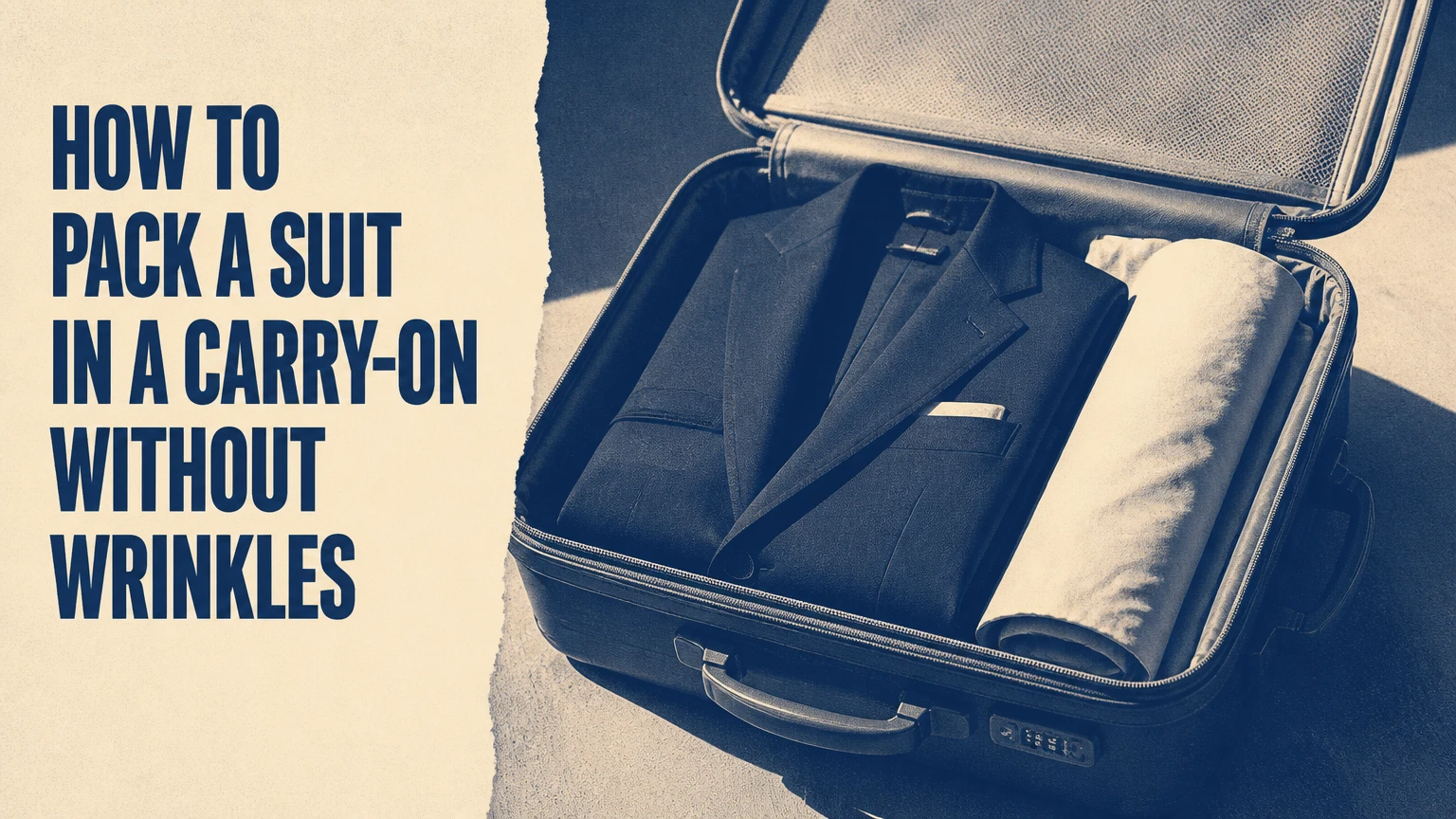
How to pack a suit in a carry-on means folding or rolling a jacket and trousers so the structured shoulders, lapels, crease lines, and outer fabric face the least pressure. The best general method is an inside-out shoulder fold, followed by a loose vertical fold and protective layering inside a correctly sized bag.
Key Facts and Quick Answer
- A standard carry-on reference size is 22 x 14 x 9 inches, or 56 x 36 x 23 centimeters, but each airline sets its own limit.
- The inside-out shoulder fold protects the jacket’s exterior by placing one shoulder inside the other.
- Fold trousers along their existing pressed creases, then place them between or across jacket layers.
- Pack the suit near the top of the case, above shoes, toiletries, and electronics.
- Hang the suit within 15 minutes of arrival and allow 20-30 minutes for minor wrinkles to relax.
- High-twist wool and wool blends recover better than pure linen or cotton after compression.
How Does Suit Packing Cause Wrinkles?
Suit wrinkles come mainly from compression, friction, folding across unsupported areas, and heat or moisture trapped in the case. A jacket becomes especially vulnerable at the shoulder padding, sleeve head, lapel roll, chest canvas, and trouser crease because those areas have more shape than ordinary clothing.
A tightly packed suitcase presses fabric against zippers, shoe edges, packing cubes, and hard case ribs. Movement during travel adds repeated friction, while a warm vehicle or aircraft hold can relax fibers into the shape created by the pressure.
Wool handles travel better because its crimped fibers can recover after moderate compression. The Woolmark Company describes wool as “naturally wrinkle resistant,” although that property does not protect a jacket from sharp folds or a crushed shoulder. Linen and cotton generally show pressure marks sooner, while polyester blends may resist wrinkles but can retain heat and shine under an iron.
Fabric Risk by Suit Material
| Suit material | Typical wrinkle recovery | Main travel risk | Best treatment |
|---|---|---|---|
| High-twist wool | 20-30 minutes hanging | Sharp fold at lapel | Loose fold, steam after arrival |
| Merino wool | 30-45 minutes hanging | Moisture retention | Air before packing |
| Wool-silk blend | 30-60 minutes hanging | Snagging and surface abrasion | Smooth garment bag layer |
| Cotton | 45-90 minutes hanging | Creasing at knees and elbows | Fold along seams |
| Linen | 60-120 minutes hanging | Deep permanent-looking creases | Wear or use a garment bag |
| Polyester blend | 20-40 minutes hanging | Heat shine and trapped odor | Avoid high heat and tight rolls |
Expert insight: A plastic dry-cleaning bag reduces fabric-to-fabric friction, but it does not prevent compression wrinkles. Use it as a slippery separator, not as structural protection. A breathable garment bag is better for extended storage because plastic can trap moisture and odor.
How to Pack a Suit in a Carry-On
The inside-out shoulder fold is the most reliable free method for one suit in a roller bag. It uses the jacket’s shoulder structure as a cushion, keeps the visible outer panels facing inward, and creates a compact bundle without sharply folding the lapels.
What to Prepare Before Folding
Use a clean, flat surface and gather the following items:
- An empty suit jacket and trousers
- One clean plastic garment bag or thin packing sheet
- A soft belt, socks, or underwear for filling shoes
- A lint roller and small stain-removal cloth
- A carry-on with at least 2-3 inches of usable depth above the suit
Remove coins, pens, keys, wallets, badges, and business cards from every suit pocket. Empty pockets prevent localized stretching and stop hard objects from imprinting the fabric.
Close the jacket’s buttons before folding only if the jacket stays smooth. For a two-button jacket, fastening the top button usually preserves alignment better than fastening both. Leave trouser pockets empty and close the fly.
Inside-Out Shoulder Fold: Step by Step
- Place the jacket face down. Lay the jacket on a bed or table with the back facing upward. Smooth the sleeves, center vent, and lower hem with your hands.
- Turn one shoulder inside out. Reach into the left shoulder and pull the left jacket panel outward so the left shoulder lining and seam face outside. Do not yank the sleeve.
- Nest the opposite shoulder. Bring the right shoulder behind the jacket and tuck it into the inverted left shoulder. The two shoulder pads should sit inside each other, with the jacket lining visible around the outside.
- Align the lapels. Fold the jacket lengthwise so the lapels, center front, and side seams line up. Smooth air from the chest toward the hem.
- Fold the trousers vertically. Match the trouser legs and align the original pressed creases. Fold the trousers once lengthwise, keeping the waistband and hems even.
- Place the trousers across the jacket. Position the trousers across the middle or lower third of the jacket, with the waistband away from the most visible chest panel.
- Fold the jacket around the trousers. Bring the lower jacket hem over the trousers, then fold the upper section down only if the case requires a smaller bundle.
- Add a friction layer. Slide the bundle into a clean plastic dry-cleaning bag or wrap it in a thin cotton shirt. Leave a small amount of air rather than compressing the package.
- Place the bundle near the top. Set the folded suit above heavier belongings, with the lapels facing upward and no shoe or toiletry edge pressing into the shoulder area.
The full process normally takes 5-7 minutes when the jacket is laid flat. Rushing the shoulder nesting step creates the sharpest defects, especially along the collar and sleeve head.
When Should You Roll the Suit Instead?
Use a loose master roll when space matters more than perfect structure, especially in a soft-sided backpack or a compact weekender. Rolling distributes pressure across a longer surface, but a tight roll can flatten shoulder padding and distort the jacket’s chest.
Master Roll Method
- Turn one shoulder inside out and nest the opposite shoulder inside it.
- Lay the jacket flat with the lining or inverted shoulder protecting the outer surface.
- Fold the trousers along the natural creases and place them down the jacket’s center.
- Fold sleeves inward so they do not protrude from the bundle.
- Start at the jacket’s lower hem and roll upward with light, even pressure.
- Stop when the bundle forms a loose cylinder. Do not use compression straps directly across the shoulders.
The roll should hold its shape without a strap. If it springs open, use a soft packing band around the middle rather than tightening a suitcase strap across the lapels.
Fold or Roll: Which Method Fits the Trip?
| Method | Typical packing time | Space use | Wrinkle risk | Best application |
|---|---|---|---|---|
| Inside-out fold | 5-7 minutes | 20-25% of medium carry-on | Low | Interview or business trip |
| Loose master roll | 4-6 minutes | 15-20% of medium carry-on | Low to medium | Backpack or one-bag travel |
| Bi-fold garment bag | 8-12 minutes | 30-40% of carry-on | Very low | Destination wedding |
| Wear on aircraft | 2-3 minutes | Minimal luggage space | Medium at seatbelt | Short flight and light luggage |
| Checked suitcase | 5-7 minutes | No cabin space | High | Multiple suits and long trips |
Expert insight: The bottom-up roll is gentler than rolling from the collar because the collar and lapel contain more shaping. Starting at the top forces those rigid areas around the entire bundle and can permanently flatten a soft canvas chest.
How Should You Arrange the Carry-On?
The suit should sit in the upper third of the carry-on, directly below the lid or garment compartment, because the upper layer experiences less concentrated pressure from hard objects. The case should close without pushing down on the jacket.
Use this arrangement from bottom to top:
| Carry-on layer | Recommended contents | Reason | Typical thickness |
|---|---|---|---|
| Base | Shoes, belts, folded denim | Dense items need support | 3-4 inches |
| Middle | Toiletry kit, chargers, casual clothing | Absorbs movement around hard items | 4-6 inches |
| Separator | Plastic bag or cotton shirt | Reduces friction | Less than 0.25 inch |
| Upper layer | Folded suit bundle | Protects jacket shape | 2-3 inches |
| Lid area | Tie, pocket square, documents | Prevents deep pressure points | 0.5-1 inch |
Keep laptops and tablets in their own sleeve. A laptop corner can leave a rectangular imprint through a jacket even when the suit is inside a garment bag.
Place shoes sole-to-sole in shoe bags, with socks or underwear inside the uppers. This preserves the shoe shape while using otherwise empty volume. Do not place shoes on top of the folded suit.
Packing Shirts, Ties, and Accessories
Pack one dress shirt per collar protector or fold the collar around a soft rolled pair of socks. Place shirts above the suit or beside it, never underneath heavy shoes. Roll ties loosely from the narrow end and place them in the lid pocket, where sharp folds are less likely.
A typical one-suit business setup requires the following space:
| Item | Typical quantity | Approximate packed volume | Placement |
|---|---|---|---|
| Suit jacket and trousers | 1 | 2-3 inches of case height | Top layer |
| Dress shirts | 2 | 1.5-2 inches | Beside or above suit |
| Dress shoes | 1 pair | 3-4 inches | Base corners |
| Tie and pocket square | 1 each | Less than 0.5 inch | Lid compartment |
| Toiletry kit | 1 | 2-3 inches | Middle layer |
| Casual trousers | 1 | 1-1.5 inches | Base or middle |
Which Carry-On Works Best for a Suit?
A hard-shell roller protects against external compression, a bi-fold garment bag minimizes folding, and a hybrid duffle garment bag combines hanging storage with flexible interior space. The correct choice depends on the suit’s construction, the number of garments, and the airline’s cabin rules.
Carry-On Luggage Comparison
| Luggage type | Typical price in USD | Suit capacity | Protection profile | Best user |
|---|---|---|---|---|
| Hard-shell roller | $70-$250 | 1 folded suit | High against crushing | Standard business trip |
| Bi-fold garment bag | $40-$180 | 1-2 suits | High against sharp folds | Formal event travel |
| Tri-fold garment bag | $60-$220 | 2-3 suits | Medium, more fold points | Several formal outfits |
| Hybrid garment duffle | $150-$450 | 1 suit plus shoes | Medium to high | Frequent fliers |
| Soft backpack with sleeve | $80-$300 | 1 lightweight suit | Low to medium | Minimalist travel |
A garment bag is preferable for a bespoke, fully canvassed, or heavily padded jacket. A roller is more practical when the trip also requires shoes, toiletries, and casual clothing.
Check the airline’s published dimensions before departure. The commonly cited 22 x 14 x 9 inch limit is a useful United States reference, not a universal rule. Some international airlines use smaller limits or impose a 7-10 kilogram weight limit, while many United States domestic carriers primarily enforce size and personal-item rules.
Measure the packed case, including wheels and handles. A garment bag that fits inside a bedroom closet may exceed the airline’s linear dimensions when folded.
What Are the Real Time and Cost Limits?
Most travelers can prepare one suit in 5-7 minutes and recover minor transit wrinkles within 20-30 minutes after hanging. Packing materials cost from $0 for a reused dry-cleaning bag to $450 for a premium hybrid garment bag, excluding airline baggage fees and hotel pressing.
Typical Costs and Timeframes
| Task or item | Typical cost in USD | Typical time | Practical limit |
|---|---|---|---|
| Reused plastic dry-cleaning bag | $0 | 1 minute | Short trips only |
| Packable garment bag | $30-$80 | 8-12 minutes | One or two suits |
| Premium hybrid bag | $150-$450 | 5-10 minutes | Frequent formal travel |
| Hotel pressing | $15-$60 per garment | 2-24 hours | Severe wrinkles |
| Portable steamer | $25-$80 | 5-10 minutes | Moderate wrinkles |
| Hanging after arrival | $0 | 20-60 minutes | Minor compression |
| Packed storage before use | $0 | Not recommended | Preferably under 16 hours |
The 12-16 hour storage figure is a practical target, not a fabric law. A dry wool suit can tolerate longer periods when folded loosely, but heat, dampness, and a tightly filled bag increase the risk quickly.
How Do You Unpack and Remove Wrinkles?
Hang the jacket and trousers within 15 minutes of reaching the destination, then smooth the lapels, sleeves, waistband, and hems by hand. Minor wrinkles often relax in 20-60 minutes, while sharp creases may require steam or professional pressing.
Use a broad, contoured hanger that supports the jacket shoulders. A thin wire hanger creates pressure points and cannot support the jacket’s intended shoulder shape. Hang trousers from the waistband or cuffs with the legs aligned to their original creases.
For steam treatment:
- Hang the jacket with room around the shoulders.
- Use a garment steamer on the lowest effective setting.
- Keep the nozzle several inches from the cloth.
- Steam the lining and exterior lightly, without soaking the canvas.
- Let the garment dry completely before wearing it.
Bathroom humidity can loosen minor wrinkles, but a hot shower does not replace controlled steaming. Keep the suit outside the direct spray and avoid leaving wool in a damp room for hours.
Never press a shiny wool surface directly with a hot iron. Use a pressing cloth and low heat, or take a structured jacket to a cleaner that understands canvassed garments.
What If the Suit Is Already Wrinkled?
A suit that is already wrinkled should first be identified by fiber and construction, then treated with hanging, controlled steam, or professional pressing. Pulling fabric aggressively or applying high heat can stretch the lining, flatten the chest, or create shine.
| Wrinkle condition | Likely cause | Safe first response | Escalation |
|---|---|---|---|
| Light vertical lines | Folding pressure | Hang 20-30 minutes | Gentle steam |
| Lapel crease | Incorrect fold | Hang on shaped hanger | Professional press |
| Crushed shoulder | Heavy compression | Reshape by hand | Tailor or cleaner |
| Shiny patch | Heat or friction | Stop ironing | Professional restoration |
| Damp odor | Trapped moisture | Air in a dry room | Cleaner if persistent |
| Deep linen creases | Fiber behavior | Steam and hang overnight | Pressing service |
If the jacket has fused construction, visible bubbling, silk trim, velvet, or delicate embellishment, skip aggressive home steaming. Heat can separate adhesive layers or change the surface texture.
What Are the Most Common Packing Mistakes?
The most damaging packing mistakes are overfilling the case, placing hard objects on top of the suit, folding against trouser creases, and leaving objects in pockets. Correcting the packing order usually produces a larger improvement than buying specialized luggage.
- Overpacking: A case that requires body weight to close will crush the jacket regardless of folding method.
- Heavy items on top: Shoes, toiletry bottles, and camera equipment create isolated pressure points.
- Wrong trouser fold: Folding across the thigh produces a new horizontal crease that may remain after hanging.
- Full pockets: Pens and wallets stretch pocket bags and leave hard impressions.
- Tight compression straps: Straps across the chest or shoulder can stamp parallel lines into the fabric.
- Wire hangers: Thin metal supports distort jacket shoulders during garment-bag travel.
- Wet packing: Damp clothing beside wool encourages odor and slows wrinkle recovery.
- Plastic used for storage: Plastic reduces friction during transit but should be removed after arrival.
Expert insight: The suit does not need the largest empty compartment. It needs the least variable pressure. A half-full hard-shell case with the suit on top is safer than a garment bag squeezed between two overstuffed packing cubes.
When Is Wearing the Suit Better?
Wearing the suit is better when the jacket is highly structured, the flight is short, and the destination has limited pressing facilities. It saves approximately 2-3 inches of carry-on height, but seatbelts, armrests, food trays, and prolonged sitting can crease the trousers and lower back.
Wear the jacket only after boarding if the airport is hot or crowded. Carry it by the collar or over one arm through security, then put it on before the aircraft door closes if cabin conditions are comfortable.
Avoid wearing a three-piece suit for a long-haul flight unless the event requires it immediately after landing. A waistcoat, jacket, and trousers create more heat and compression points than a folded two-piece suit.
Checking luggage is the least predictable option for one valuable suit because bag handling introduces crushing, delay, and loss risk. Check a suit only when the trip requires several outfits that cannot fit safely in the cabin.
How Should You Pack for Special Situations?
A destination wedding, job interview, or long international trip changes the balance between wrinkle prevention, backup clothing, and luggage risk. The more important the event, the more valuable it becomes to separate the suit from dense objects and reserve time for recovery.
Backpack Travel
Choose a lightweight, unpadded wool suit and a backpack with a dedicated garment sleeve. Pack the jacket with the inside-out fold, place it at the back panel, and keep shoes at the bottom so their weight does not pull the shoulder structure out of shape.
Destination Wedding
Use a bi-fold garment bag if the airline accepts its packed dimensions. Carry the suit in the cabin, pack a spare white shirt, and allow at least 60 minutes at the destination for hanging and light steaming before dressing.
Two Suits
Use a tri-fold garment bag or a large carry-on with separate garment panels. Place the darker, heavier suit closest to the case wall and the lighter suit above it, separating both with breathable layers rather than compressing them into one tight roll.
Long-Haul International Flight
Confirm both the operating carrier’s size rules and the weight limit. A 22 x 14 x 9 inch case may be accepted on one segment and rejected on a smaller regional aircraft, creating a gate-check risk at the connection.
Frequently Asked Questions About How to pack a suit in a carry on
Can I pack a suit in a backpack?
Yes, a lightweight wool suit can travel in a backpack when the jacket uses the inside-out fold and sits against the back panel. Keep the backpack below its maximum capacity, place shoes at the bottom, and avoid compression straps across the jacket. A heavily padded or bespoke jacket is safer in a garment bag.
Should I dry-clean a suit before flying?
Do not dry-clean a suit immediately before packing unless it has stains or odor. Fresh cleaning can leave fabric slightly warm or chemically treated, and packing it before it fully airs may trap odor. Brush the suit, empty the pockets, and let it rest overnight when possible.
Can I take a garment bag and a carry-on?
Usually, a garment bag counts as either a carry-on or personal item when it exceeds the airline’s personal-item dimensions. Policies differ by carrier, aircraft, fare, and route, so measure the folded garment bag and confirm the operating airline’s baggage allowance before traveling.
How many suits fit in one carry-on?
One suit fits comfortably with two shirts, one pair of dress shoes, toiletries, and several casual garments in a standard 22 x 14 x 9 inch case. Two suits can fit with a tri-fold garment bag, but shoes and bulky sweaters may need a second bag.
Can I use an iron on a wool suit?
Use an iron on wool only with a pressing cloth, low heat, and minimal pressure. Direct high heat can create shine or flatten the nap. A steamer held several inches away is safer for light travel wrinkles, while deep creases in a structured jacket need professional pressing.
What should I do if the airline gate-checks my suit?
Tell the gate agent that the bag contains a fragile formal garment and ask whether it can be placed in the cabin closet. If the bag must be checked, keep documents, medication, shoes, and an alternate shirt in your personal item, then request priority delivery at baggage claim.
Conclusion
How to pack a suit in a carry-on successfully depends on reducing concentrated pressure, preserving shoulder shape, and unpacking quickly. For most travelers, the inside-out shoulder fold inside a lightly filled 22 x 14 x 9 inch case offers the best balance of protection, cost, and space; use a garment bag for heavily structured jackets or important formal events.